WEN JT630H 6-Inch Benchtop Jointer Review: Worth It? (November 2026)
The WEN JT630H is the benchtop jointer to buy if you want a flat, square edge from boards up to 6 inches wide without spending spiral-head money elsewhere. Its 12 staggered HSS blades, 30-by-6-inch table and fence that bevels to 45 degrees cover the edge jointing most small shops actually do.
On this page (8 sections)
The WEN JT630H is the benchtop jointer to buy if you want flat, square edges from boards up to 6 inches wide without paying spiral-head prices from the big brands. Its 12 staggered HSS blades, 30-by-6-inch table and fence that bevels to 45 degrees cover the edge jointing most small shops actually do.
This WEN JT630H review weighs what the specs give you against what a 6-inch jointer simply cannot do.
The short answer: buy it for edge jointing and face work on stock up to 6 inches wide. Look at the wider WAHUDA or a planer-and-sled setup if your projects regularly start with 8- to 10-inch boards.
Everything below explains why those are the only two forks in the road.
The WEN JT630H at a glance
The JT630H is a 6-inch spiral-head jointer built for a bench or small stand, and it leads this comparison on features per dollar. The 10-amp motor spins the cutterhead up to 12,000 times per minute, the table measures 30 by 6 inches, and the fence bevels to 45 degrees for angled edges.
WEN JT630H 10-Amp 6-Inch Spiral Benchtop Jointer: Best for edge jointing in a small shop
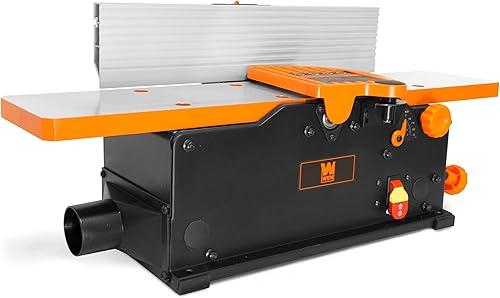
- 12 staggered HSS blades
- 30 x 6 in table
- 0 to 1/8 in depth of cut
- Fence bevels to 45 degrees
A spiral cutterhead jointer that covers edge jointing and face flattening for boards up to 6 inches wide. The long table, adjustable fence and onboard depth scale make it the strongest all-round choice here.
Pros
- 12 staggered HSS blades spread the cut for a fine finish
- 30-by-6-inch table gives decent infeed and outfeed support
- Fence bevels up to 45 degrees for angled edges
- Onboard depth-of-cut scale and two push blocks included
- Spring-loaded blade guard covers the cutterhead
Cons
- 6-inch width caps how wide a board you can face joint
- Cast iron base and table bring the weight to about 37 lb
- Blades are HSS, not carbide, so they dull sooner on hard woods
The spiral head is the headline. Twelve staggered HSS blades take many small cuts instead of one straight knife pass, which is the arrangement that usually leaves a cleaner surface on hard and soft woods alike.
WEN also includes two push blocks and a 2-1/2-inch dust port, so the safety and dust basics come in the box.
At 36.8 lb with an iron base, it sits at the heavier end for a benchtop jointer. That weight helps it stay put during a long jointing session, but plan a permanent spot rather than lifting it onto a shelf after every project.
Who should buy the WEN JT630H?
Buy the JT630H if your work centers on edge jointing boards for tabletops, panels, frames and face frames, and your stock starts at 6 inches wide or narrower. It is also the right pick when you want a spiral-style head without moving into a bigger, heavier 8- or 10-inch machine.
The 45-degree fence opens up more than edge jointing. You can bevel the face of a board for angled joinery or shaped trim, which is useful if you build more than flat panels.
Skip it if you routinely face joint wide slabs. A 6-inch cutting width means a 10-inch board needs two passes with the grain flipped between them, and any mismatch shows up as a step you have to plane out later.
It also isn't the machine for someone who only needs to thickness boards to a consistent width. That job belongs to a planer.
Read how a benchtop planer fits into a small shop before deciding you need both machines, because most shops end up buying them in that order.
The specs that matter in daily use
The 30-by-6-inch table is the first spec you'll feel every session. Infeed and outfeed support matter more on a jointer than on almost any other machine, because a board that dips at the end of a pass comes out with a curved edge.
Thirty inches is enough to keep a typical 4- to 6-foot board flat through the cut if you manage the pressure.
The 0 to 1/8-inch depth of cut with an onboard scale lets you take light passes and dial in how much material comes off. On figured or hard wood, 1/16 inch or less per pass gives a cleaner finish than hogging off the full 1/8 inch.
The scale is the practical control you'll touch most.
The fence measures 19-3/4 by 4-1/4 inches and bevels up to 45 degrees. A fence this size supports the face of the board well, and the bevel range covers chamfers and angled edges.
Check it locks firmly at the angle you set before running stock.
The 12 staggered HSS blades sit in a spiral head, and the 10-amp motor turns the cutterhead up to 12,000 RPM. That combination matters for finish, not just speed.
The staggered arrangement means the blades take small bites in sequence, which is why WEN says it produces an ultra fine finish on hard and soft woods.
Dust collection is a real spec too. The 2-1/2-inch port is small compared with a full shop dust system, so a shop vacuum with a reducer is the practical partner.
Chips pile up fast under a jointer, and a blocked port leads to chip marks in the finish.
Setting up the WEN JT630H
Setup is the part that decides whether the machine works or fights you. Mount it on a stable surface and set the fence square before your first board.
A jointer that shifts or runs out of square produces edges you can't glue up.
Start with the base. The iron base and 36.8 lb weight want a solid bench or a dedicated stand, and the machine needs clearance at the infeed and outfeed ends for the board's full length.
Measure the longest stock you plan to joint and leave that much open floor on both sides.
Fit the dust port and connect your shop vacuum. Run the jointer empty for a moment to hear it spin up cleanly and to confirm the blade guard moves freely.
The spring-loaded guard should cover the cutterhead and only expose the section in use.
Then set the fence. Use a square against the table and the fence face, lock it, and check that it stays put.
Repeat the check after you bevel it to 45 degrees, since an angle that drifts mid-cut ruins the edge.
Finally, set the depth of cut light for your first board and feed a piece of scrap. Read how to use a benchtop jointer for the feed technique, and keep the push blocks WEN includes within reach.
Safety on this machine is mostly about where your hands are and how you feed the stock, so read how to use a jointer safely before your first real board.
Blade care and routine maintenance
Blade care on the JT630H is the main ongoing job, and the good news is that the spiral head uses replaceable blades rather than knives you have to sharpen yourself. WEN lists the BP510H replacement spiral blades as the matching part.
HSS blades dull on hard woods and on stock with grit or finish on it. When the finish starts coming out fuzzy or the motor sounds like it's working harder than usual, swap the blades as a set.
A full set replacement is faster than trying to re-hone individual blades, and it keeps the cut height consistent.
Between blade changes, keep the table clean and lightly waxed so boards slide without dragging. Pitch and glue residue build up quickly and create friction that makes flat feeding harder.
Wipe the table after each session.
Check the fence and the blade guard for movement. The fence should lock firmly, and the spring on the guard should return it to cover the cutterhead.
A guard that sticks leaves the head exposed longer than it should.
Vacuum or brush out the dust port and the chip chute regularly. A partially blocked port is the most common cause of chip marks in a fresh jointed edge.
Keep the cutterhead area clear while the machine is unplugged.
The trade-offs to weigh before you buy
The 6-inch cutting width is the first limit you'll hit. It covers edge jointing on nearly any furniture stock, but face jointing a 10-inch tabletop board takes two passes with a flip between them.
Any mismatch between the two passes leaves a step you have to remove with a hand plane or a planer sled.
The second trade-off is the blade material. HSS blades cut well, but they dull faster than carbide inserts on hard woods.
Plan for replacement blade costs and a spare set on hand. The spiral head design means many small blades rather than two long knives, so a full set replacement costs more than a pair of knives.
Weight is the third. At 36.8 lb with an iron base, this is not a machine you move to a shelf after each project.
It wants a permanent spot with room at both ends. That is fine in a dedicated shop and less convenient in a shared garage.
The depth of cut is fixed at up to 1/8 inch per pass. That's normal for a benchtop jointer and fine for most work.
Just don't expect to hog off a full 1/4 inch in one go.
Finally, the 2-1/2-inch dust port is small. Plan on a shop vacuum with an adapter rather than expecting a full dust collection system to connect straight up.
Budget for that fitting when you set the machine up.
Alternatives to the WEN JT630H
Two other machines make sense depending on your stock and your space. Both change the decision in a specific way, and neither replaces the JT630H as the best pick for most small shops.
CRAFTSMAN Benchtop Jointer
The CRAFTSMAN is the variable-speed alternative for readers who work both soft pine and hard maple. It runs from 6,000 to 11,000 RPM, so you can slow the cutterhead for figured stock and speed it up for softer wood.
Its 4-1/4-inch cutting width is the catch. That's narrower than the WEN's 6 inches, so it suits edge jointing and small face work rather than board flattening.
The two-knife head with jackscrew leveling makes blade changes simpler than a spiral head, but you'll adjust knives more often than you'd swap spiral blades.
Pick it if speed control matters more to you than width. Stay with the WEN if you regularly joint boards between 4-1/4 and 6 inches wide.
WAHUDA TOOLS Jointer
The WAHUDA is the wide-board option. Its 10-inch cutting width face joints wide slabs in a single pass, and the spiral head uses 4-sided carbide inserts that stay sharp far longer than HSS.
The pull-out cast iron extensions support long boards, and the fence tilts from 90 to 135 degrees. The cost is size and weight: 70.9 lb and a footprint that needs more floor and bench space than a 6-inch jointer.
It also sits in the highest price tier of the three.
Choose it if wide boards are the center of your work. For everything up to 6 inches, the WEN does the same edge jointing with less weight and less space.
If your shop also needs a band saw for curved work, our WEN BA3959 review covers a machine that pairs well with a jointer.
Verdict: should you buy the WEN JT630H?
Buy the WEN JT630H if you need flat, square edges from boards up to 6 inches wide and want a spiral-style head without the size or price of a 10-inch machine. The 12 staggered HSS blades, 30-by-6-inch table, 45-degree fence and onboard depth scale make it the best all-round 6-inch benchtop jointer in this comparison.
Its score of 9.7 reflects that fit.
Skip it and choose the WAHUDA if wide slabs are routine in your shop. Choose the CRAFTSMAN instead if variable speed on mixed stock matters more to you than cutting width.
For most small shops doing edge jointing and occasional face work, though, the JT630H is the one to put on the bench. Set the fence square, take light passes, and keep a spare set of blades on hand.
Frequently asked questions
Is the WEN JT630H a real spiral cutterhead jointer?
Yes. WEN fits a spiral cutterhead with 12 staggered HSS blades, which spreads the cut across the head instead of taking one straight knife pass.
That arrangement usually leaves a cleaner finish on figured grain than a two-knife head, though the blades are HSS rather than carbide.
How wide a board can the WEN JT630H joint?
Six inches. That covers edge jointing on most furniture stock and face jointing on boards up to 6 inches wide.
Wider slabs need a planer sled or a jointer with a 8- or 10-inch capacity like the WAHUDA here.
What is included with the WEN JT630H?
The jointer ships with an onboard depth-of-cut scale, two push blocks and a 2-1/2-inch dust port. WEN also lists the BP510H replacement spiral blades as the matching part when the originals dull.
Can the WEN JT630H bevel edges?
Yes. The 19-3/4-by-4-1/4-inch fence bevels up to 45 degrees, so you can cut angled edges along the face of a board.
Set the fence angle and confirm it locks square before running stock through.