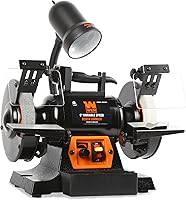
9 Best Bench Grinders for Home Use (November 2026)
The best bench grinders for home workshops include the Oregon Professional Compact Bench Chain Grinder for chainsaw owners, the WEN Bench Grinder Stand for freeing up bench space, and the BUCKTOOL 2x42 Belt Sander and 6 Inch Bench Grinder Combo for metalworking and knife making.
On this page (8 sections)
- The best bench grinders for home workshops
- How these bench grinders compare
- Which wheel size suits your projects?
- High speed or low speed: what should a home shop run?
- Do you need a chain grinder or a general grinder?
- Bench top or stand: where should the grinder sit?
- What else helps a home grinder work better?
- Verdict: the best bench grinder for home use
The best bench grinder for home use is the Oregon Professional Compact, because it turns a dull chainsaw chain into a sharp one without a shop trip. It covers most chain pitches and mounts to a bench or a wall.
For woodworking edges, the Rikon 80-805 low speed grinder protects tool steel from heat. The DeWalt DW758 handles bigger metal jobs, and the WEN BG4260 is the simplest low-cost start.
Bench grinders come in two broad families: general grinders for tools and metal, and chain grinders built around a saw chain. Your main job decides which one belongs in your shop.
Start with our guide to what a bench grinder is used for if the answer isn't obvious yet.
Our picks at a glance
-
1
 Best for chainsaw owners
Oregon Professional Compact Bench Chain Grinder
9.7/10 our score
See it on Amazon -
2

-
3
 Best for metalworking and knife making
BUCKTOOL 2x42 Belt Sander and 6 Inch Bench Grinder Combo
9.2/10 our score
See it on Amazon
- 4
 Check it
DeWalt DW758 8-Inch Bench Grinder
Best for heavy metal work - 5
 Check it
WEN BG4260 6-Inch Bench Grinder
Best budget starter grinder - 6
 Check it
Rikon 80-805 8-Inch Low Speed Grinder
Best for chisels and plane irons - 7
 Check it
Woodskil 6-Inch High Speed Bench Grinder
Best for fast touch-ups - 8
 Check it
BUCKTOOL 6-Inch Low Speed Grinder
Best small low speed option - 9
 Best for polishing and buffingCheck it
The best bench grinders for home workshops
Every pick here solves a different home job, from chain sharpening to buffing a polished edge. Read the write-ups with your own projects in mind, then check the comparison table.
Oregon Professional Compact Bench Chain Grinder: Best for chainsaw owners
- Sharpens 1/4 in to .404 in pitch chain
- Bench or wall mount with two bolts
- One-way motor rotation
- Two grinding wheels plus a depth gauge disc
A dedicated chain grinder with a clamping vise and three wheels for different chain pitches. It sharpens Oregon, Stihl, Husqvarna and other brands.
Pros
- Handles .404 in pitch chain
- Manual chain clamping vise
- Dressing brick included
Cons
- Not made for chisels or knives
Oregon builds this machine around one job: sharpening saw chain. The manual clamping vise holds each cutter at the right angle, and the one-way motor rotation keeps the wheel turning away from you for safer control.
It sharpens chain from 1/4 in up to .404 in pitch, which covers the common sizes on home saws. Oregon, Stihl and Husqvarna chains all fit.
Three wheels come in the box. Two are radius profile discs for 1/4 in, 3/8 in low profile, .325 in, 3/8 in and .404 in chain.
The third is a 6.0 mm flat profile disc for depth gauge maintenance.
It mounts to a bench or a wall with two included bolts, so a small shop can hang it and reclaim the bench. 17 lb makes it easy to lift into place.
A 220 W motor on 120 V turns the wheel at 3,150 rpm, slower than a general grinder, which suits the small cutters on a chain.
The trade-off is clear: it sharpens chain only. If you also want to grind chisels or knock burrs off metal, a general grinder is the better single purchase.
Homeowners who cut firewood regularly will save money by sharpening at home instead. If chain sharpening is your main aim, read our pick of the bench grinder for sharpening tools.
WEN Bench Grinder Stand: Best for freeing up bench space
- Cast iron and steel frame
- Onboard water pot
- 9.9 by 12.4 in mounting plate
- Fits most bench grinders
A floor stand that holds the grinder steady and keeps the workbench clear. The water pot cools parts as you work.
Pros
- Universal mounting plate
- Water pot for quenching
- Bolt holes for the floor
Cons
- Adds a footprint to the shop floor
The WEN stand puts your grinder on its own floor pedestal at 31.5 in, which suits standing work and keeps the workbench free. A cast iron and steel frame resists the walking and wobbling a grinder sets off on a bench top.
Its 9.9 by 12.4 in steel plate has slots and holes for a range of bolt orientations, and WEN says the universal design fits most bench grinders on the market. That makes it a sensible add-on whether you buy the WEN grinder or another brand.
The plate is the part that matters most, so check your grinder's base before ordering.
The onboard water pot lets you quench a part after grinding, which helps on chisels and thin metal that heat quickly. The three-legged base has bolt holes so you can fasten the stand to the floor, which is the step that finally kills vibration.
At 13.6 lb it is light enough to move around the shop. Its trade-off is floor space: a bench top needs none, and a small shop may not have a spare corner.
Measure the 16.5 by 14.5 in footprint before you commit. The stand pairs naturally with a 6 inch bench grinder.
BUCKTOOL 2x42 Belt Sander and 6 Inch Bench Grinder Combo: Best for metalworking and knife making
- 2 x 42 in belt sander plus 6 in grinder
- 1/3 HP, 3.5 A motor
- Belt tilts 0 to 90 degrees
- LED light and tool-free eye shield
One base runs a belt sander and a grinding wheel, so you can shape, sand and sharpen without changing machines.
Pros
- Two machines on one base
- Belt swivels from horizontal to vertical
- Quick belt changes
Cons
- Larger footprint than a plain grinder
Bucktool puts a belt sander and a 6 inch grinder on one base. The 2 x 42 in belt tilts from 0 to 90 degrees and the housing swivels from horizontal to vertical, so a long workpiece can travel along the belt instead of across it.
The 1/3 HP, 3.5 A motor spins the wheel at 3,450 rpm and the belt at 4,480 FPM. That belt speed suits general sanding and finishing on metal, wood and plastics.
An induction motor keeps torque up under load, so the belt doesn't bog down on a stubborn pass.
Two work tables give it range: cast iron for metal sharpening, cast aluminum for wood. Quick-release tension and tracking make belt changes fast, a real advantage once you work through grits.
A tool-free eye shield and an LED light round out the setup, and a sturdy cast iron base with rubber feet holds it still.
The trade-off is footprint and cost. It stands larger than a plain grinder and does two jobs, so it suits knife makers and metal workers who need both.
A buyer who only sharpens chisels is better served by the Rikon.
DeWalt DW758 8-Inch Bench Grinder: Best for heavy metal work
- 3/4 HP induction motor
- 12-1/2 in between wheels
- Cast iron base and motor housing
- Machined aluminum tool rests
A big 8 inch grinder with power and wheel spacing for longer parts. The cast iron base keeps it stable under load.
Pros
- High power for fast metal removal
- Wide gap between wheels
- Solid cast iron base
Cons
- High speed makes heat control harder on fine edges
The DeWalt DW758 is the heavy lifter of this group. A 3/4 HP induction motor turns 8 in wheels at 3,600 rpm, and the rugged cast iron base and motor housing hold it steady through long grinding passes.
Its 12-1/2 in between the wheels gives longer parts room to travel. Precision-machined aluminum tool rests let you lock a part at a repeatable angle.
Rear exhaust ports in the wheel guards help chips clear the work and keep the face of the wheel cleaner.
It ships with 36 and 60 grit wheels, which covers rough shaping and general grinding. Buyers with lawn mower blades, garden tools and welded parts will feel the extra power most: the wheel keeps its speed when you press into thick steel.
The high speed that makes it fast also builds heat quickly, so take light passes on a fine edge. If your work is mostly chisel and plane iron care, the Rikon's low speed is gentler.
For heavy metal, this is the pick.
WEN BG4260 6-Inch Bench Grinder: Best budget starter grinder
- 2.1 A motor
- 6 by 3/4 in wheels
- 36 and 60 grit wheels included
- Pivoting tool rests
A simple 6 inch grinder that covers tool touch-ups and light metal work. WEN backs it with a two-year warranty.
Pros
- Coarse and fine wheels in the box
- Pivoting rests for angled work
- Two-year warranty
Cons
- No low speed setting
The WEN BG4260 is the plain, affordable way into a home grinder. Its 2.1 A motor turns 6 by 3/4 in wheels at 3,450 rpm, and WEN includes a 60 grit wheel for general grinding plus a 36 grit wheel for faster removal.
Pivoting tool rests let you set an angle for grinding, and adjustable eye guards shield your face. The wheel guards come off easily when it's time to swap wheels, which matters because a fresh wheel is the cheapest way to improve results.
Both wheels use a 1/2 in arbor, a common size for replacements.
WEN backs it with a two-year warranty and keeps replacement parts in stock, which counts for a first machine.
The trade-off is speed control: single speed only, so it won't protect a fine chisel edge the way a low speed model does. For reviving old tools, cleaning up rusty parts and keeping a lawn mower blade sound, it does the job at the lowest outlay here.
Rikon 80-805 8-Inch Low Speed Grinder: Best for chisels and plane irons
- 1/2 HP low speed motor
- 8 by 1 in 60 and 120 grit wheels
- Left rest has a drill bit groove
- Diamond wheel dresser included
Slow turning wheels build less heat, which protects temper on fine edges. The grooved rest lines up drill bits for sharpening.
Pros
- Low speed reduces burning
- 120 grit wheel for finer edges
- 5-year warranty
Cons
- Slower metal removal than high speed models
The Rikon 80-805 runs its 8 in wheels at 1,750 rpm, half the speed of the high speed models here. Less wheel speed means less heat in the steel, which is why this is the grinder for chisels, plane irons and carving tools.
It ships with 60 and 120 grit white aluminum oxide wheels on a 5/8 in arbor, so you get a coarse wheel and a finishing wheel. The left tool rest has a groove for sharpening drill bits, which takes the guesswork out of bit angles.
A diamond wheel dresser is included for truing the wheels.
The cast iron base has anti-vibration rubber feet and mounting holes for a bench or stand. Adjustable eye shields and spark arrestors add safety, and the 8 by 1 in wheels give a wide face for a long edge.
The trade-off is pace: low speed removes metal slowly. That's exactly right for fine edges and frustrating for heavy welds.
Rikon's five-year warranty is the longest here. For bits, see our guide on how to sharpen drill bits on a bench grinder.
Woodskil 6-Inch High Speed Bench Grinder: Best for fast touch-ups
- 1/2 HP, 2.8 A motor
- 36 and 60 grit aluminum oxide wheels
- Pre-drilled steel base
- CSA listed
A compact high speed grinder with a steady steel base. Both grits come in the box for shaping and finishing.
Pros
- Steady steel base
- Eye shields and spark arrestors
- CSA listed
Cons
- Heat builds fast on thin edges
Woodskil's 6 inch grinder leans on speed for quick repairs. Its 1/2 HP, 2.8 A motor turns 3,450 rpm, and it ships with 36 and 60 grit aluminum oxide wheels on a 1/2 in arbor for shaping and finishing.
The pre-drilled steel base stays put during extended use, which cuts wobble and errors. A transparent eye shield and a spark arrestor handle the debris that comes off the wheel.
It's CSA listed, which is the safety mark to look for on a machine that throws sparks near your face.
Who it suits: a hobbyist who wants to touch up a shovel, a knife or a bracket in a hurry. The high speed gets it done fast, and the 2.8 A motor is the strongest in this size class here.
The trade-off matches the other high speed machines: heat. On thin steel or a fine chisel edge, a light touch matters, and a cup of water for quenching helps.
If you mainly sharpen woodworking edges, pick the low speed Rikon instead.
BUCKTOOL 6-Inch Low Speed Grinder: Best small low speed option
- 1/3 HP low speed motor
- 60 grit brown and 80 grit white wheels
- Tool-free adjustable rests
- Rubber-footed cast aluminum base
A 6 inch grinder that trades power for controlled, cool grinding. It suits small shops where an 8 inch machine is too much.
Pros
- Low heat on fine edges
- Easy rest adjustment
- Compact size
Cons
- Less power for heavy metal removal
Bucktool's low speed 6 inch grinder runs at 1,750 rpm with a 1/3 HP motor. It brings cool, controlled grinding into a smaller package for shops without room for an 8 inch machine.
The wheels differ from most here: a 60 grit brown aluminum oxide wheel and an 80 grit white wheel. That spread handles reshaping on the brown wheel and finer edge work on the white one, and it's a better pairing for tool edges than the usual 36 and 60 grit set.
The tool-free work rest adjusts without a wrench, and the cast aluminum base sits on rubber feet to cut vibration. A transparent eye shield and spark arrestor keep sparks off you.
The trade-off is power. A 1/3 HP motor takes longer on thick metal than the DeWalt or Woodskil, so budget work on heavy stock is slow.
For chisel, plane iron and axe edges in a small home shop, it's a sensible middle ground between price and control.
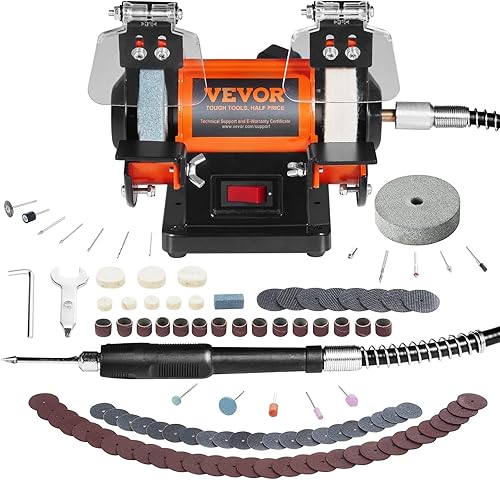
VEVOR Bench Buffer Polisher: Best for polishing and buffing
- Brushless motor
- Wool, fiber and grinding wheels
- 100 piece accessory set
- Transparent debris deflector
A light buffer for polishing metal, wood and stone. It shines where a grinding wheel would be too coarse.
Pros
- Three wheel types for stages of polish
- Light and easy to move
- Accessory kit included
Cons
- Light duty for grinding jobs
The VEVOR isn't a grinder for rough metal removal. It's a buffer for the last stage: taking a sharpened or sanded surface and bringing up a shine on metal, wood, jade or plastic.
Its brushless motor runs at 3,590 rpm with no carbon brushes to swap, so there's less maintenance over the years. Three wheels cover the stages: a hard grinding wheel, a moderate fiber wheel and a soft wool wheel.
You move from coarse to fine.
The 100 piece accessory set widens what you can do, from engraving to final polish, and it uses a 3.2 mm chuck for the small bits. A transparent deflector keeps debris from flying, and adjustable rests let you work at an angle.
Non-slip feet hold it on the bench.
At 5.5 lb it's light enough to move and store. The trade-off is duty level: a 29.7 W motor polishes rather than grinds.
Pair it with a grinder, or buy it alone if polishing jewelry or knife scales is your main job.
How these bench grinders compare
Specs decide most of the choice here: wheel size, speed and motor power set what a grinder can do. The rest is which extras fit your projects, such as a chain vise, a belt sander or a water pot.
Our score weighs specs, features and buyer feedback against what you're shopping for. We compared wheel diameter and arbor size, motor amps and horsepower, speed, included wheels and rests, then checked how well each setup matched a home job.
| Product | Best for | Speed | Power | Weight | Our score |
|---|---|---|---|---|---|
| Oregon Professional Compact Bench Chain Grinder | chainsaw owners | 3,150 rpm | 220 W, 120 V | 17 lb | 9.7 |
| WEN Bench Grinder Stand | freeing up bench space | 13.6 lb | 9.3 | ||
| BUCKTOOL 2x42 Belt Sander and 6 Inch Bench Grinder Combo | metalworking and knife making | 3,450 rpm, belt 4,480 FPM | 9.2 | ||
| DeWalt DW758 8-Inch Bench Grinder | heavy metal work | 3,600 rpm | 37 lb | 9.1 | |
| WEN BG4260 6-Inch Bench Grinder | budget starter grinder | 3,450 rpm | 8.9 | ||
| Rikon 80-805 8-Inch Low Speed Grinder | chisels and plane irons | 1,750 rpm | 8.8 | ||
| Woodskil 6-Inch High Speed Bench Grinder | fast touch-ups | 3,450 rpm | 8.7 | ||
| BUCKTOOL 6-Inch Low Speed Grinder | small low speed option | 1,750 rpm | 22.4 lb | 8.0 | |
| VEVOR Bench Buffer Polisher | polishing and buffing | 3,590 rpm | 29.7 W, 110 V | 5.5 lb | 7.9 |
Which wheel size suits your projects?
Six inch wheels cover most home sharpening, and 8 inch wheels suit heavier metal work. The wheel on the front sets how much material you can work at once and how long an edge fits on the rest.
What a 6 inch grinder handles well
A 6 in wheel turns fast at the rim, and the smaller machine takes less bench space. It's the right size for knives, drill bits, chisels and small brackets.
The WEN BG4260 and Woodskil both sit here, and the Bucktool low speed shows what a 6 in wheel can do with heat control.
The 6 in class also includes the Bucktool combo and the Oregon chain grinder, which shares the size but uses narrow profiled wheels. Check the arbor size before buying spare wheels: 1/2 in is common on the 6 in machines here, but the profile wheel on a chain grinder is a different part.
When an 8 inch grinder earns its space
An 8 in wheel has a longer arc, so long edges and larger parts sit more comfortably. The DeWalt's 12-1/2 in between wheels is the clearest example: it lets a long workpiece travel across the face.
The Rikon's 8 in low speed wheels also spin slower at the same rpm, which cuts heat.
Both 8 in machines weigh more and need a firmer mount. The DeWalt's cast iron base and the Rikon's anti-vibration feet help, but a stand or a bolted bench is still the right home.
If your projects are big, plan for that.
High speed or low speed: what should a home shop run?
Pick high speed for fast metal removal and low speed for fine edges that must keep their temper. Both run on a standard shop circuit.
High speed runs at about 3,450 to 3,600 rpm. The wheel cuts fast, which is handy for lawn mower blades, axes and rust removal.
Heat builds quickly on thin stock, and a blue tint on the steel is the sign you went too far.
Low speed runs at 1,750 rpm. The wheel cuts cooler, so the hardened tip of a chisel or plane iron holds its temper.
The Rikon 80-805 and the Bucktool low speed are the two here, and both suit woodworkers more than metal bashers.
If you do both, the combo Bucktool covers sanding and grinding and saves a machine. A sander also lets you shape a bevel slowly without the heat a grinding wheel throws.
Do you need a chain grinder or a general grinder?
A chain grinder has a clamping vise and thin profiled wheels for saw chain; a general grinder has wide wheels for tools and metal. The vise and the wheel shape are the whole difference.
The Oregon 410-120 sharpens chain from 1/4 in up to .404 in pitch, and its three wheels match the common chain sizes. The dressing brick keeps the wheel profile true, which matters because a rounded edge won't seat in a cutter.
A general grinder can't hold a chain steady enough to sharpen each cutter at the same angle. If you cut firewood with a saw, the chain grinder is the tool.
If your saw is a once-a-year tool and your chisels need work, start elsewhere.
Bench top or stand: where should the grinder sit?
A stand keeps the grinder steady and saves bench space; a bench mount suits shops with a solid, free bench top. Vibration and height are the deciding factors.
A grinder throws a lot of vibration, and on a shared bench it can move a project or rattle other tools. The WEN stand solves that with a cast iron frame and floor bolts.
Its water pot adds a quenching step right at the machine.
Bench mounting is simpler and cheaper, and both the Oregon and the small WEN can bolt down. Sit the machine so the wheel centre is near elbow height when you stand, and keep the eye shields in place.
A wall mount is the third option, and the Oregon supports it with the same two bolts. That suits a narrow garage where floor space is gone and the bench is full.
What else helps a home grinder work better?
Good rests, a fresh wheel and a water cup make more difference than a bigger motor. Plan these extras into the buy.
Adjustable tool rests let you repeat an angle. The Rikon's grooved rest is a built-in jig for drill bits, and the DeWalt's machined rests hold position.
On a plain rest, clamp a small block as a stop.
Keep a cup of water nearby for quenching. The WEN stand carries a pot for that.
Dress the wheel when it loads with metal or loses its shape. The Oregon package includes a dressing brick, and the Rikon adds a diamond dresser.
Finally, match the grit to the job: coarse for shaping, finer for a clean edge. Every grinder here ships with at least one useful wheel.
What about motor power and amps?
Motor figures tell you how the machine holds speed under load. The DeWalt's 3/4 HP is the strongest here, and the Woodskil's 2.8 A is the strongest of the 6 in high speed machines.
Horsepower and amps are two ways of describing the same motor, so don't read one as better than the other. On a small wheel, 1/2 HP is plenty for knife touch-ups.
On an 8 in wheel, the extra power keeps the wheel from slowing when you press a wide part into it.
Verdict: the best bench grinder for home use
For most people who burn firewood, the Oregon Professional Compact is the best bench grinder for home use. It sharpens the chain sizes a home saw runs, mounts to a bench or wall, and keeps its own vise and wheel profile for the job.
Woodworkers who care about fine edges should pick the Rikon 80-805 for its low speed and drill bit groove. Metal shops should pick the DeWalt DW758, and a tight budget suits the WEN BG4260.
For a two-in-one setup, the Bucktool combo is the answer. Finally, the VEVOR buffer finishes what a grinder starts.
Match the machine to your main job, add a stand if bench space is tight, and sharpen at home.
Our top 3 picks at a glance
-
1
Best for chainsaw owners
Oregon Professional Compact Bench Chain Grinder
9.7/10 our score
See it on Amazon -
2
-
3
Best for metalworking and knife making
BUCKTOOL 2x42 Belt Sander and 6 Inch Bench Grinder Combo
9.2/10 our score
See it on Amazon
Frequently asked questions
Is a 6 inch bench grinder big enough for a home shop?
For most home sharpening and light metal work, yes. A 6 inch grinder has a smaller wheel and a shorter tool rest, which suits knives, chisels and drill bits.
Step up to 8 inches when you regularly grind long edges or bigger parts.
What speed should a home bench grinder run at?
High speed wheels turn at roughly 3,450 to 3,600 rpm and remove metal quickly. Low speed wheels turn at about 1,750 rpm and build less heat, which helps on chisels and plane irons.
Pick high speed for reshaping and low speed for fine sharpening.
Do I need a stand for a bench grinder?
A stand keeps the grinder off your workbench and reduces the vibration that can move other tools. It also puts the wheels at a comfortable height for standing work.
A sturdy bench works fine if you bolt the grinder down.
Can one bench grinder sharpen both woodworking tools and saw chains?
Not well. Saw chain grinders use a thin profiled wheel and a clamping vise built for chain cutters, while general grinders use wide wheels for tools and metal.
Buy a chain grinder if chains are your main job.