How Much Is a Bench Grinder?
A bench grinder usually costs more than a drill but less than a table saw, and the price tracks motor power and wheel size. A 6-inch grinder with a light motor is the budget end, while a heavier cast iron 6-inch model with more horsepower sits mid-range.
On this page (8 sections)
- What does a typical bench grinder cost?
- What makes one bench grinder cost more than another?
- Are cheap bench grinders good enough for a home shop?
- How much does a heavy-duty bench grinder cost?
- Does a stand or extra accessory add much to the cost?
- Is a 6-inch or 8-inch bench grinder the better value?
- How do you pick the right tier without overspending?
- How much is a bench grinder, in the end?
A bench grinder usually costs more than a drill but less than a table saw, and the price tracks motor power and wheel size. A 6-inch grinder with a light motor is the budget end, while a heavier cast iron 6-inch model with more horsepower sits mid-range.
That gives you two spending tiers for the same wheel size. The real question is whether the extra money buys work you'll actually do.
This guide breaks down how much a bench grinder costs by type, what moves the number and when the cheaper model is the smarter buy.
What does a typical bench grinder cost?
Most home-shop bench grinders land in the budget to mid-range tier, and the split is less about brand than about how much metal and motor you get. A light 6-inch unit is the lower-cost choice.
A cast iron 6-inch model with more horsepower costs more.
The gap between them is smaller than the gap between a budget and premium table saw. Bench grinders are simple machines: a motor, two wheels, guards and rests.
The parts that push the cost up are the ones that affect how long it runs without shaking or bogging down.
Prices also vary by where you shop and by sales. Treat any tier label as a band, not a fixed figure.
If you want the short version, pick the tier that matches your sharpening load rather than the biggest machine you can find.
What makes one bench grinder cost more than another?
Motor horsepower and housing material do most of the work on price. The DEWALT DW756 shows the pattern: a 5/8 HP induction motor and an industrial cast iron base and motor housing.
That build is heavier and more expensive than a light grinder with a stamped base.
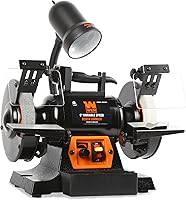
A 6-inch model like the WEN 4276 takes a different path. It uses a 2.1-Amp motor and a 16 lb frame, so the machine is lighter and easier to move.
The work light adds a feature rather than bulk.
Wheel size matters too. Bigger wheels need more motor and more guard, so an 8-inch machine usually costs more than a 6-inch one from the same maker.
A 12-1/2-inch distance between wheels on the DEWALT also means longer rests and larger guards, which add material cost.
Which parts drive the price most?
Four parts set the tier. The motor's horsepower and how it's built.
The base and housing, cast iron versus lighter material. The wheel size and how many wheels ship with it.
And the extras, such as a work light or a stand in the box.
Speed is usually the same across the class. Both grinders here run at 3,450 RPM.
So the money goes to build quality and features, not to a faster wheel.
Are cheap bench grinders good enough for a home shop?
Yes, for light sharpening and deburring. A 2.1-Amp 6-inch grinder handles dull chisels, plane irons, scissors, screwdrivers and small lawn tools.
The WEN 4276 ships with a 36-grit wheel for fast material removal and a 60-grit wheel for general grinding, which covers most touch-up work.
The limit shows up in long sessions. A light 16 lb machine walks and skips more easily under hard pressure, and it has less mass to absorb vibration.
If you grind for minutes at a time and stop, that rarely matters. If you reshape thick steel, it will.
Check what the grinder includes before you buy. Wheels, eye shields, spark deflectors and tool rests all add cost when sold separately.
A cheap machine with no rests is a false saving for sharpening work.
Who should buy the WEN 4276?
Pick the WEN 4276 if you sharpen a few tools a month and want to move the grinder when you need it. The 16 lb frame and the flexible work light suit a small shop where the bench is shared.
The 6-inch by 3/4-inch wheels with a 1/2-inch arbor are a common size, so replacement wheels are easy to find later. WEN covers it with a 2-year warranty.
That's a useful sign of confidence on a budget machine.
Skip it if your grinding is heavy or continuous. The light motor and frame are the trade-off for the low cost.
How much does a heavy-duty bench grinder cost?
Expect to pay more for cast iron and horsepower. The DEWALT DW756 pairs a 5/8 HP induction motor with an industrial cast iron base and motor housing.
The 30.4 lb body is about twice the weight of a light grinder, which is the main reason it costs more.
That weight does real work. It limits walking and wobbling during operation, so the grinder stays put when you press a chisel into the wheel.
The maker rates the motor for heavy-duty grinding operations, and the precision-machined aluminum tool rests let you position work accurately.
The 3,450 RPM motor is meant for high-speed material removal. Rear exhaust ports in the wheel guards keep the airflow smooth.
For a shop that sharpens often, the extra spend buys steadier work and less vibration.
Who should buy the DEWALT DW756?
Choose the DEWALT DW756 if you sharpen regularly or work with thicker steel. It's the better fit for a shop where the grinder stays bolted in place and runs for longer stretches.
The 12-1/2-inch distance between wheels leaves room for longer and larger grinding jobs. The cast iron base is also less likely to walk than a light frame when you lean into the work.
DEWALT backs the tool with a 1-year full warranty.
Skip it if you only touch up a chisel now and then. The lighter grinder saves money and is easier to move.
For a full comparison, see our roundup of the best bench grinders for sharpening tools.
Does a stand or extra accessory add much to the cost?
A stand is the most common add-on, and it's worth the money in a small shop. A grinder bolted to a light workbench shakes the bench and everything on it.
A separate pedestal gives the machine its own surface.
The WEN Bench Grinder Stand is a cast iron and steel pedestal at 31.5 inches tall. The 9.9-inch by 12.4-inch mounting plate takes a range of bolt layouts, and a water pot on board cools workpieces as you grind.
It's a universal design that fits most bench grinders, not only WEN models.
Budget for it as part of the setup, not as a luxury. A steady grinder is safer and gives cleaner edges than a shaky one, so the stand earns its place if you have floor space.
Is a 6-inch or 8-inch bench grinder the better value?
For most home shops, a 6-inch grinder is the better value. Six-inch wheels are cheaper to replace, easier to find and enough for chisels, plane irons, drill bits and knives.
They also spin up faster on a smaller motor.
An 8-inch grinder costs more up front and more at wheel-change time. It removes metal faster and leaves a wider hollow on a bevel, which matters if you reshape thick tools.
For touch-up sharpening, that's more machine than you need.
Wheel speed matters more than wheel size for edge quality. A 6-inch wheel at 3,450 RPM is fast enough to burn a thin edge if you press hard.
Check our guide to what a bench grinder is used for to match the size to your tasks before you spend more.
How do you pick the right tier without overspending?
Match the grinder to how often you sharpen and how hard you press. If you sharpen a few tools a month, the budget tier does the job.
If the grinder runs for longer sessions on thick steel, the heavier cast iron model pays off in steadiness.
Then add only what you'll use. A stand is worth it when the bench shakes.
A work light helps when the grinder sits in a dim corner. Extra wheels can wait until the ones in the box wear down.
If drill bits are your main job, read how to sharpen drill bits on a bench grinder first. The technique matters more than the price tag.
And if you're still choosing between wheel sizes, our roundup of the best 6-inch bench grinders narrows it down.
How much is a bench grinder, in the end?
Budget for the budget or mid-range tier and spend the difference on a stand, not a bigger motor. How much a bench grinder costs depends on horsepower, housing material and extras, not on speed.
A light 6-inch model covers home sharpening, and a cast iron 6-inch model covers steady, heavier work.
Pick the WEN 4276 if you sharpen now and then and want a light machine. Pick the DEWALT DW756 if the grinder stays put and runs longer.
Add the WEN stand if your bench shakes, and skip the 8-inch upgrade unless you reshape thick tools often.
Either way, buy the wheels and rests you need up front. A grinder with a steady base and sharp wheels is the real value, whatever the price band.
Frequently asked questions
Do cheap bench grinders wear out faster?
Not always, but lighter motors and housings take less load. A 2.1-Amp motor and a 16 lb body suit light sharpening, while a 5/8 HP cast iron unit is built for longer sessions on heavier grinding.
Is a bigger bench grinder always more expensive?
Not automatically. Wheel size, motor power, housing material and extras like a work light or stand all move the price, so a well-built 6-inch grinder can cost more than a basic 8-inch one.
Can I run a bench grinder on a normal household outlet?
Yes. Corded bench grinders run on standard household voltage, and the DEWALT DW756 runs at 110 volts with a 440-watt draw, so a normal workshop outlet handles it.
Do I need to buy a stand as well?
Only if you have no free bench space. A grinder bolts to a workbench, but vibration moves light benches around, so a cast iron pedestal stand is the extra cost that steadies the work.