8 Best Bench Grinders for Sharpening Tools (November 2026)
The best bench grinders for sharpening tools include the DeWalt DW758 8-Inch Bench Grinder for heavy grinding, the Rikon 80-805 8-Inch Low Speed Grinder for woodworking edges, and the WEN BG4286 8-Inch Slow Speed Grinder for easy slow starts.
On this page (7 sections)
- Which bench grinder is best for sharpening tools?
- How do you choose the best bench grinder for sharpening?
- Should you choose a 6-inch or 8-inch grinder?
- When does a wet sharpening system make sense?
- How should you set up and use a bench grinder for sharpening?
- What mistakes make sharpening harder?
- Which bench grinder should you choose?
The Rikon 80-805 is the best bench grinder for sharpening in most home shops because its low speed, two wheel grits, and adjustable rests suit controlled edge work. Choose the DeWalt DW758 for faster material removal, or the KFMK wet system for water-cooled sharpening.
A bench grinder can refresh chisels, plane irons, knives, and drill bits, but the right speed and tool support depend on the job. Slow speed favors control during edge work; faster speed removes material more quickly when reshaping or grinding.
For the steps, read our guide to sharpening drill bits on a bench grinder. If you are deciding whether a grinder belongs in your shop, see what a bench grinder is used for.
Our picks at a glance
-
1

-
2

-
3

- 4
 Check it
BUCKTOOL 8-Inch 3/4 HP Low Speed Grinder
Best for detailed visibility - 5
 Check it
BUCKTOOL 8-Inch Low Speed Grinder with CBN Wheel
Best for CBN sharpening - 6
 Check it
BUCKTOOL 6-Inch Low Speed Grinder
Best for small benches - 7
 Check it
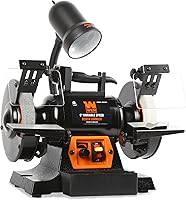
WEN BG625V 6-Inch Variable Speed Grinder
Best for speed adjustment - 8
 Check it
KFMK 10-Inch Wet Sharpening System
Best for water-cooled edges
Which bench grinder is best for sharpening tools?
The Rikon 80-805 leads this roundup for controlled sharpening, followed by the DeWalt DW758 for heavier grinding and the WEN BG4286 for a simple slow-speed setup. Each pick serves a different bench, tool mix, and sharpening routine.
DeWalt DW758 8-Inch Bench Grinder: Best for heavy grinding
- 3/4 HP induction motor
- 3,600 RPM
- 12-1/2 in between wheels
- Cast iron base and motor housing
The DW758 combines an 8-inch wheel setup with a 3/4 HP induction motor running at 3,600 RPM. Its 12-1/2 in between the wheels leaves room for longer work.
Pros
- 3/4 HP induction motor
- Long distance between wheels
- Precision-machined aluminum tool rests
Cons
- High speed calls for care on narrow cutting edges
The DW758 is the fastest grinder here, with a 3,600 RPM motor and 3/4 HP induction power. That speed suits quick stock removal and rough shaping, but use light contact on narrow cutting edges.
Its 12-1/2 in between the wheels gives more room for longer workpieces. The cast iron base and motor housing add durability, while precision-machined aluminum rests help you position the tool.
The grinder includes 36- and 60-grit wheels, eye shields, spark deflectors, and tool rests. Those grits cover coarse grinding and general work, though a finer wheel or separate honing step may be useful for refining an edge.
Choose the DW758 if you often reshape tools or need room for longer work. Skip it if most of your work is careful edge maintenance and minimizing heat matters more than fast material removal.
Rikon 80-805 8-Inch Low Speed Grinder: Best for woodworking edges
- 1/2 HP motor at 1,750 RPM
- 60- and 120-grit wheels
- Adjustable tool rests
- Diamond wheel dresser
The Rikon runs at 1,750 RPM and includes 60- and 120-grit wheels. Adjustable supports and a diamond wheel dresser add useful sharpening controls.
Pros
- Low speed for controlled grinding
- Two wheel grits included
- Drill-bit groove on the left tool rest
Cons
- Larger and heavier than a 6-inch grinder
The Rikon 80-805 is the strongest all-around choice for slow-speed sharpening. It runs at 1,750 RPM and includes 60- and 120-grit wheels, making it useful for both rougher grinding and a finer grinding pass.
Its two adjustable tool rests support different tools, and the left rest has a groove for drill bits. A cast iron base with anti-vibration rubber feet helps reduce movement and vibration; adjustable eye shields, spark arrestors, and a diamond wheel dresser are also included.
The 120-grit wheel gives you a finer starting point than a coarse wheel, but it is still a grinding wheel. Plan to hone a chisel or plane iron afterward if you want a more refined edge.
Pick the Rikon for an 8-inch slow-speed grinder that covers several woodworking tasks. Skip it if you need a compact machine for a crowded bench or prefer a wet sharpening system.
WEN BG4286 8-Inch Slow Speed Grinder: Best for easy slow starts
- 3-amp soft-start motor
- Up to 1,750 RPM
- 60- and 120-grit wheels
- Pivoting tool rests
The BG4286 combines slow speed with two included grits and pivoting rests. It suits common tool and knife sharpening without a variable-speed control.
Pros
- Soft-start motor
- Two grits included
- Adjustable eye guards
Cons
- No variable-speed control
The WEN BG4286 gives you an 8-inch slow-speed grinder with a soft-start 3-amp motor. Its 60- and 120-grit wheels cover general grinding and finer sharpening work.
Pivoting tool rests let you adjust support for the tool angle, while adjustable eye guards sit near the wheel. Pre-drilled mounting holes make it possible to install the grinder on a bench or stand.
This model suits someone who wants a straightforward low-speed grinder without a variable-speed control. The Rikon is a closer fit if a drill-bit groove or wheel dresser would help your routine.
Choose the BG4286 for a simple, slow-speed setup with a soft start. Skip it if you need speed adjustment or a special rest for drill bits.
BUCKTOOL 8-Inch 3/4 HP Low Speed Grinder: Best for detailed visibility
- 3/4 HP motor at 1,750 RPM
- 80- and 120-grit wheels
- LED work light
- Magnifying eye shield
This BUCKTOOL pairs a 1,750 RPM motor with an LED light and a magnifying eye shield. Its right wheel is 1-1/2 in wide.
Pros
- Slow speed and 3/4 HP motor
- Built-in light and magnifying shield
- Tool rest adjusts from 0 to 45 degrees
Cons
- The wide right wheel may not suit every sharpening setup
This BUCKTOOL pairs a 1,750 RPM motor with 3/4 HP. It includes 80- and 120-grit wheels, with the right wheel measuring 1-1/2 in wide.
A built-in LED light with its own switch illuminates the work area. The eye shield includes a 3x magnifier, and the aluminum tool rests adjust from 0 to 45 degrees.
The wide right wheel may suit turning tools or other edges that benefit from more wheel contact. Check that its width, arbor, and planned accessories fit your sharpening setup before choosing it.
Pick this BUCKTOOL if the light, magnifier, and wide wheel match your work. Skip it if you want standard-width wheels on both sides or do not need close-up visibility.
BUCKTOOL 8-Inch Low Speed Grinder with CBN Wheel: Best for CBN sharpening
- 3/4 HP motor at 1,750 RPM
- 180-grit CBN wheel included
- 1-1/2 in wide wheel
- LED work light
This BUCKTOOL package includes an 8-inch, 180-grit CBN wheel and a 1,750 RPM grinder. Choose it if that wheel type and grit match your sharpening work.
Pros
- CBN wheel included
- Slow-speed motor
- LED work light
Cons
- Check wheel compatibility and setup for your intended use
This BUCKTOOL bundle pairs a 1,750 RPM grinder with an 8-inch, 180-grit CBN wheel. The grinder has a 3/4 HP motor, and the wheel is 1-1/2 in wide.
An LED light is included, and the CBN wheel is the main reason to choose this package over the other BUCKTOOL 8-inch model. Check that the wheel arbor and setup suit your tools, then follow the wheel maker's mounting and operating instructions.
Choose this model when you specifically want the included CBN wheel. Skip it if conventional abrasive wheels better match your routine or you have not checked wheel compatibility.
BUCKTOOL 6-Inch Low Speed Grinder: Best for small benches
- 1/3 HP motor at 1,750 RPM
- 60- and 80-grit wheels
- Adjustable work rests
- Eye shields and spark arrestors
This 6-inch BUCKTOOL offers low-speed grinding in a smaller wheel size. Its 60- and 80-grit wheels cover general grinding and edge reshaping.
Pros
- Compact 6-inch format
- Two grits included
- Adjustable rests and eye shields
Cons
- Less motor power than the 8-inch picks
The BUCKTOOL 6-inch grinder brings slow-speed grinding to a smaller wheel format. Its 1/3 HP motor and 60- and 80-grit wheels suit general grinding and edge reshaping.
Adjustable rests, transparent eye shields, and spark arrestors support bench work. The cast aluminum base has rubber feet.
This model fits a compact bench or lighter sharpening needs where a 6-inch wheel is enough. If you often work with larger tools or want a larger wheel, choose an 8-inch model instead.
Pick the BUCKTOOL 6-inch grinder for low-speed work in a smaller format. Skip it if your regular jobs call for more motor power or a larger wheel.
WEN BG625V 6-Inch Variable Speed Grinder: Best for speed adjustment
- 2,000 to 3,400 RPM variable speed
- 80- and 36-grit wheels
- Flexible work light
- Pivoting tool rests
The BG625V offers a speed range from 2,000 to 3,400 RPM, plus a flexible work light. Its included wheels are 80 grit and 36 grit.
Pros
- Variable speed
- Flexible work light
- Two wheel grits included
Cons
- Does not run as slowly as the 1,750 RPM models
The WEN BG625V offers variable speed from 2,000 to 3,400 RPM in a 6-inch grinder. Its lowest setting is faster than the 1,750 RPM models, so it suits buyers who value speed adjustment more than the slowest available speed.
It includes an 80-grit wheel for general grinding and a 36-grit wheel for faster material removal. The flexible work light illuminates the project, and pivoting rests support angled grinding.
Choose the BG625V if you want variable speed and a built-in light. Skip it if your first priority is a wheel speed around 1,750 RPM for controlled sharpening.
KFMK 10-Inch Wet Sharpening System: Best for water-cooled edges
- 10-inch wet wheel
- 90 to 160 RPM
- Water trough
- 8-inch leather strop wheel
The KFMK uses a slow, water-cooled 10-inch wheel and an 8-inch leather strop. It is a different kind of sharpening system from a dry bench grinder.
Pros
- Water trough helps keep tools cool
- Variable speed
- Angle guide and adjustable jig support
Cons
- Wet system takes more setup than a dry grinder
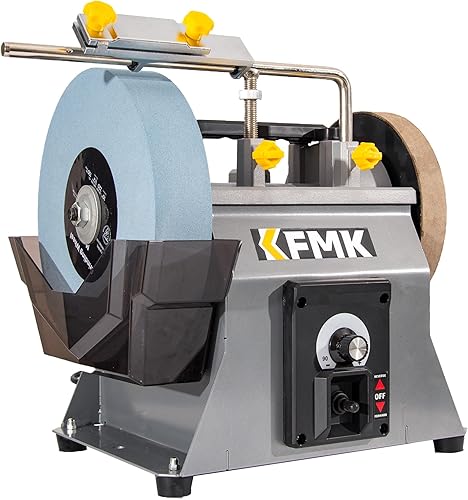
The KFMK is a wet sharpening system rather than a standard dry bench grinder. Its 10-inch aluminum oxide wheel turns from 90 to 160 RPM, with a water trough underneath to help keep tools from overheating.
An 8-inch leather strop wheel removes burrs and refines the edge. The angle guide and adjustable jig support help position knives, chisels, lathe tools, and carving tools.
This setup suits careful edge sharpening when water cooling and stropping appeal to you. It needs room for water and cleanup, so a dry grinder is simpler for general grinding and quick tool reshaping.
Pick the KFMK if wet grinding and a built-in strop fit your routine. Skip it if you need a dry grinder for general stock removal.
How do you choose the best bench grinder for sharpening?
Choose by matching wheel speed, wheel size, support, and grit to the tools you sharpen most. For many woodworking edges, a low-speed grinder around 1,750 RPM is a practical starting point because it can help limit heat buildup.
A slower wheel still needs careful handling. Use light pressure, keep the edge moving, and pause to check its temperature; overheating can damage a hardened edge.
The tool rest should support the tool close to the wheel and hold its position during use. Adjustable rests help set a working angle, while a groove or jig can make repeated tasks such as drill-bit sharpening easier.
Think about the wheel as part of the setup, not just the motor. Coarser grits remove material faster for shaping, while finer grits leave a smoother grind; honing can refine an edge beyond what a grinding wheel alone provides.
Should you choose a 6-inch or 8-inch grinder?
Choose an 8-inch grinder if you want a larger wheel and expect to sharpen longer or broader tools. A 6-inch model can fit a smaller bench and lighter work, but it has a smaller wheel.
The 8-inch Rikon, WEN, and BUCKTOOL models here run at low speed. The 6-inch BUCKTOOL is also a low-speed option, while the WEN BG625V offers a variable range starting at 2,000 RPM.
Before buying, check your available bench space, mounting needs, and tool rests. Leave room for guards and safe access to the work, not just the grinder's base.
When does a wet sharpening system make sense?
A wet system makes sense if you want water cooling and a slower grinding process for edge work. The KFMK combines a water trough, a 10-inch wheel, and a leather strop.
A wet grinder takes more setup and cleanup than a dry bench grinder. If you mainly need to remove rust, reshape tools, or do general grinding, a dry model may be easier to keep ready on the bench.
How should you set up and use a bench grinder for sharpening?
Set up the grinder on a stable bench, adjust the tool rest close to the wheel, and check that guards and eye shields are in place before starting. Follow the grinder and wheel instructions, and wear eye protection.
Inspect the wheel for damage and make sure the work rests securely before use. Keep your hands clear of the wheel, maintain support under the tool, and use light passes rather than pressing hard.
Move the edge across the wheel instead of holding one spot against it. Pause often to check the edge temperature, especially when sharpening narrow tools, and let the wheel do the work.
For a wet system, follow its setup directions for the water trough and jig. On the KFMK leather strop, sharpen against the direction of the wheel's rotation as directed by the manufacturer, so the tool does not cut into the leather.
What mistakes make sharpening harder?
The common mistakes are choosing speed for convenience, pressing too hard, and letting a tool rest too far from the wheel. Each can reduce control, make it harder to hold a consistent angle, or build heat at the edge.
A grinder is also easy to overuse when a tool only needs honing. Grinding removes material; use it for reshaping or restoring an edge, then hone when a finer finish is needed.
Another mistake is buying a wheel before checking fit. Confirm the wheel size, width, arbor, and grinder compatibility before changing a setup, and follow the wheel maker's mounting directions.
Which bench grinder should you choose?
Choose the Rikon 80-805 for an all-around 8-inch low-speed grinder with two grits, adjustable rests, and a drill-bit groove. Pick the DeWalt DW758 when fast material removal and room for longer work matter more than low speed.
For a small bench, the BUCKTOOL 6-inch model offers a compact low-speed option. Choose the KFMK if water cooling and a leather strop are central to your sharpening routine; if you want a simple dry grinder, the WEN BG4286 is a clear alternative.
A grinder is one part of a home shop, so see our guide to benchtop woodworking tools for a home shop when planning how machines fit together. For safer workholding during sharpening, compare our woodworking vise picks.
Our top 3 picks at a glance
-
1
-
2
-
3
Frequently asked questions
What speed is best for sharpening tools on a bench grinder?
A low-speed grinder running around 1,750 RPM is a common choice for controlled sharpening. Lower wheel speed can help limit heat buildup, but use a light touch and follow the tool maker's guidance.
A faster grinder can remove material quickly, which suits rough shaping better than careful edge work.
Is a 6-inch or 8-inch bench grinder better for sharpening?
An 8-inch grinder gives you a larger wheel, while a 6-inch model can take up less bench space. Choose based on the tools you sharpen, the wheel size you want, and the room available for the grinder and its guards.
Check that your planned jigs and wheel accessories fit the model.
Can you sharpen chisels on a bench grinder?
Yes, a bench grinder can help reshape or sharpen a chisel, especially with a suitable wheel and a stable tool rest. Use light passes and pause often so the edge does not overheat.
A honing step may still be needed to refine the edge after grinding.
Can a bench grinder sharpen drill bits?
Yes, a bench grinder can sharpen drill bits if you can hold the bit at the correct angle and keep both cutting lips even. A drill-bit jig or a rest designed for bits can make the task easier.
See our guide to sharpening drill bits on a bench grinder for the steps.