9 Best Woodworking Vises for Your Workbench (November 2026)
The best woodworking vises for workbenches include the Eclipse 10-Inch Quick Release Woodworking Vise for a wide-jaw bench, the Yost M9WW Rapid Action Woodworking Vise for frequent size changes, and the Yost M7WW Rapid Action Woodworking Vise for compact workspaces.
On this page (10 sections)
- How we chose these woodworking vises
- Best woodworking vise picks by bench and workpiece
- How do you choose the right woodworking vise size?
- Which mounting details should you check first?
- When is quick release worth choosing?
- How should you set up a woodworking vise?
- How do you clamp wood without damaging it?
- What mistakes should you avoid with a bench vise?
- How do you care for a woodworking vise?
- Which woodworking vise should you choose?
The Eclipse 10-Inch Quick Release Woodworking Vise is the best woodworking vise for a bench that needs a wide jaw and an adjustable front stop. The Yost M9WW offers rapid adjustments with a 9-inch jaw, while 7-inch models suit tighter spaces.
Compare jaw width, opening, throat depth, release style and mounting needs against your workpieces and bench. This roundup covers 9 woodworking vises, from broad front jaws to compact models with quick release.
For more shop planning, see our guide to benchtop woodworking tools. For sharpening, read what a bench grinder is used for or how to sharpen drill bits on a bench grinder.
Our picks at a glance
-
1
 Best for a wide-jaw bench
Eclipse 10-Inch Quick Release Woodworking Vise
8.8/10 our score
See it on Amazon -
2
 Best for frequent size changes
Yost M9WW Rapid Action Woodworking Vise
8.6/10 our score
See it on Amazon -
3
 Best for compact workspaces
Yost M7WW Rapid Action Woodworking Vise
8.5/10 our score
See it on Amazon
- 4
 Check it
Eclipse 7-Inch Quick Release Woodworking Vise
Best for short bench-stop work - 5
 Check it
Rockler 9-Inch Quick Release Front Vise
Best for parallel jaw control - 6
 Check it
Yost F10WW 10-Inch Woodworker's Vise
Best for cabinet assembly - 7
 Check it
Jorgensen 10-Inch Quick Release Woodworking Vise
Best for oversized openings - 8
 Check it
Pony Jorgensen 27091 Woodworker's Vise
Best for adjustable bench faces - 9
 Check it
VEVOR 7-Inch Quick Release Woodworking Vise
Best for included fasteners
How we chose these woodworking vises
The best woodworking vise for your shop depends on workpiece size, bench layout and how often you change jaw openings. We compared those needs against each vise's jaw width, opening, throat depth, release style, stop design and mounting details.
A quick release is useful when projects move between thin and thick stock. It lets you reposition a jaw quickly, then use the main handle to clamp; if you mostly work with one thickness, the release may matter less than fit and jaw control.
Stops and dogs extend the vise's usefulness across the bench. An adjustable front stop or jaw dog can press a board against a bench stop, but the bench needs a compatible stop and enough room for the piece.
Mounting is part of the selection, not an afterthought. Some models have predrilled holes, some call for lag bolts, and some benches may need shims or a mortise to bring the jaws level with the top.
| Product | Best for | Jaw width | Throat depth | Quick release | Our score |
|---|---|---|---|---|---|
| Eclipse 10-Inch Quick Release Woodworking Vise | a wide-jaw bench | 10 in | 4 in | Yes | 8.8 |
| Yost M9WW Rapid Action Woodworking Vise | frequent size changes | 9 in | 4 in | 8.6 | |
| Yost M7WW Rapid Action Woodworking Vise | compact workspaces | 7 in | 3 in | 8.5 | |
| Eclipse 7-Inch Quick Release Woodworking Vise | short bench-stop work | 7 in | 3 in | Yes | 8.4 |
| Rockler 9-Inch Quick Release Front Vise | parallel jaw control | 9 in | 8.3 | ||
| Yost F10WW 10-Inch Woodworker's Vise | cabinet assembly | 8.0 | |||
| Jorgensen 10-Inch Quick Release Woodworking Vise | oversized openings | 10 in | 7.9 | ||
| Pony Jorgensen 27091 Woodworker's Vise | adjustable bench faces | 7 in | 7.7 | ||
| VEVOR 7-Inch Quick Release Woodworking Vise | included fasteners | 7 in | 7.4 |
Best woodworking vise picks by bench and workpiece
The best woodworking vise picks here cover a wide jaw, quick changes, compact benches and front-mounted cabinet work. Choose by the kind of work you clamp most often, then check the mounting dimensions before buying.
Eclipse 10-Inch Quick Release Woodworking Vise: Best for a wide-jaw bench
- 10 in jaw width
- 4 in throat depth
- Quick release trigger
- Adjustable front stop
A 10-inch jaw and adjustable front stop suit larger workpieces and bench-stop use. Its quick release trigger speeds up opening and closing.
Pros
- Wide 10 in jaw
- Adjustable front stop
- Two predrilled mounting holes
Cons
- Mounting screws are not included
- Heavy at 39 lb
The Eclipse 10-inch vise is the top pick for a wide jaw and stop-based bench work. Its adjustable front stop works with a bench stop, adding tail-vise style clamping to the regular front vise.
A quick-release trigger disengages the screw so you can move the jaw, then use the handle to clamp. Its 4-inch throat gives more vertical room than the 3-inch options in this roundup.
The jaw faces are predrilled for wood cushions, and the vise has 2 mounting holes plus cast tabs. Mounting screws are not included, so plan suitable fasteners and a secure bench.
At 39 lb, this is a substantial vise. Choose it if your bench can support the weight and you often clamp larger pieces; skip it if the bench is light or the mounting area is cramped.
Choose it for a wide jaw and stop-based bench work. For smaller workpieces or tight spaces, consider a 7-inch option.
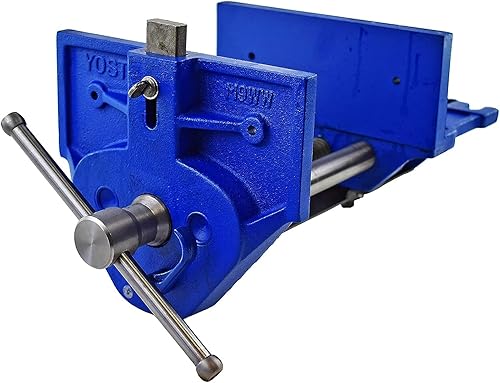
Yost M9WW Rapid Action Woodworking Vise: Best for frequent size changes
- 9 in jaw width
- 10.25 in jaw opening
- 4 in throat depth
- Rapid action lever
The M9WW pairs a 9-inch jaw with a rapid action lever for quick opening adjustments. It also has a movable bench dog.
Pros
- Rapid action lever
- 4 in throat depth
- Movable bench dog
Cons
- Requires secure bench mounting
- Use instructions call for care during setup
The Yost M9WW suits a shop that switches between workpieces of different widths but still needs a broad jaw. It has a 10.25-inch jaw opening and 4-inch throat depth.
Move the rapid-action lever toward the vise handle to disengage the nut and slide the jaw. Turn the handle to clamp after setting the opening, and loosen the finger bolt to reposition the bench dog.
Cast iron, steel guide rails and a chrome-plated sliding T-bar handle make up the vise. Yost includes a 1-year limited warranty.
Choose the M9WW for frequent changes between wider stock and smaller pieces. Skip it if a 9-inch jaw takes too much space on your bench; the M7WW is the more compact rapid-action option.
Choose the M9WW for quick adjustments across varied stock. If its jaw takes too much room, compare the M7WW.
Yost M7WW Rapid Action Woodworking Vise: Best for compact workspaces
- 7 in jaw width
- 8 in jaw opening
- 3 in throat depth
- Rapid action lever
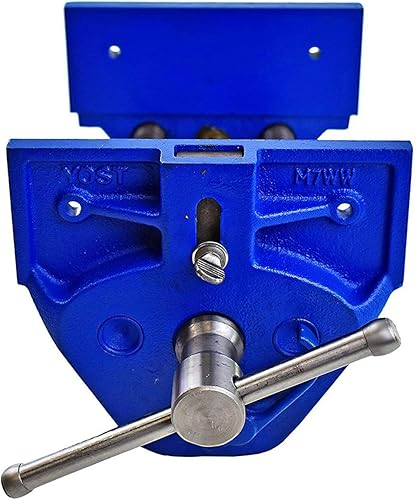
The M7WW has a narrower jaw and shorter opening than the M9WW, which can suit a smaller workbench. Its rapid action lever helps with frequent repositioning.
Pros
- Compact 7 in jaw
- Rapid action lever
- Movable bench dog
Cons
- Less jaw width and opening than larger options
- Mounting still needs to fit the bench
The Yost M7WW is a compact rapid-action pick, with a 7-inch jaw, 8-inch opening and 3-inch throat. Those proportions can suit a shorter bench or work centered on small parts.
Its lever disengages the nut so you can slide the jaw into position before tightening with the handle. The front bench dog moves after you loosen its finger bolt.
The cast iron body and steel guide rails pair with the smaller jaw size. Measure the bench face and the work you clamp, especially if you expect to hold broad panels.
Choose it when a compact vise and rapid adjustment matter together. Skip it if your regular work needs a deeper throat or more opening than its 8 inches.
Choose it for a compact vise with rapid adjustment. For a similar size with an adjustable front stop, consider the Eclipse 7-inch model.
Eclipse 7-Inch Quick Release Woodworking Vise: Best for short bench-stop work
- 7 in jaw width
- 3 in throat depth
- Quick release trigger
- Adjustable front stop
This Eclipse gives you a quick release trigger and adjustable front stop in a 7-inch format. Use the stop with a bench stop for extra support along the bench.
Pros
- Adjustable front stop
- Predrilled mounting holes
- Quick opening without turning the screw
Cons
- Mounting screws are not included
- Smaller jaw than the 10-inch model
The Eclipse 7-inch vise combines quick release with an adjustable front stop in a compact format. Its 3-inch throat depth and predrilled jaw faces suit smaller work that benefits from protective wood cushions.
The front stop works with a bench stop to support longer stock across the work surface. Two predrilled mounting holes and cast tabs help with installation, though mounting screws are not included.
The trigger lets you move the jaw without winding the screw across its full travel. That feature is useful when projects vary in thickness but do not need a 10-inch jaw.
Choose it for compact stop-based clamping. Skip it if your projects often exceed the 7.87-inch maximum opening or need a wider jaw.
Choose it for a compact bench-stop setup. If you prefer a rapid-action lever and movable bench dog, compare the Yost M7WW.
Rockler 9-Inch Quick Release Front Vise: Best for parallel jaw control
- 9 in jaw width
- Dual steel guide rods
- Quick release by handle lift
- Hardwood handle
Dual guide rods help keep the jaws parallel, including when clamping a narrow piece to one side. The vise has a quick release and a solid hardwood handle.
Pros
- Dual guide rods
- Quick release with a handle lift
- Hardwood handle included
Cons
- Wooden jaws are not included
- Mounting bolts are not included
Rockler's 9-inch front vise has dual 3/4-inch steel guide rods designed to resist racking and keep the jaws parallel, including when a narrow piece sits to one side.
Lift and hold the handle to release the vise while you move the jaws. A quarter turn engages the quick-release mechanism, and the hardwood handle is included.
The vise is ready for wooden jaws, but those are not included. It mounts with 1/4-inch lag bolts, which also need to be sourced separately.
Choose it if dual guide rods and a hardwood handle suit your bench build. Skip it if you want a vise with jaw facings and mounting bolts included.
Choose it for parallel jaw control and a hardwood handle. Plan to fit jaw facings before clamping finished stock.
Yost F10WW 10-Inch Woodworker's Vise: Best for cabinet assembly
- 10 in vise width
- Cast iron body
- Solid steel main screw
- Designed for front mounting
The F10WW is a front vise built for clamping and aligning woodworking pieces, including cabinet work. Check the vise's dimensions against your bench before mounting.
Pros
- Wide vise body
- Steel main screw
- Made for clamping and alignment
Cons
- No quick release feature is specified
- Bench fit needs checking
The Yost F10WW is a front vise for cabinet work, clamping and aligning pieces. Its 10.25-inch width and solid steel main screw suit buyers who want a broad vise body and screw clamping.
This model has a cast iron body and 3/4-inch guide rods. Its stated dimensions are 10.25 inches wide by 19.25 inches long, so compare them with your bench face and apron.
No quick-release feature is specified for this vise, so expect to use the main screw for jaw adjustments. That makes it a better fit for steady assembly work than jobs that call for rapid repositioning.
Choose it for front-mounted cabinet and assembly work. Skip it if a quick-release mechanism is important to your workflow or if the bench face cannot accommodate its length.
Choose it for front-mounted cabinet and assembly work. Check the bench dimensions before planning its mounting layout.
Jorgensen 10-Inch Quick Release Woodworking Vise: Best for oversized openings
- 10 in jaw width
- 13 in maximum opening
- Toed-in jaws
- Optional wood facings
This Jorgensen offers a 13-inch maximum opening and toed-in jaws. Its mounting design fits benches up to 3 inches thick, with countersunk holes for optional wood facings.
Pros
- Wide maximum opening
- Toed-in jaws
- Optional wood facings
Cons
- Bench thickness limit is 3 in
- Few buyer feedback details are available
The Jorgensen 10-inch vise offers a 13-inch maximum opening, the largest stated opening in this roundup. Toed-in jaws are designed to grip workpieces, and countersunk holes allow optional wood facings.
Its quick-release design supports fast workpiece adjustment. The vise fits benchtops up to 3 inches thick, so measure the bench before choosing it.
Choose it when you need the extra opening for large stock and your bench is within the stated thickness limit. Skip it if your bench is thicker than 3 inches or the mounting dimensions do not suit your layout.
Choose it when a wide jaw and large opening matter most. If your bench is thicker than 3 inches, select a vise made for that bench.
Pony Jorgensen 27091 Woodworker's Vise: Best for adjustable bench faces
- 7 in jaw width
- 9 in maximum opening
- Bench dog
- Twin guide bars
The 27091 is a medium-duty vise designed to mount to the face of a wood workbench. Its front jaw dog can work with a bench stop for holding larger pieces.
Pros
- Bench dog for bench-stop use
- Twin plated-steel guide bars
- Wood facings can protect work
Cons
- Some benches may need shims or a mortise
- Wood facings are not included
The Pony Jorgensen 27091 is a medium-duty vise designed to mount to the face of a wood workbench. It has a 7-inch jaw width and 9-inch maximum opening, twin plated-steel guide bars and an Acme-thread main screw.
The front jaw has a steel dog for use with a bench stop, which can help hold larger pieces across the bench. Its jaw holes accept wood facings, but the facings are not included.
Some benches may need shims or a mortise to bring the jaw edges flush with the benchtop. Check the bench face and top alignment before planning the installation.
Choose it for medium-duty work and a front-jaw dog. Skip it if you need a straightforward fit without bench adjustments or want jaw facings in the box.
Choose it for medium-duty work with a front-jaw dog. Leave time for bench adjustments if the jaws do not line up with the top.
VEVOR 7-Inch Quick Release Woodworking Vise: Best for included fasteners
- 7 in jaw width
- 8 in maximum opening
- Quick release
- Adjustable front stop
This VEVOR has a 7-inch jaw, quick release and adjustable front stop. Those features cover basic face-vise and bench-stop tasks in a compact size.
Pros
- Adjustable front stop
- Quick release
- Mounting screws and nuts included
Cons
- Less buyer feedback than established options
- Confirm fit and mounting needs for your bench
The VEVOR 7-inch vise combines a compact jaw with quick release and an adjustable front stop. This feature mix suits work that needs quick jaw movement and bench-stop support.
The cast iron vise opens to 8 inches, and a screw and nut set is included. Its adjustable stop can adapt to standard face-vise work or tail-vise style support.
Measure your bench and compare the included mounting pieces with your installation plan. This is a fit for buyers who want a compact vise with the main convenience features in one package.
Choose it if you want a 7-inch jaw, quick release, front stop and included fasteners. Skip it if you need a larger opening or want a longer record of buyer feedback to guide your choice.
Choose it for a compact vise with fasteners included. For other 7-inch options, compare the Eclipse and Yost models above.
How do you choose the right woodworking vise size?
Choose jaw width by the size of the work you clamp most, then check the opening and throat depth. Jaw width is the side-to-side contact area, while opening is the maximum space between jaws and throat depth is how far a piece can sit inside them.
A 7-inch jaw is easier to fit on a compact bench and suits smaller parts, rails and narrow boards. A 9- or 10-inch jaw offers a broader contact area for wider work, but the vise needs enough bench face and clearance underneath.
Opening matters when you clamp thick stock or a fixture. The products here range from 8 inches on the smaller rapid-action vises to 13 inches on the Jorgensen, so measure your thickest common workpiece rather than choosing by jaw width alone.
Throat depth can limit how far a tall or deep piece sits between the jaws. The Yost M9WW and Eclipse 10-inch list 4-inch throats, while the compact Yost M7WW and Eclipse 7-inch list 3 inches.
Which mounting details should you check first?
Check bench thickness, face height, apron clearance and the vise's mounting holes before you choose a model. A vise that fits the workpiece still needs a sound, flat mounting area and room for its screw and guide rods to travel.
The Eclipse models have predrilled holes and cast tabs, but their mounting screws are not included. Rockler calls for 1/4-inch lag bolts, which are also separate, while the VEVOR includes a screw and nut set.
Some face vises sit flush with the workbench top only after the bench face is adjusted. The Pony 27091 may need shims or a mortise, so account for that work instead of discovering the mismatch after drilling.
For the Jorgensen 10-inch, bench thickness is a firm fit check: its mounting design is for benchtops up to 3 inches thick. Measure the actual top, including any surface layer, and confirm the vise can sit squarely before laying out holes.
When is quick release worth choosing?
Quick release is useful when you often change the opening between workpieces. It lets you slide the moving jaw close to the stock before using the screw handle to apply clamping pressure.
The Eclipse uses a trigger, the Yost rapid-action models use a lever, and Rockler releases by lifting its handle. Those controls serve a similar purpose, so choose by the jaw size, bench fit and stop features you need as well.
If you mostly clamp pieces of similar thickness, you may not use a quick-release feature often. A well-fitted standard screw vise such as the Yost F10WW can be a sensible choice when front mounting and alignment matter more than fast repositioning.
How should you set up a woodworking vise?
Set up the vise so the jaws meet the work squarely and the moving jaw travels without hitting the bench or apron. Read the model's instructions, mark the mounting points carefully and confirm the bench can support the vise before drilling.
For a face vise, align the top of the jaws with the bench surface when the design calls for a flush fit. Use the mounting holes and suitable fasteners for the vise and bench, and check that guide rods and the main screw have clear travel through the full opening.
Wood facings are useful when you want to protect a workpiece from direct contact with metal jaws. Several models have holes for adding them, but the facings are not included with the Eclipse, Rockler or Pony options described here.
After installation, test the jaw movement with no workpiece in place. Confirm that the jaws open fully, close evenly and hold a scrap board without rocking before clamping a finished part.
How do you clamp wood without damaging it?
Use enough pressure to hold the piece steady, then stop turning the handle once it no longer shifts. Excess force can mark wood or put unnecessary strain on the vise and its mounting.
Fit wooden jaw facings for delicate or finished surfaces, and keep their faces aligned with the vise jaws. For narrow pieces held near one side, the Rockler's dual guide rods are designed to help keep the jaws parallel.
Support long boards along the bench rather than letting the full length hang from the vise. A front stop or jaw dog can work with a bench stop to hold stock across the bench, provided the stop positions line up with the work.
Keep fingers clear as the moving jaw closes, and keep the workpiece seated before tightening. When cutting or drilling, arrange the stock so the force of the tool pushes it into the jaws instead of pulling it loose.
What mistakes should you avoid with a bench vise?
The most common buying mistake is choosing by jaw width alone. A wide jaw does not help if the maximum opening is too small, the throat is too shallow or the vise does not fit your bench.
Do not assume mounting hardware or facings are included. Rockler's lag bolts and several models' wooden jaw facings are separate, while the Eclipse models do not include mounting screws.
Avoid clamping a small piece at the far end of a jaw with heavy pressure. That can twist the moving jaw; choose a vise designed to resist racking, center the work when possible and use protective facings.
Do not use a woodworking vise as a substitute for a metalworking vise or apply force beyond the handle's normal hand pressure. The Eclipse tommy bars are designed to bend before the vise is overstressed, but that feature is a safety measure, not a reason to force the handle.
How do you care for a woodworking vise?
Keep the screw, guide rods and sliding surfaces free of sawdust and chips so the jaw can move cleanly. Brush away debris after shop sessions, especially around quick-release levers and the front stop.
Check mounting fasteners and bench joints from time to time, particularly after the vise has held heavy or awkward stock. A vise that shifts on the bench cannot hold work reliably, even if its jaw mechanism is in good shape.
Keep metal surfaces dry and protect them from rust in a damp shop. Follow the maker's instructions for lubrication, since the right care can vary with the screw and release design.
Which woodworking vise should you choose?
Choose the Eclipse 10-inch for a broad jaw and adjustable front stop, or the Yost M9WW for rapid adjustment with a 9-inch jaw. Pick the Yost M7WW or Eclipse 7-inch when bench space is tight, and choose Rockler if dual guide rods are a priority.
For cabinet assembly, the Yost F10WW is the direct front-vise option; the Pony 27091 suits medium-duty face mounting with a front-jaw dog. Choose the Jorgensen when its 13-inch opening is useful and your bench is no thicker than 3 inches, or the VEVOR for a compact quick-release vise with fasteners included.
Measure the bench and your common stock before deciding, then plan for facings and mounting hardware where needed. If you're building out the rest of your shop, compare these picks with our guide to benchtop woodworking tools for a home shop and our roundup of bench grinders for sharpening.
Our top 3 picks at a glance
-
1
Best for a wide-jaw bench
Eclipse 10-Inch Quick Release Woodworking Vise
8.8/10 our score
See it on Amazon -
2
Best for frequent size changes
Yost M9WW Rapid Action Woodworking Vise
8.6/10 our score
See it on Amazon -
3
Best for compact workspaces
Yost M7WW Rapid Action Woodworking Vise
8.5/10 our score
See it on Amazon
Frequently asked questions
What size woodworking vise should I get?
Choose a jaw width and opening that fit your common workpieces and available bench space. A 7-inch vise can suit a compact bench, while 9- and 10-inch jaws offer more width.
Also compare throat depth and maximum opening, since those determine how far a piece can sit inside the jaws.
Is a quick-release woodworking vise useful?
A quick-release vise lets you move the front jaw without turning the screw through its full travel. That can save time when you switch between workpieces with different widths.
If you rarely change the opening, a standard screw adjustment may be enough for your work.
Do I need wooden jaws on a bench vise?
Wooden jaw facings help protect a workpiece from direct contact with the vise jaws. Some vises have predrilled jaw faces or countersunk holes for adding them.
Check whether the facings are included, then fit them to your bench and the work you clamp.
Can a woodworking vise work as a tail vise?
Some front vises include an adjustable dog that can work with a bench stop to support a longer board across the bench. The Eclipse 10-inch and 7-inch models here have adjustable front stops.
A tail vise is a bench feature, so check the layout and stop positions before relying on that setup.