7 Best Bench Grinder for Sharpening Lathe Tools (November 2026)
The best bench grinders for sharpening lathe tools include the BUCKTOOL 8" 1/2HP Dual Speed Bench Grinder (best overall for most turners), the DeWalt DW758 8-Inch Bench Grinder for heavy metal removal, and the Rikon 80-805 8-Inch Low Speed Grinder for cool, controlled edges.
On this page (8 sections)
- The best bench grinders for sharpening lathe tools
- How these bench grinders were compared
- What speed should a bench grinder run for lathe tools?
- Do you need an 8-inch or a 6-inch wheel for lathe tools?
- Which wheels and rests matter for lathe tool edges?
- Should you choose a wet or dry grinder for lathe tools?
- What else should you plan for on the bench?
- Verdict: which bench grinder should you buy for lathe tools?
The best bench grinder for sharpening lathe tools for most turners is the BUCKTOOL 8" 1/2HP Dual Speed, because its 1725 RPM low setting sharpens without burning the edge while the 3450 RPM setting handles reshaping. Pick the Rikon 80-805 if you want the slowest, coolest edge, or the KFMK wet system for water-cooled honing.
Lathe tools lose their edge fast, and a bench grinder that runs too hot can draw the temper out of the steel before you notice. Speed, wheel choice and a steady tool rest matter more than motor size for this job.
The right setup lets you touch up a gouge or skew in a couple of minutes and get back to the lathe.
If you are still choosing a machine for the shop in general, our guide to the best bench grinder for sharpening covers the wider range. Once your grinder is set up, how to sharpen drill bits on a bench grinder shows the rest technique that carries over to lathe tools.
A solid woodworking vise also helps when you want to touch up an edge by hand.
Our picks at a glance
-
1
 Best overall for most turners
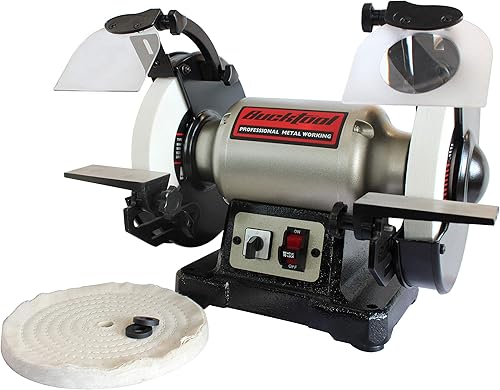
BUCKTOOL 8" 1/2HP Dual Speed Bench Grinder
9.4/10 our score
See it on Amazon -
2

-
3
 Best for cool, controlled edges
Rikon 80-805 8-Inch Low Speed Grinder
8.8/10 our score
See it on Amazon
- 4
 Check it
WEN BG4286 8-Inch Slow Speed Bench Grinder
Best budget slow speed pick - 5
 Check it
BUCKTOOL 6-Inch Low Speed Grinder
Best for tight shops - 6
 Check it
Ecarke 3" Mini Bench Grinder Compatible
Best for portable touch-ups - 7
 Check it
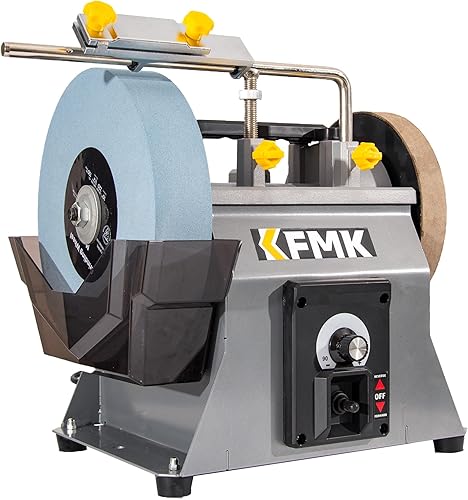
KFMK 10-Inch Wet Sharpening System
Best for water-cooled honing
The best bench grinders for sharpening lathe tools
The BUCKTOOL dual speed is the strongest all-round choice for a turner, while the other picks solve more specific needs like the coolest possible edge or a tiny bench. Choose by how much reshaping you do and how much space you have.
BUCKTOOL 8" 1/2HP Dual Speed Bench Grinder: Best overall for most turners
- 1/2 HP dual speed motor, 1725 and 3450 RPM
- 80 and 120 grit white aluminum oxide wheels
- Two independently adjustable cast aluminum tool rests
- Cast iron base with mounting holes
A dual speed 8-inch grinder that covers both slow edge work and faster reshaping. The independent tool rests and stable base make repeatable bevel angles easier.
Pros
- Low speed for controlled sharpening
- High speed for quick reshaping
- Independent tool rests
- Buffing wheel included
Cons
- Larger footprint than a 6-inch model
- Weighs about 20.4 kg
BUCKTOOL suits a turner who shapes a bowl gouge on one day and touches up a skew the next. Its dual speed motor covers both jobs: 1725 RPM for a controlled edge and 3450 RPM for quick metal removal.
The 80 and 120 grit white aluminum oxide wheels cut cooler than gray wheels, which helps on heat-sensitive tool steel. Two cast aluminum tool rests adjust independently, so you can set one rest for roughing and keep the other flat for honing.
The cast iron base with mounting holes keeps the machine steady, and BUCKTOOL includes a buffing wheel for polishing. The trade-off against the slow speed picks is size and weight, at about 20.4 kg and a 16.93 inch length.
Buy it if you want one grinder for shaping and sharpening, and you have bench space to mount it. Skip it for a very small shop where a 6-inch model fits better.
DeWalt DW758 8-Inch Bench Grinder: Best for heavy metal removal
- 3/4 HP induction motor
- Runs at 3600 RPM
- Cast iron base and motor housing
- Precision-machined aluminum tool rests
- 12-1/2 inches between wheels
A powerful high-speed 8-inch grinder built for fast material removal. Best where you reshape a lot of steel and manage heat with light passes.
Pros
- 3/4 HP motor for fast stock removal
- Long 12-1/2 inch span between wheels
- Rugged cast iron base and housing
Cons
- Single high speed only
- Runs too fast for delicate edge honing
DeWalt suits a turner who removes a lot of steel, such as reshaping a roughing gouge or cleaning up a damaged edge. Its 3/4 HP motor runs at 3600 RPM, and DeWalt builds the base and motor housing from cast iron for a long service life.
The long 12-1/2 inch span between wheels gives more room around each wheel, which helps when you swing a long tool handle. Precision-machined aluminum tool rests let you position the work accurately.
The trade-off is heat. At 3600 RPM this grinder removes metal fast, so use light passes and cool the tool often.
Against the dual speed BUCKTOOL, you lose the slow setting that makes edge honing easier.
Buy it for heavy reshaping and metal cleanup, not for finishing a delicate bevel. If your work is mostly final edges, the slow speed grinders here are the better fit.
Rikon 80-805 8-Inch Low Speed Grinder: Best for cool, controlled edges
- 1/2 HP motor at 1750 RPM
- 8-inch 60 and 120 grit wheels on a 5/8 inch arbor
- Dual adjustable tool rests with a drill-bit groove
- Cast iron base with anti-vibration feet
- Diamond wheel dresser and 5-year warranty
A slow speed 8-inch grinder that reduces heat buildup during sharpening. The left tool rest has a groove for drill bits, and a diamond dresser keeps the wheels flat.
Pros
- Low 1750 RPM for reduced heat
- Diamond wheel dresser included
- Drill-bit groove in the left rest
- 5-year warranty
Cons
- No high speed for rough reshaping
- Heavier than most 8-inch models
Rikon suits the turner who wants the edge to stay cool and the bevel to stay flat. Its 1/2 HP motor runs at 1750 RPM, which Rikon says reduces heat buildup during sharpening and gives controlled grinding.
The 8-inch 60 and 120 grit wheels sit on a 5/8 inch arbor. Dual adjustable tool rests support work at useful angles, and the left rest has a groove for drill bits.
A diamond wheel dresser is included, so you can keep the wheels flat and the bevel true.
The cast iron base has anti-vibration rubber feet and mounting holes for a bench or stand. Rikon backs it with a 5-year warranty, the longest here.
The trade-off is that there is no high speed for rough reshaping, and it is heavy to move. Buy it for a dedicated sharpening station where cool, repeatable edges matter most.
WEN BG4286 8-Inch Slow Speed Bench Grinder: Best budget slow speed pick
- 3-amp soft start motor at 1750 RPM
- 8 x 1 inch 60 and 120 grit wheels
- Pivoting tool rests
- Adjustable eye guards
An affordable slow speed 8-inch grinder with pivoting rests for angled work. A sensible first grinder for a turner sharpening a few tools at a time.
Pros
- Low speed with soft start
- Pivoting rests for angled grinding
- Easy guard removal for wheel changes
Cons
- Rests are lighter than cast aluminum
- No high speed for heavy reshaping
WEN suits a turner setting up a first sharpening station on a budget. The 3-amp soft start motor runs the 8-inch wheels at 1750 RPM, and WEN says the low speed gives maximum precision with minimal heat to the workpiece.
It includes a 60 grit general wheel and a 120 grit finishing wheel. Pivoting tool rests allow angled grinding, and the guards come off easily for wheel changes.
A sturdy base with pre-drilled mounting holes keeps it in place.
The trade-off against the Rikon is the rest: WEN's pivoting rests are lighter than cast aluminum, so they flex more under a heavy pass. Against the BUCKTOOL you also give up the high speed setting.
Buy it if you want slow speed sharpening without spending much, and you mostly touch up edges rather than reshape. Step up to the Rikon for a heavier rest and longer warranty.
BUCKTOOL 6-Inch Low Speed Grinder: Best for tight shops
- 1/3 HP motor at 1750 RPM
- 60 grit brown and 80 grit white aluminum oxide wheels
- Tool-free adjustable work rest
- Cast aluminum base with rubber feet
A compact 6-inch slow speed grinder for small benches. The smaller wheels suit light touch-ups more than full bevel reshaping.
Pros
- Compact 6-inch size
- Low 1750 RPM
- Tool-free rest adjustment
- 2-year warranty
Cons
- Smaller wheels wear faster
- Less power than the 8-inch picks
BUCKTOOL's 6-inch model suits a small shop or a bench that already carries a lathe. The 1/3 HP motor runs at 1750 RPM, so it sharpens slowly and predictably for its size.
It comes with a 60 grit brown wheel and an 80 grit white wheel. A tool-free adjustable work rest and a rubber-footed cast aluminum base reduce vibration during long sessions.
The eye shield and spark arrestor keep debris away from your face.
The trade-off is the wheel size. A 6-inch wheel curves more sharply than an 8-inch one, so it hollows a bevel faster and wears down sooner.
Against the 8-inch picks you also get less power for reshaping.
Buy it for light touch-ups in a tight space, such as a garage shop where the lathe and grinder share one bench. For full bevel shaping, choose an 8-inch model.
Ecarke 3" Mini Bench Grinder Compatible: Best for portable touch-ups
- 3-inch wheels, 36 and 60 grit
- 2000 to 10000 RPM variable speed
- Works with DeWalt 20V battery or AC adapter
- Stainless steel body with anti-vibration feet
A small variable speed grinder that runs from a battery or wall power. Handy for quick edge touch-ups away from the bench, not for shaping full lathe tool bevels.
Pros
- Variable speed from 2000 to 10000 RPM
- Battery or AC power
- Compact and portable
Cons
- 3-inch wheels are small for lathe tools
- Battery not included
Ecarke suits a turner who wants to touch up an edge away from the bench, or in a shop without a free outlet. The 3-inch wheels run on a DeWalt 20V battery or the included AC adapter, and a speed dial takes it from 2000 to 10000 RPM.
The 36 grit red wheel handles stock removal and the 60 grit white wheel refines the edge. Stainless steel construction and four anti-vibration feet keep it stable, and a non-slip towel goes underneath.
The trade-off is scale. Three-inch wheels are small for lathe tools, so the hollow grind is deep and the wheels wear quickly.
Battery power also means the battery is not included.
Buy it as a portable second grinder for quick honing, not as your main lathe tool sharpener. Keep an 8-inch machine for shaping bevels.
KFMK 10-Inch Wet Sharpening System: Best for water-cooled honing
- 10-inch aluminum oxide wet wheel
- 90 to 160 RPM variable speed
- 8-inch leather strop wheel
- Angle guide and adjustable jig support
A slow wet system that cools the edge in water and finishes on a leather strop. Best as a second machine for final honing after a dry grinder shapes the bevel.
Pros
- Water trough keeps tools cool
- Very slow 90 to 160 RPM
- Leather strop for burr removal
- Angle guide for repeatable bevels
Cons
- Not built for fast reshaping
- Takes more bench space and setup
KFMK suits the turner who wants a polished final edge without any risk of overheating. Its 10-inch wet wheel turns at 90 to 160 RPM in a water trough, and an 8-inch leather strop wheel removes the burr afterward.
An angle guide and an adjustable jig support help you hold a consistent bevel, and the support moves to horizontal or vertical positions. KFMK says the system suits lathe and hand-carving tools as well as chisels and knives.
The trade-off is speed. At 90 to 160 RPM it shapes a bevel far more slowly than a dry grinder, so most turners use it after a bench grinder has done the rough work.
It also takes more bench space and setup.
Buy it as a finishing station next to a dry grinder, not as your only sharpener. For a single machine, the BUCKTOOL dual speed covers more ground.
How these bench grinders were compared
We compared the grinders on the specs that decide how a lathe tool sharpens: wheel size and grit, running speed, tool rest design, base stability and included accessories. Slow speed models scored higher for edge work because they build less heat.
Dual speed models gained points for covering both shaping and sharpening. We also weighed wheel size, since an 8-inch wheel gives a flatter bevel than a 6-inch one.
Our score weighs specs, features and buyer feedback against what you're shopping for.
What speed should a bench grinder run for lathe tools?
For sharpening lathe tools, 1750 RPM is the safer speed, because a slower wheel removes steel more gradually and builds less heat at the edge. High speed grinders around 3450 to 3600 RPM remove metal faster but heat the edge quickly.
If you do both shaping and sharpening, a dual speed grinder gives you both settings in one machine.
Slow speed grinders around 1750 RPM
Slow speed grinders suit final edges and touch-ups. The Rikon 80-805 and WEN BG4286 both run at 1750 RPM, and the BUCKTOOL 6-inch matches that speed in a smaller frame.
These are the machines to choose if burning an edge is your main worry.
Dual speed grinders for shaping and sharpening
A dual speed model like the BUCKTOOL 8" switches between 1725 and 3450 RPM with a dial. Use the low setting for honing and the high setting when you need to reshape a damaged bevel.
This covers more work than a single speed machine.
High speed grinders for reshaping only
High speed grinders such as the DeWalt DW758 are built for fast metal removal. Use them to reshape a roughing gouge or clean up rust and burrs, then move to a slow wheel for the final edge.
Do you need an 8-inch or a 6-inch wheel for lathe tools?
An 8-inch wheel is the better default for lathe tools, because the larger radius gives a flatter bevel and more clearance under the tool rest. A 6-inch wheel hollows the bevel more and wears down faster.
Choose 6-inch only when bench space is tight and your work is light touch-ups.
When an 8-inch wheel makes sense
Most of the picks here use 8-inch wheels, including the BUCKTOOL dual speed, DeWalt, Rikon and WEN. An 8-inch wheel stays flatter for longer and gives a more predictable bevel on a bowl gouge or skew.
If you have the bench depth for a 16 inch machine, start here.
When a 6-inch wheel is enough
The BUCKTOOL 6-inch grinder fits a small bench and handles light sharpening. It costs less bench space and is easier to move.
For a turner who sharpens a few tools now and then, it does the job without taking over the shop.
Which wheels and rests matter for lathe tool edges?
White aluminum oxide wheels in 60 and 120 grit cover most lathe tool work, with the coarser wheel for shaping and the finer one for the edge. A rest you can lock at a set angle matters just as much, since it decides whether your bevel stays repeatable.
A wheel dresser keeps both wheels flat.
Choosing wheel grit and material
White aluminum oxide cuts cooler than the gray wheels on many basic grinders. The BUCKTOOL dual speed, Rikon and WEN all include 60 and 120 grit wheels.
Keep the coarse wheel for reshaping and the fine wheel for the final edge, and dress them flat when they load up.
Setting up a tool rest for repeatable bevels
Set the rest close to the wheel and lock it at the angle you want, then slide the tool across it. The cast aluminum rests on the BUCKTOOL dual speed adjust independently, so you can set one for roughing and keep one flat.
The Rikon left rest has a groove for drill bits, which also helps with small tools. If you also sharpen bits, our drill bit sharpening guide covers the rest angles in detail.
Adding a wet wheel for the final hone
A wet system like the KFMK cools the edge in water and finishes on a leather strop. Use it after a dry grinder has shaped the bevel.
The water trough keeps the tool from overheating, and the angle guide helps hold a consistent bevel.
Should you choose a wet or dry grinder for lathe tools?
A dry bench grinder shapes a lathe tool bevel far faster, while a wet system cools the edge and gives a finer finish. Most turners keep a dry grinder for shaping and add a wet wheel for honing.
Pick wet only if your work is mostly final edges and you can wait for the slower cut.
What a wet sharpening system does well
The KFMK wet system runs at 90 to 160 RPM in a water trough and finishes on an 8-inch leather strop wheel. It removes the burr and leaves a refined edge without heat.
An angle guide and adjustable jig help keep the bevel consistent.
Where a dry grinder still wins
A dry grinder removes steel quickly, which matters when you reshape a damaged edge. The DeWalt DW758 at 3600 RPM and the BUCKTOOL dual speed at 3450 RPM handle that work.
For most turners a dry grinder is the first machine, with wet as a later addition.
What else should you plan for on the bench?
Plan for a mounted, steady machine with room to swing the tool handle, because a grinder that walks or wobbles ruins a bevel. The base matters as much as the motor.
Every pick here has mounting holes or anti-vibration feet, but bolting it down is still the best way to keep it still.
Space and mounting
The 8-inch machines here run about 14 to 18 inches long, so measure your bench before buying. Leave room on both sides to swing a long tool handle.
The cast iron bases on the BUCKTOOL and Rikon have mounting holes, and the WEN base has pre-drilled holes too. A woodworking vise on the same bench helps when you want to hold a tool for hand honing.
Safety gear and guards
Every grinder here includes eye shields and spark arrestors except the mini Ecarke. Wear safety glasses anyway, since sparks and wheel dust get past guards.
Keep the rests close to the wheels and never grind on the side of a wheel.
Keeping wheels flat and true
A wheel dresser is the tool most buyers forget. The Rikon includes a diamond dresser, which is a real advantage.
On the other grinders, buy a dresser and use it when the wheel loads up or goes out of round. A flat wheel gives a flat bevel.
Our guide to what a bench grinder is used for around the shop covers the other jobs it can do.
Verdict: which bench grinder should you buy for lathe tools?
The BUCKTOOL 8" 1/2HP Dual Speed is the best bench grinder for sharpening lathe tools for most turners, because the low speed protects the edge and the high speed handles reshaping. Pick the Rikon 80-805 if you want the slowest, coolest edge with a heavy rest and a 5-year warranty.
Choose the DeWalt DW758 for heavy metal removal, the WEN BG4286 for a budget slow speed start, or the BUCKTOOL 6-inch for a small bench. The KFMK wet system makes a good finishing station, and the Ecarke mini grinder is best for portable touch-ups.
If you are still deciding on the machine itself, read our guide to the best bench grinder for sharpening before you buy. Then set your rest and dress your wheels, and your lathe tools will hold an edge far longer between trips to the grinder.
Our top 3 picks at a glance
-
1
Best overall for most turners
BUCKTOOL 8" 1/2HP Dual Speed Bench Grinder
9.4/10 our score
See it on Amazon -
2
-
3
Best for cool, controlled edges
Rikon 80-805 8-Inch Low Speed Grinder
8.8/10 our score
See it on Amazon
Frequently asked questions
Can I sharpen lathe tools on a high speed grinder?
Yes, but high speed removes steel quickly and heats the edge fast. Use light passes and cool the tool in water often, or fit a cooler-cutting wheel so the temper is not drawn out of the steel.
What wheels should I fit for lathe tool sharpening?
White aluminum oxide wheels in 60 and 120 grit cover most lathe tool work, with the coarser wheel for shaping and the finer one for the edge. Keep the wheels dressed flat so the bevel stays true.
Is a wet sharpening system better than a dry bench grinder?
A wet system cools the edge and suits final honing, while a dry grinder shapes a bevel far faster. Many turners keep both, using the dry grinder to shape and the wet wheel to finish.
How do I hold a lathe tool steady at the grinder?
Set the tool rest close to the wheel and slide the tool across it rather than jabbing it in. A rest you can lock at the angle you want makes repeatable bevels much easier to hold.