9 Best Scroll Saws for Beginners and Hobby Crafters (November 2026)
The best beginner scroll saws for hobby crafters include the WEN 3922 16-Inch Scroll Saw for first benchtop saw, the WEN 3921 16-Inch Scroll Saw for a lit work area, and the WEN 3923 16-Inch Scroll Saw for light plus access.
On this page (7 sections)
- Which scroll saw is best for beginners?
- How should you choose the best scroll saw for beginners?
- How we chose these beginner scroll saws
- Scroll saw picks for different hobby needs
- What should you compare before choosing a scroll saw?
- How should you set up and care for a beginner scroll saw?
- Which scroll saw is the right first buy?
The WEN 3922 is the best scroll saw for beginners who want a full-size benchtop setup, with variable speed, a 16-inch throat and a side panel that opens for lower blade access. The WEN 3921 adds a flexible light and a two-direction blade option, while the Dremel Moto-Saw suits small jobs where handheld use matters.
A scroll saw makes controlled curved cuts and interior cutouts in wood. For a first machine, focus on blade access, speed adjustment, table space and the patterns you expect to cut.
If you're comparing curve-cutting tools, see our beginner guide to using a band saw and scroll saw versus jigsaw comparison. Our curve-cutting saws guide covers how these tools fit into a home shop.
Our picks at a glance
-
1

-
2

-
3

- 4
 Best for portable coping cutsCheck it
- 5
 Check it
SKIL SS9503 16-Inch Scroll Saw
Best for built-in cut visibility - 6
 Check it
WEN LL2156 21-Inch Parallel Arm Scroll Saw
Best for wide patterns - 7
 Best for front-facing controlsCheck it
- 8
 Check it
Ryobi SC165VS 16-Inch Scroll Saw
Best for a simple blade swap - 9
 Best for lift-up blade accessCheck it
Which scroll saw is best for beginners?
The WEN 3922 is the best starting point for most beginners who plan to do regular pattern work. Its variable speed and side panel for lower blade access keep the learning curve manageable, while the 16-inch throat fits many hobby projects.
What makes a beginner scroll saw easier to learn?
A beginner scroll saw is easier to learn when you can control its speed, see the cut line and change blades without struggling to reach the clamps. Those features matter because curved cuts require you to guide the workpiece steadily and interior cutouts require blade removal and reinstallation.
Variable speed gives you a way to start at a controlled pace on scrap. Accessible blade holders and a useful light or dust blower can reduce setup friction, but neither replaces a stable bench, a sharp suitable blade and careful feeding.
How should you choose the best scroll saw for beginners?
Choose by matching the saw's capacity and setup to your usual projects, then compare the space it needs with the space you have. A basic 16-inch machine covers many craft patterns; a longer throat helps only when your workpieces need it.
For frequent interior cuts, look for comfortable access to the lower holder or an arm that lifts out of the way. If visibility is your main concern, prioritize a light and dust control; if you have to move the tool between jobs, a compact detachable format may suit you better.
A larger saw adds room but also takes bench space and can require more planning. Avoid paying attention to capacity alone when most of your work will be small ornaments or signs.
How we chose these beginner scroll saws
We compared the listed features and specifications with common beginner needs: manageable setup, speed control, blade access, visibility, throat depth and work surface. The scores reflect how well each feature set fits a new hobby user.
Blade changes and useful controls carry more weight here than capacity that a new crafter may not use. The WEN 3922 leads for its mix of variable speed and an opening panel for lower blade access; the Dremel, SKIL and longer WEN serve different project needs.
| Product | Best for | Throat depth | Speed | Table | Our score |
|---|---|---|---|---|---|
| WEN 3922 16-Inch Scroll Saw | first benchtop saw | 16 in | 550 to 1600 strokes per minute | 16 x 10 in; bevels up to 45 degrees | 9.1 |
| WEN 3921 16-Inch Scroll Saw | a lit work area | 16 in in standard position | 400 to 1600 strokes per minute | 16 x 11 in; bevels up to 45 degrees left | 8.9 |
| WEN 3923 16-Inch Scroll Saw | light plus access | 16 in | 550 to 1600 strokes per minute | 16 x 10 in; bevels up to 45 degrees | 8.5 |
| Dremel MS20 Moto-Saw | portable coping cuts | 8.3 | |||
| SKIL SS9503 16-Inch Scroll Saw | built-in cut visibility | 16 in | 16 x 10 in; tilts 0 to 45 degrees | 8.2 | |
| WEN LL2156 21-Inch Parallel Arm Scroll Saw | wide patterns | 21 in | 25-5/8 x 16 in; bevels 45 degrees left and 30 degrees right | 8.0 | |
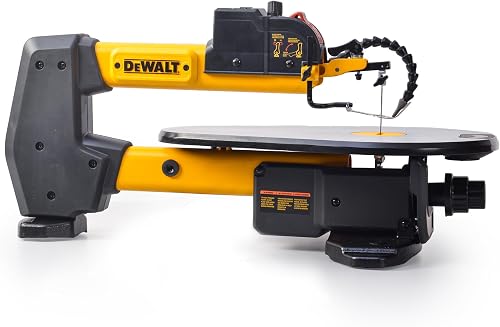
| DeWalt 18-Inch Scroll Saw | front-facing controls | 18 in | 500 to 1500 strokes per minute | 7.8 | |
| Ryobi SC165VS 16-Inch Scroll Saw | a simple blade swap | 7.6 | |||
| BUCKTOOL 16-Inch Scroll Saw | lift-up blade access | 360 to 1550 RPM | 19-11/16 x 13-3/8 in | 7.2 |
Scroll saw picks for different hobby needs
The right model depends on project size, workspace and how often you'll change blades. A 16-inch saw can suit small and medium patterns, while larger pieces may need more throat and table area.
WEN 3922 16-Inch Scroll Saw: Best for first benchtop saw
- 550 to 1600 strokes per minute
- 16-inch throat
- Cuts wood up to 2 inches thick
- Side panel opens for blade changes
The side panel opens to reach the lower blade holder, which can make blade changes less awkward for a new user. Variable speed and dust-management features support detailed work.
Pros
- Easy-access side panel
- Variable speed
- Air pump and dust port
Cons
- Table is smaller than the 21-inch WEN model
- Corded setup needs a nearby outlet
The WEN 3922 is the strongest all-around starting point for a first benchtop scroll saw. Its speed range gives you room to adjust the stroke rate, and the table bevels up to 45 degrees for angled cuts.
The side panel opens to reach the lower blade holder. It also has a thumb screw adapter for tool-free blade changes, an air pump to clear dust from the work area and a dust port.
Its throat is 16 inches, and it cuts wood up to 2 inches thick. Compare those limits with the largest piece you expect to turn on the table before setting up.
Choose the 3922 for regular pattern work and easier access during blade changes. Skip it if you need a larger table or routinely cut pieces that exceed its throat.
WEN 3921 16-Inch Scroll Saw: Best for a lit work area
- Variable speed
- Flexible work light
- Accepts blades in two directions
- Onboard blade and holder storage
A flexible light, air pump and onboard storage keep useful controls and accessories close. Its blade holder can turn pinned blades 90 degrees for cutting in another direction.
Pros
- Flexible work light
- Two-direction blade setup
- Onboard storage
Cons
- No side panel for lower blade access
- Published descriptions give different lower speed limits
The WEN 3921 fits a beginner who values lighting and wants the option to orient pinned blades in another direction. Its flexible work light bends toward the cut, and onboard storage keeps blades and holders near the saw.
WEN describes the alternate blade direction as a way to cut beyond the standard 16-inch throat limit with pinned blades. The saw also has an adjustable air pump and dust port to help keep the cutting area visible.
There is a speed discrepancy in the product information: the bullets give a range of 400 to 1600 strokes per minute, while the description gives 550 to 1600. Check the manual for the exact lower limit if it matters to your work.
Choose the 3921 for its light and blade-direction option. Skip it if easy access to the lower holder is your priority; the side-opening 3922 or 3923 is a better fit.
WEN 3923 16-Inch Scroll Saw: Best for light plus access
- 550 to 1600 strokes per minute
- Side panel opens for blade changes
- Flexible work light
- Cuts wood up to 2 inches thick
The 3923 combines a flexible work light with a side panel that opens for access to the lower blade holder. It shares the 3922's throat depth and speed range.
Pros
- Work light and easy-access panel
- Variable speed
- Air pump and dust port
Cons
- Overlaps with the WEN 3922's main features
- Corded setup needs a nearby outlet
The WEN 3923 pairs a flexible work light with the side panel that provides access to the lower blade holder. It suits a new user who wants both features in a 16-inch saw.
The table bevels up to 45 degrees, and the air pump clears dust near the cut. Its dust port provides another way to manage debris around the work area.
The 3923 shares many core features with the 3922. Choose it if you want a light as well as easy blade access; skip it if the light is unnecessary and you'd rather choose the simpler 3922.
Dremel MS20 Moto-Saw: Best for portable coping cuts
- Detachable coping saw function
- Variable speed
- Auto-tensioning quick-change mechanism
- Fast-clamp base
This compact saw detaches from its base so you can bring it to the workpiece. Its auto-tensioning mechanism helps simplify accessory changes.
Pros
- Can be used handheld or on its base
- Variable speed
- Dust port adapter
Cons
- Shorter blade than the 16-inch saws
- Compact format differs from a full benchtop scroll saw
The Dremel Moto-Saw is the compact choice for small workpieces, limited storage and occasional coping cuts. It works as a stationary scroll saw on its clamp base, then detaches so you can take it to the workpiece.
The variable-speed control is designed for materials including wood, plastic, laminates and metal. Its auto-tensioning quick-change mechanism helps keep the blade taut when changing accessories.
This is a different format from a standard benchtop saw. Choose it if portability matters more than a broad table and long throat; skip it if you plan to cut larger panels or do regular pattern work.
For another look at this compact tool, read our Dremel Moto-Saw review.
SKIL SS9503 16-Inch Scroll Saw: Best for built-in cut visibility
- Integrated LED work light
- Dust removal system
- Electronic variable speed control
- Keyless blade change
An integrated LED and dust removal system focus on visibility around the cut line. Keyless blade changes and on-tool storage keep swaps and spare blades convenient.
Pros
- LED work light
- Integrated dust removal
- On-tool blade storage
Cons
- Speed range is not specified
- Corded setup needs a nearby outlet
The SKIL SS9503 is a good fit if you want built-in lighting, dust removal and convenient blade storage. The LED work light and dust system focus on keeping the cut line visible, while its keyless blade change avoids a separate tool for that task.
The table tilts from 0 to 45 degrees, and electronic variable speed control supports adjustments for different materials. The on-tool storage keeps spare blades close at hand.
No speed range is specified. Choose the SKIL if visibility and easy blade changes are top priorities; skip it if you need a known stroke-rate range before buying.
WEN LL2156 21-Inch Parallel Arm Scroll Saw: Best for wide patterns
- 21-inch throat
- Large dual-bevel steel table
- Variable speed from 550 to 1600 strokes per minute
- Upper arm locks raised for interior cuts
The longer throat and broad table provide room for larger workpieces. Its raised, locking upper arm can help when adjusting a piece for an interior cut.
Pros
- Large work surface
- Upper arm locks raised
- Tool-free blade changes
Cons
- 53.8 lb weight needs a planned bench spot
- Larger footprint than 16-inch models
The WEN LL2156 is the pick for larger patterns that need more room than a 16-inch saw provides. Its 21-inch throat and broad steel table give you space for wider workpieces, and the table bevels left and right.
Its upper arm locks in a raised position to help with interior cuts and workpiece adjustments. Dual side panels open for tool-free blade changes, and the variable speed range supports different cutting needs.
At 53.8 lb, it needs a sturdy, planned bench location. Choose it if larger pieces are a regular part of your projects; skip it for small ornaments or a shop where bench space is tight.
DeWalt 18-Inch Scroll Saw: Best for front-facing controls
- 18-inch throat
- Front-mounted controls
- Bevels 45 degrees left to 15 degrees right
- Die-cast aluminum table
Its 18-inch throat offers more capacity than the 16-inch options. The front bevel scale and oversized controls are easy to reach from the operator's position.
Pros
- 18-inch throat
- Upfront bevel scale
- Large front controls
Cons
- Product information is limited
- Table bevel range is not even on both sides
The DeWalt 18-inch saw suits a hobby shop that needs more throat than a 16-inch model and values front-mounted controls. Its die-cast aluminum table has a front-facing bevel scale, with angles from 45 degrees left to 15 degrees right.
The stated speed range is 500 to 1500 strokes per minute, and the saw weighs 34.2 lb. Its product details are less extensive than those of several other picks, so review the manual for blade setup and operating guidance before choosing it.
Choose it if the 18-inch throat and front controls match your projects. Skip it if you want more clearly described blade access features to guide your first setup.
Ryobi SC165VS 16-Inch Scroll Saw: Best for a simple blade swap
- 16-inch format
- Integrated dust blower
- Tool-free blade changes
- Corded electric
The SC165VS has tool-free blade changes, an integrated dust blower and a 1.2 A motor. Check the manual for its throat depth and other setup details.
Pros
- Tool-free blade changes
- Integrated dust blower
- 1.2 A motor
Cons
- Available product details are sparse
- Description does not confirm speed control
The Ryobi SC165VS may suit a buyer who wants a 16-inch corded saw with tool-free blade changes and an integrated dust blower. Its motor is rated at 1.2 A, and it weighs 27 lb.
Available details don't guarantee its throat depth, table adjustment or speed control. Check the manual for blade compatibility, speed adjustment and included accessories before you buy.
Choose it if those missing setup details are easy to confirm and the format fits your needs. Skip it if you want a beginner saw with clear published guidance on speed and capacity; the WEN 3922 is a more direct choice.
BUCKTOOL 16-Inch Scroll Saw: Best for lift-up blade access
- Upper arm lifts for interior cuts
- Variable speed from 360 to 1550 RPM
- Rotating arm for angled cuts
- Pinless blades
The upper arm lifts for top-down blade insertion during interior cutouts. Its rotating arm and variable speed offer several adjustments, though this feature set takes more setup choices to learn.
Pros
- Upper arm lifts for interior cuts
- Front controls
- Dust hood and blower
Cons
- Feature-rich setup may feel less simple at first
- Bench footprint is worth checking before setup
The BUCKTOOL suits a beginner who already knows they need a lift-up arm for interior cuts and a rotating arm for angled work. It has front controls, a dust hood and adjustable blower, with a variable speed range from 360 to 1550 RPM.
Its table measures 19-11/16 by 13-3/8 inches, so check your bench space before choosing a location. It uses pinless blades and the upper arm lifts to allow top-down insertion.
Choose it if those adjustments solve a specific project need. Skip it if you want fewer setup choices while learning; the WEN 3922 offers a more straightforward starting point with accessible lower blade changes.
What should you compare before choosing a scroll saw?
Compare throat depth, blade access, speed adjustment and bench space before choosing a scroll saw. Those details shape the projects you can fit and the amount of setup you'll do.
How much throat depth do hobby projects need?
Throat depth is the distance from the blade to the rear frame. A 16-inch model can handle many ornaments and smaller patterns, while an 18- or 21-inch throat leaves more room for broader workpieces.
Measure the largest pattern you expect to cut and consider how you need to turn the piece. A longer throat won't make a saw easier to learn if it takes up space you need for other tools.
Which blade features help with interior cuts?
Interior cuts begin with a starter hole drilled in the waste area of a pattern. Release the blade, pass it through the hole, then clamp and tension it before cutting.
Choose a holder you can reach and operate confidently. The WEN 3922 and 3923 have opening side panels, while the LL2156 has dual side panels and an upper arm that locks raised.
Our guide to changing a scroll saw blade explains the basic sequence. Practice threading and tensioning on scrap before working on a finished piece.
Does variable speed matter for a beginner?
Variable speed gives you control over the saw's stroke rate. Several picks specify a range, including the WEN 3922 and 3923 at 550 to 1600 strokes per minute.
Start at a controlled pace on scrap and follow the manual for the material and blade you use. A slower setting gives you more time to steer, but steady feeding and a suitable blade also matter.
Should you choose a 16-inch or 21-inch saw?
A 16-inch saw is a practical starting size for many craft patterns and takes less bench space than the WEN LL2156. The LL2156 offers a 21-inch throat and larger table for broader pieces.
Check the full footprint and weight, not just the throat measurement. The 21-inch WEN weighs 53.8 lb, so plan a sturdy location before it arrives.
How should you set up and care for a beginner scroll saw?
Set up your saw on a stable bench with enough room to guide the workpiece and reach blade controls. Read the manual before installing a blade, making an adjustment or using an unfamiliar feature.
Unplug the saw before changing blades or clearing a jam. Use the blade type and tensioning steps specified for your model, and confirm that both ends are secured before turning the saw on.
Keep the cut line visible by positioning the work light, air pump or dust collection features as needed. Clear loose dust from the table and work area, and check that the blade is straight and in good condition before each session.
What common scroll saw mistakes should beginners avoid?
The most common early mistake is pushing the workpiece too quickly. Let the blade cut at a steady pace; forcing the wood can make it harder to follow a tight curve.
Don't turn a piece sharply while the blade is still cutting straight ahead. Ease into the curve, use scrap to learn how the blade responds, and make relief cuts when a pattern has tight turns.
For interior cuts, beginners can also forget to secure and tension the blade after threading it through the starter hole. Check both clamps before cutting, and keep fingers clear of the blade path.
Which scroll saw is the right first buy?
Choose the WEN 3922 for the best scroll saw for beginners who want a 16-inch benchtop saw with variable speed and easy lower blade access. Pick the WEN 3921 for its flexible light and two-direction blade option, or the Dremel Moto-Saw when handheld coping cuts matter more than throat depth.
For larger pieces, the WEN LL2156 offers the most throat capacity here, but it needs more bench space. If you're still weighing tools for curved cuts, our scroll saw and jigsaw comparison explains where each one fits.
Our top 3 picks at a glance
-
1
-
2
-
3
Frequently asked questions
What should a beginner look for in a scroll saw?
Start with variable speed, accessible blade clamps, a stable place to mount the saw and a way to keep dust away from the cut line. A work light can help you follow a pattern.
Match throat depth and table size to your usual project, then check which blade types the saw accepts.
Is a 16-inch scroll saw enough for hobby projects?
A 16-inch throat suits many small and medium patterns, ornaments and craft pieces. The measurement is the distance from blade to rear frame, which limits how far a workpiece can reach into the saw.
For larger panels, consider a longer throat and make sure your bench has room for the machine.
Are pinless blades easier for beginners?
Pinless blades can pass through a small drilled starter hole for interior cutouts, but they must be clamped securely at both ends. Some saws use holders or adapters that affect how blade changes work.
Check compatibility and practice tensioning on scrap before cutting a project.
Should a beginner choose a compact scroll saw?
A compact saw makes sense when portability and storage matter more than a full benchtop work area. The Dremel Moto-Saw detaches from its base for handheld coping cuts.
A 16-inch benchtop model gives you a larger work surface and throat for regular pattern work.
How do you make interior cuts with a scroll saw?
Drill a starter hole in the waste area, release the blade, pass it through the hole, then secure and tension it before cutting. Follow the saw manual for its blade holder and safety steps.
Our scroll saw blade change guide walks through the setup.


