Scroll Saw vs Jigsaw: Which Cuts Curves Better? (November 2026)
A scroll saw handles tight patterns and interior cutouts; a jigsaw is the practical choice for curves in large panels. Choose by the workpiece size, cut shape and where the work will happen.
On this page (8 sections)
- Scroll saw vs jigsaw: which cuts curves better?
- Which saw handles small patterns and interior cutouts?
- How should workpiece size guide the choice?
- Which saw is easier to control?
- How do you set up each saw for a clean cut?
- What common mistakes make curved cuts harder?
- What should you consider before buying?
- Which saw should you choose for your project?
For scroll saw vs jigsaw, choose the scroll saw for tight patterns and interior cutouts, and the jigsaw for curves in large panels. The right saw depends on the size of your work, the tightness of the curve and whether you can bring the material to a bench.
A scroll saw stays in one place while you move the workpiece around its blade. That arrangement suits small parts, repeated shapes and decorative patterns that need careful steering.
A jigsaw moves across a supported workpiece, so it can reach panels that would not fit on a scroll saw table. It is also useful for work already fixed in place, provided you can guide the tool safely and keep its shoe flat.

Scroll saw vs jigsaw: which cuts curves better?
A scroll saw is easier to steer through tight, intricate curves; a jigsaw is better for broad curves in large stock. Both follow curved lines, but they ask you to control different things.
With a scroll saw, the table supports the material and you turn the workpiece around the blade. That gives you two-handed control of a small part and helps with narrow bridges between cuts.
With a jigsaw, the work stays on a bench or stable supports while you steer the saw. This is often simpler for plywood panels, furniture parts and other pieces that are too large to maneuver on a compact table.
Before choosing, picture the whole cut rather than only its curve. A scroll saw needs enough free table area to rotate the piece; a jigsaw needs a path for the tool body and your hands, plus support that keeps the panel from shifting.
For a different stationary option for curved work, see our guide to using a band saw for beginners. A band saw may suit projects that call for deeper cuts or larger curves.
When does a scroll saw make sense for detailed cuts?
A scroll saw makes sense when your projects involve tight turns, small shapes, repeated patterns or enclosed cutouts. The work rests flat, and you can turn it around the blade without steering a large tool over the surface.
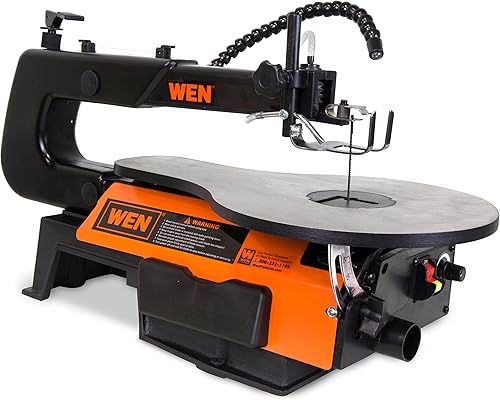
The WEN 3921 has a 16-inch throat in its standard position and cuts wood up to 2 inches thick. Its variable speed runs from 400 to 1600 strokes per minute, and the table tilts left for angled cuts.
For an interior cutout, drill a starter hole in the waste area, remove the blade, pass it through the hole and reattach it as directed in the manual. This lets the blade cut an enclosed shape without starting from the outside edge.
A scroll saw is less useful for long, straight cuts in large boards or for projects where the piece cannot be turned around the blade. If that describes most of your work, a jigsaw or another larger saw will be easier to use.
The WEN's blade can also be set in two directions, including a 90-degree position that can extend ripping capacity beyond the standard throat. That option can help with certain long cuts, but plan how you will support and guide the stock before using it.
When is a jigsaw the better choice?
A jigsaw is the better choice when the material is too large or awkward to bring to a scroll saw. Keep a panel supported and guide the tool to the line, whether the work is on a bench or already in place.
The DeWalt 20V MAX XR is cordless and has a variable speed trigger and dial. Its four orbital settings let you adjust the cut for speed or quality, while an LED and integrated dust blower help keep the line visible.
It uses T-shank blades and has a keyless shoe bevel with stops at 0, 15, 30 and 45 degrees. The battery and charger are sold separately, so include them in your setup plans if you do not already have a compatible battery.
A jigsaw is a poor fit for tiny decorative parts that need frequent, tight turns. The tool must travel around the curve, and its shoe and body can crowd small workpieces; a scroll saw keeps the blade stationary and lets the material turn.
Which saw handles small patterns and interior cutouts?
A scroll saw is usually the better tool for small patterns and interior cutouts. Its table supports the piece, and a blade can pass through a starter hole to cut an enclosed shape.
Keep the workpiece flat against the table and feed it gently. If you push too fast or twist the piece sharply, the blade can wander or break, especially in a narrow section.
The WEN 3921 has a thumb screw blade adapter for tool-free blade changes. Its air pump and flexible light help keep the cut area visible as you work.
A jigsaw can also make interior openings when you create a starting opening large enough for the blade and have room to turn the saw. On a small piece, the shoe may cover much of the area you need to see and steer.
For a compact alternative that combines stationary and handheld detail work, read the Dremel Moto-Saw review. Its detachable coping function lets you take the tool to the workpiece.
How should workpiece size guide the choice?
Choose by the largest piece you need to cut and the space required to turn it. Small, manageable pieces favor a scroll saw, while wide panels usually favor a jigsaw.
The WEN 3921's standard throat measures 16 inches from blade to frame. Its two-direction blade feature can extend ripping capacity, but long stock still needs stable support so it does not tip or pull away from the cut.
A jigsaw has no surrounding throat, so a panel can extend past a bench while you work. Support both sides of the cut and keep the panel from shifting or closing against the blade.
Also check where the curve begins and ends. A scroll saw needs room for the entire workpiece to rotate, while a jigsaw needs space for your hands and the saw to follow the curve without hitting clamps, walls or nearby objects.
If your curves are larger than a scroll saw can comfortably handle, band saws for small shops may be another option to compare. That guide helps when your work calls for a stationary saw and more room around the cut.
Which saw is easier to control?
A scroll saw supports the material while you steer it; a jigsaw requires you to guide the tool steadily. Pick the setup that lets you see the cut line, keep the work stable and avoid awkward reaches.
The scroll saw table carries the workpiece's weight. You guide the piece with both hands and turn it through the curve, keeping it flat as you feed it toward the blade.
With a jigsaw, keep the shoe flat on the work and move the tool along the line without forcing a turn too sharply. The DeWalt's speed control helps you adjust the pace, but the cut still depends on steady hand guidance and suitable blade choice.
Either saw needs a stable setup. Clamp or support the work when appropriate, keep hands clear of the blade path and follow the manual for blade installation, adjustment and operation.
If you are learning the stationary option, our beginner's guide to scroll saws covers what to consider when choosing one. The WEN 3921 is a full-size example with a work table, speed control and work light.
How do you set up each saw for a clean cut?
Start with a secure workpiece, a suitable blade and a visible cut line. A few minutes of setup can prevent a crooked cut and reduce the need to force either saw through a turn.
On a scroll saw, place the machine on a stable bench, install the blade as directed and set the hold-down foot so it steadies the work without blocking movement. Check that the blade is tensioned correctly according to the manual, then try the speed on scrap before cutting the finished piece.
On a jigsaw, support the work so the offcut cannot fall or pinch the blade. Fit a blade suited to the material, set the shoe flat and confirm that the cord or battery arrangement leaves you room to move along the whole curve.
Mark the cut clearly, but leave enough visible line to judge the blade's path. If dust hides the mark, pause to clear the area rather than turning or pushing blindly through the curve.
For either tool, plan where the blade will exit and how you will hold the workpiece as the cut finishes. A loose offcut can tear the edge or move suddenly when the final fibers separate.
What common mistakes make curved cuts harder?
Forcing the saw is the most common way to lose control of a curve. Let the blade cut at a steady pace and make gradual turns that match the blade's ability to follow the line.
On a scroll saw, pushing the workpiece too quickly can bend the blade and pull the cut away from the pattern. Turning the piece too sharply can also strain the blade, so use relief cuts or change direction in small steps when the pattern is tight.
On a jigsaw, tilting the tool or lifting its shoe can leave a rough, angled cut. Keep the shoe flat, support the panel and avoid twisting the saw body to make a turn the blade cannot follow.
A dull, damaged or unsuitable blade can cause drifting, rough edges or excess effort. Change blades when needed and match the blade to the material and cut, using the manuals for the tool and blade as a guide.
Finally, do not choose a saw based only on its maximum capacity. If the piece is difficult to support, too large to rotate or hard to reach safely, a different cutting method may suit the job better.
What should you consider before buying?
Compare cut size, workspace, blade format and mobility before choosing a model. These practical limits determine whether a saw fits your projects and shop.
- Cut size: The WEN 3921's standard throat is 16 inches and it cuts wood up to 2 inches thick. Measure the largest piece you expect to turn on its table.
- Work location: A scroll saw needs a stable bench spot. A cordless jigsaw can go to the workpiece, but the DeWalt's battery and charger are separate.
- Detail level: Small patterns and interior cutouts favor the scroll saw. Long curves in wide panels favor the jigsaw.
- Blade changes: The WEN uses a thumb screw adapter, while the DeWalt has a lever-action clamp for T-shank blades.
- Visibility: The WEN includes an air pump and flexible light. The DeWalt has an LED and dust blower.
- Portability: The Dremel Moto-Saw detaches for handheld coping work, and its fast-clamp base attaches to tables, benches and other surfaces.
The Moto-Saw suits someone who wants a compact option for detail cuts and the ability to bring the tool to the work. Its 3.8-inch blade and compact format make it different from a full-size scroll saw or a general-purpose jigsaw.
Which saw should you choose for your project?
Choose the scroll saw for small, precise patterns; choose the jigsaw for curves in large or fixed workpieces. If you want a compact tool that works both on a base and by hand, consider the Dremel Moto-Saw.
Use the largest workpiece and tightest curve in your usual projects to make the call. If you can comfortably turn the piece around a fixed blade, the scroll saw is likely the better fit; if you need to move along a large panel, choose the jigsaw.
For a bench setup focused on small patterns, compare beginner scroll saws. If your work needs bigger curves and a stationary saw, see band saws for small shops.
About this guide: This scroll saw vs jigsaw guide compares curve-cutting uses, workpiece handling and features.
Frequently asked questions
Which saw is easier for tight curves?
A scroll saw is usually easier for tight curves because the workpiece rests on its table and you guide it around the blade. That support makes small, intricate shapes easier to control.
A jigsaw can cut curves too, but you guide the saw across the workpiece by hand.
Can a jigsaw cut curves in plywood?
Yes, a jigsaw can cut curves in plywood, especially on larger panels that are hard to fit on a scroll saw. Mark the curve clearly, support the panel, and move at a pace that lets you keep the blade on the line.
Use a blade suited to the material and cut.
Can a scroll saw cut inside shapes?
A scroll saw can make interior cutouts when you can thread the blade through a starter hole in the workpiece. The WEN 3921 accepts blades in 2 directions, including a 90-degree position that can extend ripping capacity.
Follow the saw's manual for blade setup.
Is a scroll saw or jigsaw better for a beginner?
A scroll saw may feel easier for small patterns because the table supports the workpiece as you guide it. A jigsaw suits larger pieces and cuts away from a bench.
Your comfort with holding and steering a handheld saw matters, so practice on scrap before a finished piece.
Can the Dremel Moto-Saw replace a full-size scroll saw?
The Dremel Moto-Saw offers a compact stationary scroll-saw function and detaches for handheld coping cuts. Its 3.8-inch blade and portable format suit small detail tasks, while a full-size saw like the WEN 3921 has a 16-inch throat for larger workpieces.