9 Best Band Saws for a Small Shop (November 2026)
The best band saws for small shops include the WEN BA3959 9-Inch Benchtop Band Saw for hobby benches, the SKIL BW9501 9-Inch Benchtop Band Saw for speed changes, and the WEN BA3962 10-Inch Band Saw with Stand for thick stock.
On this page (5 sections)
The WEN BA3959 is the best band saw for a small shop if you mainly cut curves, small parts and stock within a 3-1/2 in depth. It stays on a bench, includes a fence and miter gauge, and avoids assigning floor space to a stand.
A 10 in saw makes more sense when you regularly work with thicker stock or want a freestanding setup. The WEN BA3962 offers up to 6 in of cutting height, while the JET 10 in model adds an extendable table for longer workpieces.
The right choice depends on the largest piece you cut often, the type of cuts you make, and where the saw will sit. If you are still weighing throat and cut height, see our band saw size guide.
New to this tool? Read how to use a band saw for beginners before planning your first cuts, and compare the compact SKIL in our SKIL BW9501 review.
Our picks at a glance
-
1

-
2

-
3

- 4
 Check it
Rikon 10-3062S 10-Inch Band Saw with Stand
Best for quick adjustments - 5
 Check it
JET 10-Inch Band Saw with Stand
Best for long workpieces - 6
 Check it
DeWalt 9-Inch Two-Speed Band Saw
Best for dim workspaces - 7
 Best for warranty coverageCheck it
- 8
 Check it
VEVOR 10-Inch Two-Speed Band Saw
Best for wide cuts - 9
 Check it
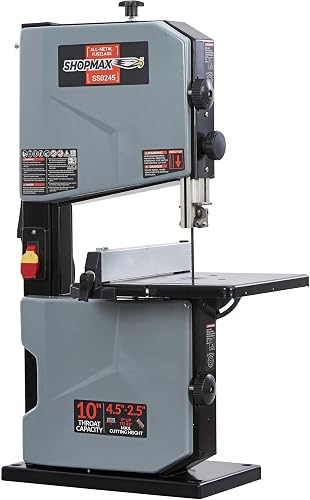
ShopMax 10-Inch Benchtop Band Saw
Best for deeper bench cuts
The best band saw for a small shop: 9 picks
The WEN BA3959 is the top choice for a compact bench, while the larger models offer more height, a stand or setup features for particular work. Compare the product cards, then use the buying advice below to narrow the choices to your stock and shop layout.
WEN BA3959 9-Inch Benchtop Band Saw: Best for hobby benches
- Cuts up to 3-1/2 in deep and 9 in wide
- Accepts 59-1/2 in blades from 1/8 to 3/8 in wide
- Table bevels up to 45 degrees
- Fence and miter gauge included
A 9 in benchtop saw with a fence, miter gauge and beveling table. Its stated depth suits many small-shop curve cuts and modest stock.
Pros
- Benchtop format
- Fence and miter gauge included
- 2-1/2 in dust port
Cons
- Cut depth is less than the 10 in models here
- Does not include a stand
The WEN BA3959 suits a small shop that needs a dedicated curve-cutting saw without giving up floor space to a stand. Its 3-1/2 in cutting depth and 9 in width cover many hobby projects and modest resaw work.
The 12-1/4 x 11-7/8 in table bevels up to 45 degrees. The included fence guides straight cuts, the miter gauge helps guide crosscuts, and the 2-1/2 in dust port provides a connection point for dust collection.
It accepts 59-1/2 in blades from 1/8 to 3/8 in wide. Choose a blade width suited to the cut, since a blade made for straight cuts won't turn as tightly as a narrower option.
Buy it when bench space is available and most stock falls within its capacity. Skip it if you routinely need more than 3-1/2 in of cutting height or want a stand in the box; the BA3962 is the better fit for those needs.
For setup and safe-use advice, read our band saw basics guide.
SKIL BW9501 9-Inch Benchtop Band Saw: Best for speed changes
- 2.8 amp induction motor
- Two-speed drive system
- Tool-free belt tensioning
- Rack-and-pinion table adjustment
SKIL combines a small benchtop format with two speeds and quick blade tension setting. A tracking sight window helps you follow the blade while cutting.
Pros
- Two-speed drive system
- Dust port accepts standard 2-1/2 in vacuum hoses
- Steel base
Cons
- Cut depth and width are not specified here
- No stand is included
The SKIL BW9501 fits a small shop that values speed changes and straightforward blade tensioning. Its two-speed drive system uses tool-free belt tensioning, and a quick tension setting helps make blade setup less involved.
A tracking sight window lets you watch the blade, while the rack-and-pinion table adjustment supports angle changes. The dust port accepts a standard 2-1/2 in vacuum hose, and the included miter gauge guides crosscuts.
Cut height and throat width aren't specified, so don't choose it for a planned resaw job until you confirm the capacity. Buy it for its two-speed arrangement and tracking features; skip it if you need a published capacity to match thicker stock.
See our SKIL BW9501 review for more on its home-shop fit.
WEN BA3962 10-Inch Band Saw with Stand: Best for thick stock
- Cuts up to 6 in deep and 9-3/4 in wide
- Two speeds: 1,520 or 2,620 FPM
- Stand and work light included
- 3-in-1 dust port
This 10 in model adds cutting height and comes with a stand, so it can free a bench for other work. Its two speeds support a wider range of cutting tasks.
Pros
- Stand included
- Two operating speeds
- Work light, fence and miter gauge included
Cons
- Larger footprint than a benchtop-only saw
- Needs room for its 58-1/2 in listed height
The WEN BA3962 is a stronger fit when a small shop needs more cut height and a freestanding saw. It cuts up to 6 in deep and 9-3/4 in wide, and its stand keeps the machine off a crowded bench.
Its two speeds are 1,520 and 2,620 FPM. The 14-1/8 x 12-1/2 in cast-aluminum table bevels up to 45 degrees, and the saw accepts 72 in blades from 1/8 to 1/2 in wide.
A work light, fence, miter gauge and 3-in-1 dust port come with the saw. The assembled setup is 58-1/2 in high, so check the intended spot and route for bringing the machine into the shop before assembly.
Choose it for thicker stock and a stand-based layout. Skip it if you mostly cut small curves and want to avoid dedicating floor area to a saw; a 9 in benchtop model should take less room.
Rikon 10-3062S 10-Inch Band Saw with Stand: Best for quick adjustments
- Cuts up to 5 in high and 9-5/8 in wide
- Two speeds: 1,515 and 3,280 FPM
- Quick-release blade tension lever
- Steel stand included
Quick-release tension and tool-less blade guides simplify setup. The coated cast-iron table, fence, miter gauge and steel stand suit a shop that wants a freestanding 10 in saw.
Pros
- Quick-release blade tension
- Two speeds
- Steel stand included
Cons
- Heavier than the benchtop picks
- Few buyer ratings are available
The Rikon 10-3062S suits a shop that wants a 10 in saw with quick blade setup. Its quick-release tension lever and tool-less upper and lower guides make blade changes and adjustments easier to manage.
It cuts up to 5 in high and 9-5/8 in wide, with speeds of 1,515 and 3,280 FPM. The SP-coated cast-iron table tilts from -5 to 45 degrees, and the included steel stand creates a floor setup.
A fence, miter gauge and 2-1/2 in dust port are included, and Rikon lists a lifetime warranty. Choose it if you expect to change blades or adjust guides often; skip it if weight and stand space are a poor match for your shop.
JET 10-Inch Band Saw with Stand: Best for long workpieces
- Cast-iron table with slide-out extension
- Cuts wood up to 4 in thick
- Quick-release blade tension
- Steel stand and LED work light included
The slide-out table extension supports longer stock, and the cast-iron table tilts for bevel cuts. JET says this saw is for wood, not metal, bone or meat.
Pros
- Extendable cast-iron table
- Fence and miter gauge included
- 5-year warranty for woodworking machinery
Cons
- Heavier than benchtop models
- A 15A circuit is recommended
The JET 10 in model suits a shop that needs extra table support for longer stock. Its retractable extension expands the cast-iron table from 13-1/8 x 13-3/8 in to 13-1/8 x 19 in.
It cuts wood up to 4 in thick and has a 9-1/2 in throat. The table tilts right up to 45 degrees and left up to 5 degrees after a stop adjustment, with a locking fence and miter gauge included.
Quick-release blade tension helps with blade changes, and the steel stand and LED work light come with the saw. JET recommends a dedicated 15A circuit, so check the electrical setup where you plan to use it.
Choose this model if table support and a stand matter more than keeping the saw on a bench. Skip it if you need to cut metal, bone or meat; this is a woodworking saw.
For a lighter bench-based option, compare the JET 9 in benchtop model only if its stated 3-1/2 in resaw capacity fits your work.
DeWalt 9-Inch Two-Speed Band Saw: Best for dim workspaces
- 3.5 amp motor
- Two speeds: 1,700 and 2,500 SPM
- Integrated LED work light
- Two dust-port adapters included
The compact saw has two speeds and an LED to light the cut path. Its dust adapters connect to common shop-vac sizes.
Pros
- Two speeds
- LED work light
- Two dust-port adapter sizes
Cons
- Cut capacity is not specified here
- Few buyer ratings are available
The DeWalt 9 in saw is a compact option for a shop that needs an integrated work light. Its two speed settings, 1,700 and 2,500 SPM, give you options for different cutting jobs.
A 3.5 amp motor powers the saw, and the LED lights the cut path. It includes 2-1/2 in and 1-1/4 in dust adapters, which help when your shop-vac hose differs in size.
The saw is intended for curves, small resawing jobs and detailed work. Its cutting capacity isn't specified, so confirm that it suits your stock before buying.
Buy it when visibility and dust-hose options matter in your layout. Skip it if the lack of a stated capacity makes it hard to match the saw to your work.
JET 9-Inch Benchtop Band Saw: Best for warranty coverage
- 3-1/2 in resaw capacity
- 9 in throat
- Table tilts up to 45 degrees
- 2-1/2 in dust port
This 40 lb benchtop saw has a defined resaw capacity and a tilting table. JET backs its woodworking machinery with a 5-year warranty.
Pros
- Benchtop format
- Fence and miter gauge included
- 5-year warranty
Cons
- Mounting hardware is not included
- Cut width is not specified here
The JET 9 in benchtop saw is a compact pick with a stated 3-1/2 in resaw capacity. Its 9 in throat and table tilt up to 45 degrees suit curves, resawing and general wood-shop cuts within that capacity.
It measures 19 x 14-1/8 x 29 in and weighs 40 lb. A 2-1/2 in dust port connects to a shop vacuum or collector, and the saw includes a fence and miter gauge.
JET backs its woodworking machinery with a 5-year warranty. Mounting bolts, washers and nuts aren't included, so plan to supply suitable hardware if you want to secure it to a bench or stand.
Choose it if you want a defined resaw capacity in a bench-sized saw. Skip it if your bench is already crowded or you want mounting hardware included.
VEVOR 10-Inch Two-Speed Band Saw: Best for wide cuts
- Two speeds
- Cuts up to 6 in high and 10 in wide
- Cast-iron table tilts 5 degrees left and 45 degrees right
- Work light, fence and miter gauge included
The 10 in saw pairs a cast-iron table with two speeds and a work light. Its stated cut capacity is the largest in this group.
Pros
- Cut capacity up to 6 x 10 in
- Table tilts left and right
- Fence and miter gauge included
Cons
- At 63.7 lb, it needs a sturdy bench or stand
- Dust port size is not specified here
The VEVOR 10 in saw offers the broadest stated cutting capacity in this group, up to 6 in high and 10 in wide. Its cast-iron table tilts 5 degrees left and 45 degrees right for angled cuts.
The saw has two speeds and uses a 72 in blade. A 360-degree LED work light, fence and miter gauge are included for visibility and guided cuts.
At 63.7 lb, it needs a sturdy bench or stand. Its dust port size isn't specified, so confirm compatibility with your dust setup before choosing a tight location.
Choose it when the stated capacity matters more than a compact 9 in frame. Skip it if you don't have sturdy support or need a known dust-port size before planning a connection.
ShopMax 10-Inch Benchtop Band Saw: Best for deeper bench cuts
- 4.2 amp induction motor
- Cuts up to 4.5 in deep and 10 in wide
- Table tilts up to 45 degrees
- 67.4 in blade
ShopMax offers a 10 in format with a 4.5 in stated cut depth and a tilting table. The 54.7 lb saw comes with a stand.
Pros
- 4.2 amp induction motor
- Stand included
- Ball-bearing blade support
Cons
- Dust extractor sold separately
- No miter gauge is listed among the included components
The ShopMax 10 in saw combines a benchtop format with a stated 4.5 in cut depth and 10 in width. Its 4.2 amp induction motor and tilting table suit a shop that wants a larger frame for deeper work.
The 67.4 in blade accepts widths from 0.14 to 0.47 in. Ball bearings support the blade, and the table tilts up to 45 degrees.
A stand is included, and the saw measures 17.13 x 19.92 x 32.83 in. The dust extractor is sold separately, and the included components don't specify a miter gauge.
Consider it if the cut width and blade range suit your projects. Skip it if you need a miter gauge in the box or want dust collection included.
How do you choose the best band saw for a small shop?
Start with the thickest stock and widest workpiece you cut regularly, then compare capacity and footprint. After that, look at blade range, table support, setup controls and dust connection so the saw fits both your work and your room.
What cutting capacity do small-shop projects need?
Choose cut height based on the thickest stock you expect to cut, and throat width based on how far a workpiece must extend from the blade. A 9 in saw can cover many curves and smaller jobs, while the 10 in picks here offer stated cut heights from 4 to 6 in.
Don't buy extra capacity just because a larger number sounds useful. If your usual pieces fit a 9 in saw, the added stand and floor footprint may not earn their place; if you plan to resaw thicker boards, a higher capacity can prevent the saw from ruling out those jobs.
Is a benchtop or stand-mounted saw right for your layout?
A benchtop saw keeps floor space open, but it uses a work surface and needs a stable mounting location. A stand-mounted saw frees that surface while claiming a dedicated floor area.
Measure the full setup, including height, table extension and room to move stock past the blade. Also check that the dust hose and controls remain reachable once the saw is in position.
Which blade and speed features matter?
Blade width affects how tightly a saw can follow a curve, so match the blade to the cut and confirm the saw accepts that width. Blade length is model-specific, which matters when you buy replacement blades.
Two-speed models offer another way to match the saw to a job. Quick tension controls, tool-less guides and tracking windows can reduce setup friction, but they don't replace correct blade choice and adjustment.
What accessories should come with the saw?
A fence helps guide straight cuts, and a miter gauge guides crosscuts. A work light can make the cut path easier to see, while a stand matters if you don't have a suitable bench.
Check each saw's included equipment before buying. Some models have a dust port but don't include a hose or extractor, and some require separate mounting hardware.
How should you plan dust collection?
Check the port diameter and whether adapters come with the saw. The WEN BA3959 has a 2-1/2 in port, while the DeWalt includes adapters for 2-1/2 in and 1-1/4 in connections.
Leave room for the hose to connect without blocking the table or controls. For broader shop planning, see our small-shop dust collector sizing guide.
How should you set up and care for a small band saw?
Set up the saw on a stable surface, follow its manual for blade installation and tracking, and keep the blade guard close to the work. Good setup starts with room to move the stock and reach the controls without stretching across the blade.
Before cutting, make sure the blade is appropriate for the work and correctly tensioned. Check tracking and guide position as the manual directs, then use scrap material to confirm the cut direction and feel before committing to a finished piece.
Keep the table clear of offcuts and dust, and disconnect power before changing a blade or making adjustments. Remove built-up debris around the blade path and dust port, and inspect the blade for damage or dullness when cuts become harder to control.
Use the fence for straight rips and the miter gauge for supported crosscuts. For curves, make relief cuts where useful and feed steadily; forcing a tight turn can bind the blade or pull the work off line.
What mistakes should you avoid with a small band saw?
The most common buying mistake is choosing by frame size alone. A 10 in saw may offer more height, but it can also take more room and require a stand, while a compact saw may be the better match for frequent curve work.
Another mistake is assuming a model has enough capacity when the figures aren't specified. The SKIL and DeWalt picks lack stated cut height and width here, so confirm those details before planning a resaw job.
Don't force stock through the blade or twist it sharply around a curve. Let the blade cut at a controlled pace, and choose a blade width that can follow the intended turn.
Finally, don't place the saw where the table, blade guard, dust port or long stock will be obstructed. A little layout planning makes routine cuts easier and keeps the machine usable after it is installed.
Which band saw should you choose for your small shop?
Choose the WEN BA3959 for a compact bench setup and everyday curve work within its 3-1/2 in capacity. Pick the WEN BA3962 when you need up to 6 in of cut height and want a stand included, or the JET 10 in model when a cast-iron table extension will support longer stock.
For blade setup features, consider the Rikon 10-3062S; for a compact saw with a defined resaw capacity and warranty coverage, consider the JET 9 in. The SKIL and DeWalt suit buyers drawn to speed or lighting features, but verify capacity before choosing either for thicker work.
The best band saw for a small shop is the one that clears your regular stock, fits its assigned bench or floor space, and has the setup features you'll use. If you are new to the tool, revisit our beginner band saw guide before making your first cut.
Our top 3 picks at a glance
-
1
-
2
-
3
Frequently asked questions
What size band saw works for a small shop?
A 9 in benchtop saw can suit a small shop when most jobs involve curves, small parts and stock within its cut capacity. Choose a 10 in model if you need more height or throat space, and measure the footprint before you commit to a stand.
The right size depends on the largest piece you plan to cut, not only available floor space.
Is a benchtop band saw enough for woodworking?
A benchtop band saw can handle many hobby cuts, including curves and smaller workpieces. Capacity varies by model, so compare the stated cut height and width with your usual stock.
For deeper cuts or a permanent setup, a 10 in saw with a stand may fit better.
What should I check before choosing a band saw?
Check cut height, throat width, blade length and width, table size, dust connection and how the saw will sit in your shop. A larger capacity can help with thicker stock but may take more room.
Also check what accessories come with the saw, since a fence, miter gauge or stand can affect setup.
Can a small band saw cut curves?
Yes. A band saw is useful for curved cuts, and a narrower blade can make tighter turns when the saw accepts that blade size.
Feed the work slowly and let the blade follow the curve.
For beginner setup and safe handling, see our band saw basics guide.
Do small band saws need dust collection?
Dust collection helps manage chips and dust around the saw. Several picks here have a dust port, but port sizes and included adapters differ, so check compatibility with your shop vacuum or collector.
Leave access to the port when planning the saw's position.


