Types of Bench Grinders Explained
The main types of bench grinders are 6-inch and 8-inch wheel models in fixed or variable speed. An 8-inch grinder with a 3/4 HP motor removes metal fast for heavy work, while a 6-inch variable speed unit gives you more control for sharpening.
On this page (7 sections)
- What are the main types of bench grinders?
- How do 8-inch bench grinders differ from 6-inch models?
- What is the difference between fixed and variable speed grinders?
- What is a buffer or polisher type of bench grinder?
- Which wheel grits and wheel types should you choose?
- How should you set up and use a bench grinder safely?
- Which type of bench grinder should you buy for a home shop?
The types of bench grinders come down to wheel size and speed control. An 8-inch grinder with a 3/4 HP motor removes metal fast, while a 6-inch variable speed model gives you more control for sharpening and lighter work.
Wheel size decides how much steel you can take off and how long a stone lasts. Speed control decides how much heat reaches the tool edge.
Get those two choices right and the rest, like wheel grit and tool rests, is easy to sort.
This guide breaks down the types by size and speed, then covers the buffer and polisher type, the wheel choices and the safety setup. It ends with a clear pick for the home shop.
For the wider picture of what these machines do, read what a bench grinder is used for.
What are the main types of bench grinders?
There are two wheel sizes and two speed types, and most grinders combine one of each: a 6-inch or 8-inch model, running at fixed or variable speed. That gives four common combinations to choose from.
Wheel size is measured across the stone. A 6-inch wheel spins faster in revolutions per minute than an 8-inch wheel at the same motor speed, but the 8-inch wheel has a larger circumference.
The larger stone moves more abrasive past the edge on each turn.
Speed type is about control. A fixed-speed grinder runs at one rpm from startup to shutdown.
A variable speed grinder lets you dial the rpm down for delicate work and up for fast removal.
A third family sits alongside these: the buffer and polisher. It uses cloth or fiber wheels rather than grinding stones and is built for finishing rather than shaping.
A jewelry polisher is the small-shop version of that type.
The right type depends on what you grind most. Heavy lawn mower blades and chisels point to an 8-inch fixed-speed machine.
Knives, drill bits and lathe tools reward slower, controlled passes.
Start with wheel size, then decide whether speed control earns its place for the work you do most.
How do 8-inch bench grinders differ from 6-inch models?
An 8-inch grinder is the heavy-removal type, built around a larger wheel and, usually, a stronger motor. A 6-inch grinder is the lighter, more compact type for a small shop and finer edges.
The DeWalt DW758 shows the 8-inch pattern. It has a 3/4 HP induction motor running at 3,600 rpm, a cast iron base and motor housing, and 12-1/2 inches between the wheels.
That gap lets you grind longer work without the motor housing getting in the way.
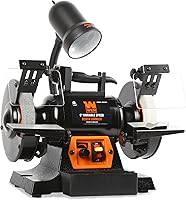
A 6-inch grinder like the WEN BG625V runs a 2.5-amp motor and two 6-inch wheels. The smaller wheels take up less bench space and are cheaper to replace.
The trade-off is less abrasive per turn and a shorter wheel life under heavy use.
Wheel wear matters here. An 8-inch stone starts with more material to wear away, so it lasts longer between replacements.
That suits a shop that grinds often and hard.
The larger wheel also changes the feel at the edge. Its surface speed is higher for a given rpm, so it cuts faster and heats the work faster too.
That is why 8-inch grinders reward a light touch.
Pick 8-inch for regular heavy grinding; pick 6-inch for light sharpening and a tight bench.
What fits a small shop better?
A 6-inch grinder usually fits a small shop better because it takes less bench space and its wheels cost less to replace. The WEN BG625V is a compact example built around that idea.
Its two wheels are 6 inches by 3/4 inch with 1/2-inch arbors. One is 80-grit for general work and the other is 36-grit for faster material removal.
That pairing covers shaping and finishing without a wheel change.
The smaller cabinet leaves more room beside it for a vise or a sharpening station. A bench grinder earns its place when it can sit next to the work rather than across the shop.
The WEN also includes a flexible work light, which helps when the bench sits under a shadow. Its wheel guards come off simply for wheel changes.
Choose 6-inch when bench space is short and your grinding is mostly edges and small parts. Step up to 8-inch only when you need the extra removal rate.
What is the difference between fixed and variable speed grinders?
A fixed-speed grinder runs at one rpm the whole time, while a variable speed grinder lets you set the rpm to suit the job. Fixed speed is simpler and fine for general deburring; variable speed gives you control over heat.
The DeWalt DW758 is the fixed-speed type. Its motor runs at 3,600 rpm for high-speed material removal.
That speed suits rough grinding, deburring and reshaping a worn edge quickly.
The WEN BG625V is the variable-speed type. Its 2.5-amp motor goes anywhere from 2,000 to 3,400 rpm.
You can slow it for a knife edge and speed it up for faster stock removal.
Heat is the reason speed control matters. A fast wheel grinds quickly but can overheat a thin edge and draw the temper from the steel.
Slowing the wheel gives you more time to watch the edge and cool it.
Variable speed also helps with different wheels. A coarse wheel at high speed removes material fast, while a fine wheel at lower speed gives a cleaner finish with less burn.
Pick fixed speed for rough grinding and deburring; pick variable speed for sharpening and mixed work.
When does variable speed earn its place?
Variable speed earns its place when you sharpen heat-sensitive tools or work with more than one wheel type. It also helps when you want one grinder to do both heavy and light jobs.
The WEN BG625V covers that mix. Its speed range of 2,000 to 3,400 rpm lets you slow down for a delicate edge or speed up for general grinding.
The flexible work light and pivoting tool rests support the same flexibility.
A fixed-speed grinder cannot do that. It always runs at its rated rpm, so your only control over heat is pressure and time at the wheel.
That is workable for a chisel or a lawn mower blade but harder on a thin knife.
If you sharpen lathe tools or knives often, the slower end of the range is the useful part. Our guide to the best bench grinders for sharpening lathe tools covers that use in more detail.
Choose variable speed when sharpening is the main job; fixed speed is enough for a grinding-only bench.
What is a buffer or polisher type of bench grinder?
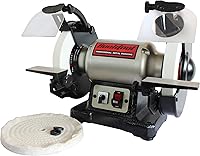
A buffer or polisher is a bench grinder built for cloth wheels and compounds rather than grinding stones. It spins softer wheels at controlled speeds to shine metal instead of removing it.
The OPAVIOC Jewelry Polisher is a small example of this type. It has a 320W motor with speeds from 1,750 to 8,500 rpm.
It ships with six 4-inch cotton wheels, two fiber wheels and a polishing compound.
The type matters because cloth wheels behave differently from stones. A cotton wheel loaded with compound polishes and shines, while a fiber wheel takes off rust and light oxidation.
Neither is meant to shape hard steel.
Speed control is central here. Low speeds keep compound on the wheel and polish gently; high speeds give a brighter final finish.
The same machine can be a dental lathe for small precision parts.
A buffer is a finishing tool. It comes after grinding and sharpening, when the edge is set and you want a clean surface or a bright shine.
Add a buffer as a second machine for finishing; keep the grinder for shaping and edges.
Who needs a buffer in a small shop?
A buffer suits a shop that finishes metal after grinding, such as jewelry, small tools, hardware or model parts. It is less useful as a first machine for someone who only needs to sharpen.
The OPAVIOC is compact and light, so it can sit on a shelf and come out for a polishing session. Its cotton wheels handle jewelry and small metal parts, and its fiber wheels remove rust.
A woodworker who restores old chisels and plane irons might use one to clean and shine after sharpening. A metalworker might use it to finish a bracket or a small part before assembly.
The type is not a substitute for a grinder. It cannot hog off material or reset a badly damaged edge.
Think of it as the last step in a sharpening or finishing routine.
Buy a buffer when finishing is part of your work; skip it if you only need to grind and sharpen.
Which wheel grits and wheel types should you choose?
Wheel choice sets how fast the stone cuts and how clean the edge ends up. A coarse wheel removes material quickly, while a finer wheel refines the edge or surface.
The DeWalt DW758 includes a 36-grit wheel and a 60-grit wheel. The WEN BG625V includes an 80-grit wheel and a 36-grit wheel.
Both pair a coarser wheel with a finer one so you can shape on one side and finish on the other.
Grit is the number of abrasive particles per inch. A lower number is coarser and cuts faster.
A higher number is finer and leaves a smoother surface, but it removes metal more slowly.
For a general shop, a 36-grit wheel on one side and a 60 or 80-grit wheel on the other covers most work. You shape and repair on the coarse side, then refine the edge on the finer side.
Wheel type also matters. Aluminum oxide wheels suit steel and general metal.
Silicon carbide suits harder materials and carbide tooling. Match the wheel to the metal you grind most.
Pair one coarse wheel with one finer wheel, then choose the abrasive type to match your metal.
How do tool rests change the type you pick?
Tool rests change how accurately and safely you can hold work against the wheel. Precision-machined rests let you set a steady angle, which matters for sharpening more than for rough grinding.
The DeWalt DW758 has precision-machined aluminum tool rests. They let you position work accurately against the wheel.
That helps when you want a consistent bevel on a chisel or a plane iron.
The WEN BG625V has pivoting tool rests that adjust for angled grinding. That is useful when you want to hold a tool at a set angle rather than flat to the wheel.
A buffer like the OPAVIOC is different. It is meant for freehand polishing with cloth wheels, so a precision rest is less central to its job.
If you plan to sharpen drill bits or chisels, the rest is as important as the wheel. Our guide to sharpening drill bits on a bench grinder shows how the rest supports a steady angle.
Check the tool rest before you buy, because a steady rest is what turns a grinder into a sharpening tool.
How should you set up and use a bench grinder safely?
Set up the grinder firmly on the bench with the guards and eye shields in place, then stand to one side when you start it. A bench grinder throws sparks and metal dust, so the setup protects you as much as it improves the work.
Mount the grinder so the wheels sit at a comfortable height for your hands. A cast iron base like the one on the DeWalt DW758 gives a stable footing.
The WEN BG625V includes adjustable eye guards and a flexible work light.
Keep the tool rests close to the wheels, with a small gap. A large gap can pull a thin tool down between the rest and the stone.
Adjust the rests so the work sits flat and steady.
Wear safety glasses and keep loose clothing away from the wheels. The eye shields on both machines add a barrier, but they do not replace glasses.
Stand to the side when you switch on, in case a wheel has a fault.
Dress the wheels when they load up or wear unevenly. A clean, true wheel cuts cooler and leaves a better edge.
Replace a wheel that is cracked or chipped rather than using it.
Set up the guards and rests first, then check them before every session.
Which type of bench grinder should you buy for a home shop?
For most home shops, an 8-inch fixed-speed grinder is the best all-round type because it removes metal fast and its larger wheels last longer. The DeWalt DW758 fits that role with its 3/4 HP motor and cast iron build.
It is the top pick here for general grinding, deburring and reshaping worn edges. The 8-inch wheels and 3/4 HP motor give it the removal rate for lawn mower blades, chisels and heavy shop work.
Its 12-1/2 inches between wheels handle longer pieces.
The WEN BG625V is the better type when sharpening and control matter more than raw removal. Its variable speed from 2,000 to 3,400 rpm suits knives, drill bits and mixed work.
Its 6-inch wheels fit a small bench.
The OPAVIOC Jewelry Polisher is the pick when finishing is part of the job. It brings cloth wheels, fiber wheels and a compound for polishing after the edge is set.
For sharpening tools specifically, our roundup of the best bench grinders for sharpening compares the options in more depth. Start with the type that matches your main job, then add a second machine only when a real need appears.
Pick the 8-inch DeWalt for heavy grinding, the 6-inch WEN for controlled sharpening, and the OPAVIOC for polishing.
Frequently asked questions
Is a 6-inch or 8-inch bench grinder better?
An 8-inch grinder is better for heavy material removal because its larger wheel runs at a higher surface speed and lasts longer. A 6-inch grinder suits a small shop and finer sharpening, where its smaller wheel and lower cost fit the space.
What does variable speed do on a bench grinder?
Variable speed lets you slow the wheel for heat-sensitive work like sharpening a knife edge and speed it up for fast metal removal. A fixed-speed grinder runs at one speed only, which is fine for general deburring.
Do I need two wheels on a bench grinder?
Two wheels let you keep a coarse stone for shaping and a finer one for finishing without changing wheels. A 36-grit wheel removes material fast, while an 80-grit wheel leaves a cleaner edge.
Can a bench grinder be used as a buffer?
A grinder can run buffing wheels if the spindle and speed suit them, but a dedicated buffer or polisher comes set up for cloth wheels and compounds. Polishing also needs lower speeds than most grinding work.