What Does a Thickness Planer Do in a Home Shop?
A thickness planer makes a board evenly thick from face to face by shaving wood from its upper surface as you feed it through. It helps size rough or uneven stock, but it doesn't flatten a twisted board by itself.
On this page (7 sections)
A thickness planer makes a board evenly thick from face to face by shaving wood from its upper surface as you feed it through. It helps size rough or uneven stock, but it doesn't flatten a twisted board by itself.
That makes it useful when you want boards of consistent thickness for a tabletop, cabinet parts, shelves, or trim. You can also use one to turn rough lumber into stock that's easier to join and assemble.
What is a thickness planer used for?
A thickness planer is used to reduce board thickness and make the top face parallel to the bottom face. The bottom face rides on the machine bed while a rotating cutter removes wood from above.
A planer is most useful after one face has been made flat. It follows that reference face to cut the other side to a more even thickness.
This process is called thicknessing. For example, if a board varies in thickness from one end to the other, you can take shallow passes until the faces are parallel and the board is closer to your target thickness.
A planer can also help you make a batch of boards more consistent. Set a target depth, then feed each board through in the same direction and check the results as you go.
How does a thickness planer work?
A thickness planer uses feed rollers to move a board under a rotating cutterhead. The cutter removes a thin layer from the upper face while the board travels along the bed.
The bed supports the board, and the cutterhead height controls how much wood the machine removes. A depth adjustment sets the gap between the bed and cutterhead, but it doesn't mean you should take the full adjustment in one pass.
Take light cuts, especially when the board is wide, hard, or rough. A shallow pass puts less strain on the machine and can help avoid tear-out, ridges, and an uneven finish.
Many benchtop planers have two or more knives in the cutterhead. Some use more knives or different cutter styles, so check the knife arrangement and replacement process before choosing a machine.
Dust collection matters because planing produces a large volume of chips. Connect a suitable collector or shop vacuum to the machine's dust port when its design allows it, and keep the surrounding area clear.
Does a thickness planer flatten twisted or bowed boards?
A thickness planer doesn't reliably flatten a twisted or bowed board on its own. Its rollers can press a board against the bed as it passes through, which may leave the cut face parallel to the board's uneven underside.
If the board springs back after the cut, the twist or bow can remain. A thickness planer needs a stable, flat reference surface to make the opposite face parallel.
A jointer can flatten one face before the board goes through a planer. If you don't have a jointer, a planer sled for flattening boards can support a warped board so it rides steadily through the cutter.
For a clearer tool comparison, read whether you need a jointer if you have a planer. The two machines handle related jobs, but the planer doesn't replace the jointer's face-flattening role.
What kinds of boards can you plane?
A thickness planer can size solid wood boards that fit within its capacity. Rough lumber is a common use, since planing can make a board smoother and bring it closer to a chosen thickness.
Check the machine's width and maximum thickness limits before feeding a board. The DeWalt DW735 has a 13 in cutting width, while the Craftsman CMEW320 is 12.25 in wide and the WEN PL1252 is 12.5 in wide.
Some planers can also handle glued-up panels, but follow the machine's instructions and make sure the panel is stable and sized for the cutter. Avoid feeding loose, split, dirty, or painted material through a planer.
The condition of the wood affects the finish. Knots, changing grain direction, and rough surfaces can increase tear-out, so inspect boards and take shallow passes where the grain is difficult.
How do you use a thickness planer safely?
Use a thickness planer with the board supported, hands clear of the cutter, and the machine set up according to its manual. Wear eye and hearing protection, and use dust collection where practical.
Before starting, check the board for nails, screws, staples, stones, and loose sections. Remove anything that could damage the knives or become a projectile.
Support long stock at the infeed and outfeed so it stays level as it enters and leaves the machine. Keep your hands away from the opening and let the feed rollers pull the board through.
Don't force a board that stalls or feeds unevenly. Turn off and unplug the planer before clearing a jam or making adjustments inside the machine.
What should you consider before getting a planer?
Choose a planer based on the width and thickness of your typical stock, available support space, and chip collection. A benchtop machine still needs room for long boards to enter and exit without tipping.
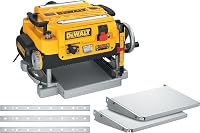
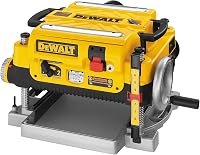
Look at cutter width, feed options, knife changes, depth adjustment, and the dust port. The DeWalt DW735 has a three-knife cutterhead, two feed-speed settings, and a fan-assisted chip ejection system.
The Craftsman CMEW320 has a two-knife cutterhead and vacuum port. The WEN PL1252 includes two reversible blades and allows up to 1/8 in of removal per pass.
For a broader look at options, see our guide to the best benchtop planers. If cutterhead style is your main concern, compare helical and spiral cutterhead planers.
When is a thickness planer the right tool?
A thickness planer is the right tool when you need boards with a more consistent thickness and parallel faces. It is especially handy when you work with rough lumber or want multiple pieces to match.
Pick a planer when the face resting on the bed is already flat, or when you have a sled that can support a warped board. If you need to flatten one face directly or square an edge, a jointer serves that part of the process.
Start by matching the planer’s cutting width to the boards you use most often, then consider cutter style and dust collection. For more shop layout and machine choices, browse our planing and jointing guides.
Frequently asked questions
What is a thickness planer used for?
A thickness planer reduces board thickness and makes the two faces parallel when one face is already flat. It can bring rough lumber closer to a chosen thickness.
It can also make several boards more consistent.
It doesn't reliably remove a twist or cup unless the board has a flat reference face or is supported on a suitable sled.
Can a thickness planer flatten a board?
A planer can make one face parallel to the face riding on its bed, but rollers can press a bowed or twisted board flat during the cut. The board may spring back afterward.
Flatten one face with a jointer or a stable planer sled first, then plane the opposite face.
Do I need a jointer if I have a thickness planer?
A jointer is useful for flattening one face and squaring an edge; a thickness planer then makes the opposite face parallel and reduces thickness. You can skip a jointer for some work if you have another reliable way to create a flat reference face, such as a well-supported planer sled.
What should you check before buying a thickness planer?
Check the maximum board width and thickness, cutter type, feed options, dust collection connection, and the space needed for long infeed and outfeed support. Also consider whether the machine's knives are reversible or replaceable and how you'll handle chips.
Match those details to the stock you expect to plane.