9 Best Benchtop Band Saws for Woodworking (November 2026)
The best benchtop band saws for woodworking include the Woodskil 9-Inch Band Saw for most small shops, the Woodskil 10-Inch Benchtop Bandsaw with Stand for cutting tall stock, and the WEN BA3959 9-Inch Benchtop Band Saw for straightforward blade changes.
On this page (4 sections)
The best benchtop band saw for woodworking is the Woodskil 9-Inch Band Saw, a compact saw with a 3-amp motor and a 9-inch throat that covers curves, light resawing and angled cuts on a bench. Pick the Woodskil 10-Inch with Stand when you need to cut 4x4 stock, or the WEN BA3959 for a simple 9-inch saw with clear blade sizing.
A benchtop band saw earns its bench space when you cut shapes a table saw can't follow. Curved furniture parts, toy wheels, decorative brackets and thin resawn boards all start with a narrow blade and a steady table.
The catch is that "benchtop" covers a wide range: some saws are 40 lb and sit on a shelf, while others come with a stand and stand 74 inches tall.
That spread matters because the saw's throat width and cutting height set what you can actually make. A 9-inch throat cuts a curve through a 9-inch-wide board.
A 3-1/2-inch cutting height limits you to stock that thick. Know your largest project before you compare motors or speeds.
If you're still deciding between a bench model and a floor saw, our guide on what size band saw you need sorts the sizes by project type. For more compact options, the roundup of the best band saws for a small shop covers the same category from a space-first angle.
Our picks at a glance
-
1

-
2
 Best for cutting tall stock
Woodskil 10-Inch Benchtop Bandsaw with Stand
9.1/10 our score
See it on Amazon -
3
 Best for straightforward blade changes
WEN BA3959 9-Inch Benchtop Band Saw
9.0/10 our score
See it on Amazon
- 4
 Check it
SEESII Benchtop Band Saw for Woodworking
Best for tight bench space - 5
 Check it
SKIL BW9501 9-Inch Benchtop Band Saw
Best for quick speed changes - 6
 Best for resawing thick slabsCheck it
- 7
 Check it
WEN BA3962 10-Inch Band Saw with Stand
Best for two-speed cutting - 8
 Best for cutting on a budgetCheck it
- 9
 Best for a full-size shop floorCheck it
The best benchtop band saws for woodworking projects
The Woodskil 9-Inch is the strongest all-round bench saw here, while the other picks answer a specific need: more height, a stand, a smaller footprint or a bigger resaw cut. Match the saw to your largest board first, then weigh the extras.
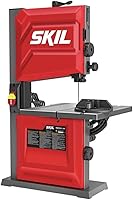
Woodskil 9-Inch Band Saw: Best for most small shops
- 3-amp motor, 2500 FPM blade speed
- 9-inch cutting width, 3-1/2-inch depth
- 0-45° cast aluminum table with 120° miter gauge
- 2-1/2-inch dust port and dust brush
A compact 9-inch saw with enough depth for curves, light resawing and angled cuts. The steel base and cast aluminum table keep it steady on a bench.
Pros
- 120° miter gauge for angled cuts
- Rip fence for straight cuts
- Dust brush on the wheel
Cons
- 3-1/2-inch depth limits thick stock
- Battery powered
The Woodskil 9-Inch suits a garage or spare-room shop where the saw shares a bench with other tools. Its 3-amp motor spins the blade at 2500 FPM, enough for steady cuts through hardwood and softwood without stalling in curves.
The table is 12-5/16 by 11-7/8 inches of cast aluminum and tilts from 0 to 45 degrees. A 120° miter gauge covers angled cuts, and the rip fence keeps straight cuts true.
That combination handles more than curves: you can cut joinery cheeks and trim small parts.
Blade size runs from 1/8 to 3/8 inch wide on a 59-1/2-inch loop. The 1/8-inch blade turns tight scroll work, while 3/8 inch tracks straighter for resawing thin boards.
A 2-1/2-inch dust port and a wheel brush cut down on sawdust. The steel base adds weight to keep vibration low.
The 3-1/2-inch cutting depth is the limit here; thicker stock needs one of the 10-inch saws below. See how to set it up in our beginner's guide to using a band saw.
Woodskil 10-Inch Benchtop Bandsaw with Stand: Best for cutting tall stock
- 3.4-amp motor, dual speed 2360 and 3000 FPM
- 5-1/8-inch cutting height, 10-inch throat
- Six ball bearing blade guides
- Quick tension system and tool-free doors
More height and a second speed for hardwood and softwood. The stand, quick tension handle and tool-free doors make blade changes and cleaning easier.
Pros
- 5-1/8-inch height handles 4x4 lumber
- Six ball bearing guides reduce drift
- Metal stand included
Cons
- Takes more floor space than a bench-only saw
- Only 10 inches of throat width
The Woodskil 10-Inch with Stand is the pick when your projects include thicker stock. Its 5-1/8-inch cutting height clears 4x4 lumber, and the 10-inch throat slices wide panels for tabletops and cabinet parts.
The 3.4-amp motor runs two speeds: 2360 FPM for hardwood like oak and maple, and 3000 FPM for softwood and plywood. That second speed matters when you cut pine shelves or plywood jigs and want to move faster without burning the edge.
Six ball bearing guides support the blade from every angle. The tension handle releases with a single lift, and the side knobs open the saw door without tools, so blade changes and dust cleanup take minutes.
The 0-45° table, rip fence and miter gauge handle bevels for picture frames. A 1-7/8-inch dust port connects to a shop vac.
The included metal stand takes floor space, so this saw suits a shop with room rather than a packed bench. Woodskil backs it with a 2-year warranty.
WEN BA3959 9-Inch Benchtop Band Saw: Best for straightforward blade changes
- 2.8-amp motor, 2500 FPM
- 9-inch width, 3-1/2-inch depth
- 59-1/2-inch blades from 1/8 to 3/8 inch
- 2-year warranty
A 9-inch saw with a clear blade range and a table that bevels to 45 degrees. Ball-bearing blade guides and a standard dust port keep it easy to live with.
Pros
- Adjustable blade guard with ball-bearing supports
- Rip fence and miter gauge included
- 2-1/2-inch dust port
Cons
- Single speed
- Smaller motor than the Woodskil 9-Inch
The WEN BA3959 is the 9-inch saw for buyers who want a known, simple blade setup. Its 2.8-amp motor turns a 59-1/2-inch blade at up to 2500 FPM, and the blade width range runs from 1/8 to 3/8 inch, the same as the Woodskil 9-Inch.
Cuts reach 3-1/2 inches deep and 9 inches wide. The 12-1/4 x 11-7/8-inch table bevels to 45 degrees for angled work.
A 1/4-inch blade comes in the box, which is a good starting width for curves and general cutting.
WEN includes a rip fence, a miter gauge and an adjustable blade guard with ball-bearing supports. The 2-1/2-inch dust port fits a shop vac, and the saw carries a 2-year warranty.
Against the Woodskil 9-Inch, this saw gives up some motor headroom and the 120° miter sweep. In return it's a well-known 9-inch model with parts support.
Read the full WEN BA3959 review for the blade and fence details.
SEESII Benchtop Band Saw for Woodworking: Best for tight bench space
- 3-amp motor, 350 watts, 900 RPM blade speed
- 8-inch cutting width, 3-1/8-inch height
- 0-45° tilting table with miter gauge
- Dual power buttons and dust port
The smallest throat here, aimed at garage benches that have no room to spare. A steel table and double-sided fence cover small curves and straight cuts.
Pros
- Dual power buttons for safer starts
- Steel table with etched measurement grid
- Includes miter gauge and double-sided fence
Cons
- 8-inch throat is the narrowest in this group
- 3-1/8-inch height limits thicker boards
The SEESII is the saw for a bench that's already full. Its 8-inch throat is the narrowest here, so it fits into tighter spots, but boards wider than 8 inches won't pass through the blade line.
Cutting height reaches 3-1/8 inches, which covers most trim, hobby stock and thin boards. A 3-amp, 350-watt motor runs the 55-inch blade at 900 RPM.
The 12 x 12-inch steel table has laser-etched measurement marks and a non-slip surface.
The table tilts from 0 to 45 degrees with rack-and-pinion adjustment. A precision miter gauge locks at common angles, and the double-sided fence guides straight cuts.
Two power buttons make accidental starts less likely in a home shop.
A dust port takes a shop vac hose for MDF and pressure-treated dust. The accessory bundle includes the miter gauge, fence and a carbon brush.
This is the smallest-capacity saw in the group, so choose it for space over reach.
SKIL BW9501 9-Inch Benchtop Band Saw: Best for quick speed changes
- 2.8-amp induction motor
- 2-speed drive with tool-free belt tensioning
- Quick blade tension setting
- Blade-tracking sight window
A 9-inch saw with two speeds and a window for checking blade tracking. The rack and pinion table adjustment speeds up angle changes.
Pros
- Tool-free belt tensioning
- 3-year limited warranty
- Miter gauge for crosscuts
Cons
- No cutting depth given
- 9-inch blade length in the specs
The SKIL BW9501 brings a two-speed drive and a blade-tracking window to the 9-inch class. The 2.8-amp induction motor runs quietly, and the tool-free belt tensioning lets you switch speeds without reaching for a wrench.
The blade-tracking sight window is the practical detail here. You can watch the blade sit on the wheels and correct drift before it ruins a cut.
Precision ball bearing and lower blade guides keep tracking consistent.
A rack and pinion table adjustment makes angle changes quick. The table bevels for bevel cuts and the miter gauge guides crosscuts.
A 2-1/2-inch dust port accepts standard vacuum hoses. SKIL backs the saw with a 3-year limited warranty, the longest of the 9-inch models here.
The trade-off is thin information: the blade length and cutting depth aren't stated in the specs, so check those before you order blades. If tracking and speed changes matter more than a stated depth, this saw earns its place.
JET 14" Woodworking Band Saw: Best for resawing thick slabs
- 1.75 HP motor, 116-inch blade loop
- 13-inch resaw capacity, 13-1/2-inch throat
- Ground cast-iron table tilts 0-45° right
- 5-year warranty
A floor-standing 14-inch saw with the power and height to resaw thick stock. The cast-iron table and wide blade range handle both scroll work and veneer cuts.
Pros
- 13-inch resaw capacity in one pass
- 1/8 to 3/4-inch blade range
- Steel stand and resaw fence included
Cons
- 272 lb and far from benchtop-sized
- Blade sold separately
The JET 14-Inch is the outlier in this group: it's a floor saw with benchtop-era buyers in mind. Its 13-inch resaw capacity slices thick slabs into bookmatched panels or veneer in one pass, something no 9-inch or 10-inch saw here can do.
The 1.75 HP motor runs a 116-inch blade loop. Blades from 1/8 to 3/4 inch wide cover tight scroll cuts and fast resawing.
The 13-1/2-inch throat and 360 sq in ground cast-iron table give wide boards room to move.
The table tilts 0 to 45 degrees right on a diecast and steel trunnion. Independently adjustable ball-bearing blade guides hold the blade steady.
The package includes a steel stand and a machined-aluminum resaw fence with an easy-read scale.
The blade is sold separately, and JET backs the saw with a 5-year warranty. At 272 lb and 75.5 inches long, it's a shop anchor rather than a bench tool.
Pick it only if you have the floor space and a real resawing need.
WEN BA3962 10-Inch Band Saw with Stand: Best for two-speed cutting
- 3.5-amp motor, 1520 or 2620 FPM
- 6-inch cutting depth, 9-3/4-inch width
- 72-inch blades from 1/8 to 1/2 inch
- Work light and 3-in-1 dust port
A 10-inch saw with a deep 6-inch cut and a stand that frees up your bench. Two speeds cover hardwood and softwood, and the work light helps in dim shops.
Pros
- 6-inch depth is the deepest here outside the JET
- Work light over the table
- 3-in-1 dust port fits several hose sizes
Cons
- Stand takes floor space
- 72-inch blades are less common than 59-1/2-inch ones
The WEN BA3962 is the 10-inch saw for shops that want depth and a stand without the JET's footprint. Its 6-inch cutting depth is the second deepest here, and the 9-3/4-inch throat handles wide curves.
The 3.5-amp motor runs two speeds, 1520 and 2620 FPM. The slower speed suits hardwood and the faster one smooths softwood cuts.
A 72-inch blade runs from 1/8 to 1/2 inch wide, a wider range than the 9-inch saws.
The 14-1/8 x 12-1/2-inch table bevels to 45 degrees. A flexible work light illuminates the cut line, which helps in a dim garage.
The 3-in-1 dust port fits 1-3/4, 2-3/4 and 4-inch hoses, so it works with more vacuums than the 2-1/2-inch ports elsewhere.
The easy-to-assemble stand frees your bench, but it also takes floor space. The 72-inch blades are less common than 59-1/2-inch ones, so buy spares in advance.
WEN includes a fence, miter gauge and 2-year warranty.
QD-KYOHO Band Saw: Best for cutting on a budget
- 1/2 HP, 5.3-amp motor
- 1515 and 3280 FPM dual speed
- 4-3/4-inch height, 9-5/8-inch throat
- Double-sided fence and quick-release tension
A 10-inch saw with a wide table and dual speeds, sold without a stand. The low speed suits hardwood and the high speed smooths softwood cuts.
Pros
- 20.5 x 17.5-inch table
- Quick-release blade tension
- 2-1/2-inch dust port
Cons
- Bare tool, no stand included
- Heavier motor draw than most 9-inch saws
The QD-KYOHO 10-Inch is a bare-tool saw for buyers who already own a stand or a sturdy bench. Its 1/2 HP, 5.3-amp motor runs two speeds, 1515 FPM for hardwood and 3280 FPM for softwood, and the blade is 70-1/2 inches long.
Cuts reach 4-3/4 inches high and 9-5/8 inches wide. The table measures 20.5 x 17.5 inches, the largest in this group, so wide workpieces have more support.
The table tilts right 45 degrees and left 5 degrees.
A detachable double-sided fence works from either side of the table. Quick-release blade tension cuts the time spent on blade changes.
The upper and lower guide structure adjusts the blade vertically and horizontally for precision.
A 2-1/2-inch dust port handles cleanup. The 632-watt draw is heavier than the 9-inch saws, so check your circuit.
No stand comes in the box, which is the main reason it sits lower in the ranking despite the big table.
QD-KYOHO Band Saw: Best for a full-size shop floor
- 2 HP, 14-amp motor
- 1445 and 2950 FPM dual speed
- 13-inch height, 13-5/8-inch throat
- Overload protection and cast-iron table
The largest saw in this group, built for shops that resaw wide boards. The 2 HP motor and 13-inch capacity move it well past benchtop territory.
Pros
- 13-inch cutting height
- Cast-iron table tilts both ways
- Overload protection
Cons
- 74 inches tall and 34 inches long
- Bare tool with no stand
The QD-KYOHO 14-Inch is the largest saw here and the closest rival to the JET on capacity. Its 13-inch cutting height and 13-5/8-inch throat handle wide boards and deep resaw cuts.
The 2 HP, 14-amp motor runs 1445 and 2950 FPM.
The cast-iron table measures 21-1/2 x 15-3/4 inches and tilts right 45 degrees and left 5 degrees. A 111-inch blade runs the saw.
Welded steel construction and dynamically balanced cast aluminum wheels keep the cut stable.
The upper and lower guides adjust vertically and horizontally. Quick blade tension setting speeds changes.
Overload protection guards the motor, and a work light socket lets you add a lamp.
At 34 x 25 x 74 inches and bare tool only, this is a shop-floor saw that needs a stand and a dedicated outlet. Pick it over the JET only if the wider throat and both-way table tilt matter more than a 5-year warranty and an included stand.
How these benchtop band saws compare
The comparison table lines up the numbers that decide most purchases: throat width, cutting height, blade size, speed and what comes in the box. Read the columns for the projects you actually make rather than the largest numbers.
| Product | Best for | Cutting width | Cutting depth | Blade length | Our score |
|---|---|---|---|---|---|
| Woodskil 9-Inch Band Saw | most small shops | 9 in | 3-1/2 in | 59-1/2 in | 9.4 |
| Woodskil 10-Inch Benchtop Bandsaw with Stand | cutting tall stock | 10 in | 9.1 | ||
| WEN BA3959 9-Inch Benchtop Band Saw | straightforward blade changes | 9 in | 3-1/2 in | 59-1/2 in | 9.0 |
| SEESII Benchtop Band Saw for Woodworking | tight bench space | 8 in | 55 in | 8.9 | |
| SKIL BW9501 9-Inch Benchtop Band Saw | quick speed changes | 9 in | 9 in | 8.6 | |
| JET 14" Woodworking Band Saw | resawing thick slabs | 13-1/2 in | 8.5 | ||
| WEN BA3962 10-Inch Band Saw with Stand | two-speed cutting | 9-3/4 in | 6 in | 72 in | 8.5 |
| QD-KYOHO Band Saw | cutting on a budget | 9-5/8 in | 70-1/2 in | 8.4 | |
| QD-KYOHO Band Saw | a full-size shop floor | 13-5/8 in | 111 in | 8.2 |
Our score weighs specs, features and how well each saw fits a small woodworking shop against what most buyers need. Cutting height and throat width carry the most weight, because they set the size of project a saw can handle.
Motor power and speed options come next, then the extras: a stand, a fence, a work light, a dust port size and the warranty length.
We also checked blade compatibility. A saw that takes common 59-1/2-inch blades in 1/8 to 3/8 inch widths is easier to keep supplied than one that needs a 72-inch or 111-inch loop.
A tracking window or ball-bearing guides count for more than a bigger motor when you cut curves all day.
A few entries have details that don't line up. The SKIL BW9501 title calls it a 9-inch saw, but its blade length spec reads 9 inches; the cutting depth isn't stated either.
The Woodskil 9-Inch lists its power source as battery powered despite a 3-amp rating. Check the label on the saw or ask the seller when either detail matters for your setup.
Which benchtop band saw fits your projects?
Start with the thickest and widest piece you plan to cut. That single answer rules out half the field before you compare motors.
The sections below sort the saws by the job that matters most.
How much cutting height do you need?
A 3-1/2-inch cut covers boards up to that thickness, which suits trim, small furniture parts and most hobby projects. The Woodskil 9-Inch and WEN BA3959 sit at 3-1/2 inches.
The SEESII reaches 3-1/8 inches, so it's the tightest of the group.
Step up to 5-1/8 inches on the Woodskil 10-Inch or 6 inches on the WEN BA3962 when you plan to cut 4x4 stock or resaw thicker boards. For deep resawing past 6 inches, only the JET and the QD-KYOHO 14-Inch reach 13 inches.
How wide a throat do you need for curves?
Throat width sets how wide a board can pass the blade line. An 8-inch throat, as on the SEESII, handles small blanks and hobby curves.
A 9-inch throat on the Woodskil 9-Inch, WEN BA3959 and SKIL covers most furniture parts.
The 10-inch saws reach 9-3/4 to 10 inches. For wide panels and large curved cuts, the JET's 13-1/2 inches or the QD-KYOHO 14-Inch's 13-5/8 inches give the most room.
Pick your throat by the widest piece you'll turn through a curve.
One speed or two: which matters for your wood?
Single-speed saws run the blade at one rate all the time. The Woodskil 9-Inch and WEN BA3959 both run at 2500 FPM.
That's fine for general cutting in softwood and thin hardwood, and it's simpler to set up.
Two speeds let you slow the blade for hardwood and speed it up for softwood. The Woodskil 10-Inch runs 2360 and 3000 FPM, the WEN BA3962 runs 1520 and 2620 FPM, and both QD-KYOHO saws offer two speeds.
If you cut oak and maple often, the low gear saves blades and burns less.
Bench, stand or floor: how much space do you have?
A bench-only saw weighs about 40 lb and measures roughly 18 x 12 inches. The SEESII, Woodskil 9-Inch, WEN BA3959 and SKIL all fit a workbench without a stand.
The two QD-KYOHO saws come as bare tools too, so they need a stand or a sturdy bench.
Saws with a stand save bench space but take floor space. The Woodskil 10-Inch and WEN BA3962 include a stand.
The JET needs a stand, which comes in the box, and 75.5 inches of floor length. Measure your shop before you commit to a stand model.
What else should you check before buying?
Blade size is the first practical check. A 59-1/2-inch blade in 1/8 to 3/8 inch widths covers most 9-inch saws and is easy to find.
A 72-inch or 111-inch blade needs ordering ahead. The JET's 1/8 to 3/4-inch range gives the most flexibility for resawing.
Then look at the table and fence. A larger table supports wide workpieces; the QD-KYOHO 10-Inch has the biggest here at 20.5 x 17.5 inches.
A rip fence and miter gauge are included on most models. A tracking window or ball-bearing guides help you keep cuts straight.
Finally, weigh the warranty and the dust port. WEN and Woodskil offer 2-year coverage, SKIL offers 3 years and JET offers 5 years.
A 2-1/2-inch dust port fits most shop vacs; the WEN BA3962's 3-in-1 port fits more hose sizes.
Which benchtop band saw should you buy?
The Woodskil 9-Inch Band Saw is the best benchtop band saw for woodworking for most small shops. Its 3-amp motor, 9-inch throat and 120° miter gauge cover curves, angled cuts and light resawing without taking over a bench.
Pick it first unless your projects need more height or floor space.
Reach for the Woodskil 10-Inch with Stand when you cut 4x4 stock and want a second speed and six ball bearing guides. The WEN BA3959 suits buyers who want a known 9-inch saw with clear blade sizing and a 2-year warranty.
For a tight bench, the SEESII's 8-inch throat fits where a 9-inch saw won't.
The WEN BA3962 is the strongest 10-inch option when you need a 6-inch depth and a work light. For resawing thick slabs, step up to the JET or the QD-KYOHO 14-Inch and give up the bench footprint.
Any of these saws rewards a tuned blade and a steady feed; start with our band saw basics guide before your first curve.
Our top 3 picks at a glance
-
1
-
2
Best for cutting tall stock
Woodskil 10-Inch Benchtop Bandsaw with Stand
9.1/10 our score
See it on Amazon -
3
Best for straightforward blade changes
WEN BA3959 9-Inch Benchtop Band Saw
9.0/10 our score
See it on Amazon
Frequently asked questions
What size benchtop band saw do I need for woodworking?
For curves in boards up to about 2 inches thick, a 9-inch saw with a 3-1/2-inch cut is enough. Go to a 10-inch model when you need to resaw 4x4 stock or cut deeper curves.
Anything past 13 inches of height moves you into floor-standing saws.
Can a benchtop band saw resaw lumber?
Yes, within its cutting height. A 9-inch saw handles boards up to about 3-1/2 inches tall, while the 10-inch Woodskil and WEN reach 5-1/8 and 6 inches.
Resawing wide boards flat needs a taller floor saw like the JET.
What blade width should I use for curved cuts?
Use a narrow blade for tight curves and a wider one for straight cuts and resawing. The 9-inch saws here take blades from 1/8 to 3/8 inch wide.
The 1/8-inch blade turns the tightest radius, while 3/8 inch tracks straighter.
Do I need a stand with a benchtop band saw?
Not always. A stand raises the saw to working height and saves bench space, and the Woodskil 10-Inch and WEN BA3962 include one.
Saws sold as bare tools, like the QD-KYOHO models, sit on a sturdy bench or a stand you supply.
How much space does a benchtop band saw take?
Most 9-inch models have a footprint around 18 x 12 inches and weigh about 40 lb. The Woodskil 10-Inch with Stand measures 37 x 18.31 inches, so plan for a stand if you choose a floor model.
Leave room to feed long boards in and out.
What dust collection does a benchtop band saw need?
Most models here have a 2-1/2-inch dust port that fits a shop vac hose. The WEN BA3962 uses a 3-in-1 port for 1-3/4, 2-3/4 and 4-inch hoses.
A shop vac is enough for a benchtop saw; a full dust collector is not needed.