9 Best Drill Presses for Woodworking at Home (November 2026)
The best drill presses for home woodworking include the WEN 12-Inch Variable Speed Drill Press for frequent speed changes, the WEN 4206T 8-Inch Benchtop Drill Press for tight workshops, and the JET 12-Inch Benchtop Drill Press for warranty coverage.
On this page (10 sections)
- How to choose the best drill press for woodworking
- Compare the best drill presses for woodworking
- The best drill presses for home woodworking
- How do you choose swing and travel for woodworking?
- Is variable speed worth it on a woodworking drill press?
- What table features help with woodworking?
- How should you set up a woodworking drill press?
- What common drill press mistakes should you avoid?
- How do you care for and use a drill press well?
- Which drill press fits your woodworking shop?
The best drill press for woodworking at home is the WEN 12-Inch Variable Speed Drill Press, with its 12-inch swing, variable speed and digital RPM readout. If bench space is tight, the WEN 4206T has an 8-inch swing and weighs 32 lb; for wider workpieces, the WEN radial arm model adjusts to a 33-inch swing.
A drill press earns its space when you need straight, repeatable holes or consistent depth. The right machine depends on the size of your work, the space you have and whether you prefer fixed speed steps or variable control.
If you're choosing a machine size, start with our guide to choosing a drill press size. For more context on shop footprint, see benchtop or floor drill press.
Our picks at a glance
-
1
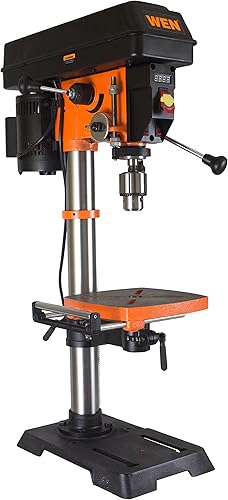 Best for frequent speed changes
WEN 12-Inch Variable Speed Drill Press
9.0/10 our score
See it on Amazon -
2

-
3

- 4
 Check it
SKIL DP9505 10-Inch Drill Press
Best for mid-size projects - 5
 Check it
WEN 10-Inch 5-Speed Drill Press with Laser
Best for belt-speed simplicity - 6
 Check it
JET JWDP-10 10-Inch Drill Press
Best for movable shop layouts - 7
 Check it
VEVOR 12-Inch Benchtop Drill Press
Best for digital speed setting - 8
 Check it
BUCKTOOL 12-Inch Benchtop Drill Press
Best for rotating-table setups - 9
 Check it
WEN 33-Inch Radial Arm Drill Press
Best for broad workpieces
How to choose the best drill press for woodworking
The best choice balances swing, spindle travel, speed control and table size against the work you actually do. We compared these features to show which presses suit compact benches, repeat drilling and broader stock.
A larger swing gives more room between the spindle and column, which matters when positioning a panel or jig. Spindle travel sets how far the bit moves down in one stroke, while a depth stop helps repeat hole depth.
Variable speed is convenient if you change bit sizes and materials often. Fixed speeds can work well when the available settings match your routine jobs.
Think about the largest workpiece you drill regularly, not an occasional project. Also measure bench width, overhead clearance and the space needed to support long stock.
Compare the best drill presses for woodworking
These presses range from a compact 8-inch model to a radial arm machine with adjustable reach. Compare swing, speed and travel, then check each machine’s height and weight against your shop.
| Product | Best for | Swing | Speed | Spindle travel | Our score |
|---|---|---|---|---|---|
| WEN 12-Inch Variable Speed Drill Press | frequent speed changes | 12 in | 580 to 3100 RPM, variable | 3-1/8 in | 9.0 |
| WEN 4206T 8-Inch Benchtop Drill Press | tight workshops | 8 in | 750, 1100, 1500, 2100 or 3200 RPM | 2 in | 8.8 |
| JET 12-Inch Benchtop Drill Press | warranty coverage | 12 in | 530 to 3100 RPM, variable | 3-1/8 in | 8.7 |
| SKIL DP9505 10-Inch Drill Press | mid-size projects | 10 in | 610 to 2800 RPM, 5 settings | 8.4 | |
| WEN 10-Inch 5-Speed Drill Press with Laser | belt-speed simplicity | 10 in | 630, 1100, 1800, 2450 or 3300 RPM | 2 in | 8.1 |
| JET JWDP-10 10-Inch Drill Press | movable shop layouts | 10 in | 630 to 3300 RPM, 5 settings | 8.0 | |
| VEVOR 12-Inch Benchtop Drill Press | digital speed setting | 12 in | 530 to 3140 RPM, variable | 7.7 | |
| BUCKTOOL 12-Inch Benchtop Drill Press | rotating-table setups | 12 in | 580 to 3200 RPM, variable | 2 in | 7.6 |
| WEN 33-Inch Radial Arm Drill Press | broad workpieces | 11 to 33 in, adjustable | 600, 1100, 1700, 2300 or 3100 RPM | 7.4 |
The best drill presses for home woodworking
The best fit depends on your workpiece size and preferred speed control. These picks are ordered by score, with the highest-scoring pick first.
WEN 12-Inch Variable Speed Drill Press: Best for frequent speed changes
- 12-inch swing
- 580 to 3100 RPM mechanical variable speed
- Digital RPM readout
- 3-1/8-inch spindle travel
- Tilting worktable
Mechanical variable speed and a digital readout make it easier to set an RPM for different bits and materials. Its reach and travel suit a broad range of home woodworking tasks.
Pros
- Variable speed without belt changes
- Digital speed readout
- Laser, LED light and roller extension
Cons
- 85 lb, so plan for a sturdy bench and help during setup
The WEN 12-Inch Variable Speed Drill Press is the top pick for a home shop that needs a broad speed range and a larger work area. Its mechanical control adjusts from 580 to 3100 RPM without changing belt positions, and the digital readout shows current speed.
The 12-inch swing and 3-1/8-inch spindle travel give you room for many furniture, cabinet and hobby tasks. Its table bevels 45 degrees left or right, and a roller extension supports longer stock.
An X-pattern laser points to the drill center, while the overhead light illuminates the work surface. At 85 lb and 36.6 inches tall, it needs a planned location and a sturdy mounting surface.
Choose it if you want variable control, a digital readout and a 5/8-inch keyed chuck. Skip it if you need a press you can move often or don't have a stable bench.
WEN 4206T 8-Inch Benchtop Drill Press: Best for tight workshops
- 8-inch swing
- 5 belt speeds from 750 to 3200 RPM
- 2-inch spindle travel
- 45-degree tilting table
This compact press takes less room than the larger options while keeping a tilting table and five speed choices. Its 32 lb weight makes it a manageable choice for a small bench.
Pros
- Compact 23-inch height
- Five speed settings
- Table bevels 45 degrees each way
Cons
- Smaller swing and shorter spindle travel than the 12-inch picks
The WEN 4206T is the compact choice for small parts and a crowded bench. Its 8-inch swing and 23-inch height take less space than the 10- and 12-inch presses here.
It offers five speeds, selected by moving the belt between pulley positions. The 2-inch spindle travel is shorter than the 3-1/8-inch travel on the larger WEN and JET presses, so check the depth of your common holes.
The 6.5 by 6.5-inch table bevels 45 degrees in either direction. It also has a 1/2-inch keyed chuck, onboard key storage and a locking depth stop.
Choose this model for smaller woodworking projects where compact size matters more than a broad work area. Skip it if you regularly position wide panels or need longer travel.
JET 12-Inch Benchtop Drill Press: Best for warranty coverage
- 12-inch swing
- 530 to 3100 RPM mechanical variable speed
- Digital RPM readout
- 3-1/8-inch spindle travel
- 5-year warranty
The JWDP-12 pairs a wide speed range with a digital readout, tilting table and roller extension. JET specifies a 5-year warranty for this model.
Pros
- Variable speed with live RPM display
- Cast iron base and table
- Laser crosshair and LED light
Cons
- 85 lb and requires bench or stand mounting
The JET 12-Inch Benchtop Drill Press combines a broad work area with variable speed from 530 to 3100 RPM. Its digital display shows spindle speed, so you can set a target without moving a belt.
The cast iron table tilts 45 degrees left or right and includes a retractable roller extension. Two XACTA lasers form a crosshair at the drill point, and an LED light brightens the table.
JET specifies a 5-year warranty for this model. It weighs 85 lb and must be bolted to a bench or stand, so plan for mounting hardware and help during assembly.
Choose it if you want a 12-inch press with live speed control and the JET warranty. Skip it if the weight or setup requirements don't suit your shop.
SKIL DP9505 10-Inch Drill Press: Best for mid-size projects
- 10-inch swing
- Five speeds from 610 to 2800 RPM
- Adjustable depth stop
- Tilting work surface
The SKIL offers a middle-size swing with five speed settings, a depth stop and a tilting table. Its laser and work light support setup at the drill point.
Pros
- 10-inch swing
- Laser alignment and LED work light
- Table tilts up to 45 degrees left and right
Cons
- Speed changes use a five-setting system
The SKIL DP9505 suits woodworkers who want a 10-inch swing and five speed settings. Its range runs from 610 to 2800 RPM, with settings for different material types.
A laser alignment system, LED work light and adjustable depth stop support positioning and repeat drilling. The table height adjusts, and the work surface tilts up to 45 degrees left and right.
Its 1/2-inch chuck capacity is a useful limit to check against your bits. The five-step system gives you set choices rather than adjustment across a continuous range.
Choose the SKIL for a middle-size work area with fixed speed steps and built-in alignment aids. Skip it if you want to dial in an exact RPM within a range.
WEN 10-Inch 5-Speed Drill Press with Laser: Best for belt-speed simplicity
- 10-inch swing
- Five belt speeds from 630 to 3300 RPM
- 2-inch spindle travel
- Laser and LED work light
This WEN combines a 10-inch swing with a 1/2-inch chuck and five belt-selected speeds. Its adjustable table bevels 45 degrees in either direction.
Pros
- 10-inch swing and 6.2-amp motor
- Laser and LED work light
- Onboard chuck key storage
Cons
- Changing speed means adjusting the belt position
The WEN 10-Inch 5-Speed Drill Press gives you a 10-inch swing and a 6.2-amp induction motor. It uses five belt-selected speeds rather than a variable-speed lever.
Its 2-inch spindle travel and 1/2-inch chuck suit common drilling tasks on furniture parts and shop projects. The 7.5 by 6.5-inch table bevels 45 degrees left or right and adjusts in height.
The laser guide indicates the drill point, while the LED work light illuminates the work. Onboard chuck key storage gives the key a dedicated place when the press isn't in use.
Choose it if the 10-inch swing and alignment aids appeal, and belt changes are acceptable. Skip it if you expect to change speed frequently during a job.
JET JWDP-10 10-Inch Drill Press: Best for movable shop layouts
- 10-inch swing
- Five speeds from 630 to 3300 RPM
- Table tilts 45 degrees
- 48.5 lb
The JWDP-10 weighs less than the 12-inch JET and has a 10-inch swing for smaller work. Its table tilts 45 degrees, and the model includes a laser and LED light.
Pros
- Lighter than the 12-inch models here
- Five speed settings
- 5-year warranty
Cons
- Spindle travel isn't specified
The JET JWDP-10 is a lighter option for shops that want a 10-inch swing. At 48.5 lb, it weighs less than the 85 lb 12-inch JET and WEN presses in this guide.
It has five speed settings and a maximum speed of 3300 RPM. Its table tilts 45 degrees, and the integrated laser and LED light support alignment and visibility at the work surface.
JET specifies a 5-year warranty. Spindle travel isn't specified, so compare that measurement with your drilling needs before choosing this model.
Choose it if you want a 10-inch JET press that's easier to reposition than the heavier models. Skip it if you need confirmed spindle travel before deciding.
VEVOR 12-Inch Benchtop Drill Press: Best for digital speed setting
- 12-inch swing
- 530 to 3140 RPM variable speed
- Digital readout
- Tilting worktable
The VEVOR offers a 12-inch swing, variable speed and a digital readout. Its table adjusts in height and tilts 45 degrees left or right.
Pros
- Variable speed and digital readout
- X-laser and LED work light
- 12-inch swing
Cons
- 84.3 lb, so allow for a fixed, sturdy work surface
The VEVOR 12-Inch Benchtop Drill Press pairs a wide swing with variable speed from 530 to 3140 RPM and a digital readout. Its specs list a 1 HP motor and 6.2 A amperage.
The table adjusts in height and tilts 45 degrees to either side. An X-laser and LED work light are included.
At 84.3 lb and 37.4 inches tall, it needs a well-planned bench location. Chuck capacity isn't specified, so check that measurement if your work calls for larger bits.
Choose it if you want a 12-inch swing with variable speed and a digital display. Skip it if chuck capacity is a deciding requirement and you can't confirm it.
BUCKTOOL 12-Inch Benchtop Drill Press: Best for rotating-table setups
- 12-inch swing
- 580 to 3200 RPM variable speed
- 2-inch spindle travel
- Table rotates 360 degrees and bevels 45 degrees
The BUCKTOOL table rotates 360 degrees and bevels 45 degrees each way, giving you room to position work. It also has a digital speed readout, laser and work light.
Pros
- Variable speed and digital readout
- Rotating and tilting table
- Emergency stop switch
Cons
- 39-inch overall height needs overhead clearance
The BUCKTOOL 12-Inch Benchtop Drill Press offers variable speed from 580 to 3200 RPM and a digital readout. Its 2-inch spindle travel is shorter than the 3-1/8-inch travel listed for the higher-scoring WEN and JET 12-inch presses.
The flat table rotates 360 degrees and bevels 45 degrees left or right. A laser, work light, emergency stop switch and no-voltage release switch are among its features.
The press stands about 39 inches tall and weighs 86.5 lb, so check overhead clearance and bench support. Its 5/8-inch keyed chuck capacity accommodates larger bits than the 1/2-inch chucks on several smaller picks.
Choose it if a rotating table and broad speed range matter to your setup. Skip it if overhead clearance is limited or you need longer spindle travel.
WEN 33-Inch Radial Arm Drill Press: Best for broad workpieces
- Adjustable 11 to 33-inch swing
- Five speeds from 600 to 3100 RPM
- 3-1/8-inch spindle travel
- Tilting 10-inch table
The radial arm design lets the head slide and swivel to adjust the swing from 11 to 33 inches. Choose it when the workpiece needs reach that a standard benchtop press may not offer.
Pros
- Adjustable reach up to 33 inches
- 3-1/8-inch spindle travel
- Tilting cast iron table
Cons
- 105 lb and measures 38 inches long
The WEN 33-Inch Radial Arm Drill Press is the specialized choice for workpieces that need reach beyond a conventional benchtop press. Its sliding and swiveling head adjusts the swing from 11 to 33 inches.
Five belt speeds range from 600 to 3100 RPM, and spindle travel is 3-1/8 inches. The 10-inch cast iron table tilts 45 degrees in either direction, and the cast iron base has predrilled mounting holes.
This press measures 38 inches long and weighs 105 lb. Its size and weight make it a substantial fixture, so plan the placement before bringing it into the shop.
Choose the radial arm model for wide workpieces or flexible head positioning. Skip it for ordinary bench projects where a 10- or 12-inch press reaches the work.
How do you choose swing and travel for woodworking?
Choose a swing that lets you position your usual work with room for clamps and a fence. A 10- or 12-inch press suits many home projects, while an 8-inch model works for smaller parts and a radial arm press reaches farther.
Swing is twice the distance from the spindle center to the column. It gives a rough guide to the width of work you can position under the bit, but fixtures and clamping space also matter.
Spindle travel is how far the chuck and bit move in one stroke. More travel can help with deeper holes without repositioning the piece, though the depth stop and bit length also affect setup.
For help matching machine size to your shop, read what size drill press you need. If you are outfitting a small work area, benchtop woodworking tools covers other machines that share the same space.
Is variable speed worth it on a woodworking drill press?
Variable speed is useful when you change bit sizes and materials often because you can adjust within a range. Fixed-speed models work when their preset choices cover your regular tasks.
The WEN and JET 12-inch models offer variable control with digital RPM displays. The WEN 8-inch, SKIL, WEN 10-inch and radial arm WEN use preset speeds, with belt changes on the WEN models.
Before buying, consider how often you change speed and whether the adjustment method will slow your workflow. A simple speed system is enough when most projects use similar bits and materials.
What table features help with woodworking?
A tilting table helps with angled holes, while a level, stable surface and secure clamping matter for ordinary straight drilling. A roller extension can support longer stock.
Most picks here tilt up to 45 degrees left and right. The BUCKTOOL table also rotates 360 degrees, and the WEN and JET 12-inch models include roller extensions.
Check that your workpiece fits on the table and that clamps or a vise can hold it without interfering with the bit. Don't rely on the table tilt or laser to keep a loose board aligned.
How should you set up a woodworking drill press?
Set up the press on a stable bench or stand, secure its base, and make sure the table and workpiece are supported before drilling. Review the model's instructions for assembly, speed changes and safety controls.
The heavier presses are difficult to position alone, so arrange help for assembly and lifting. Leave room for the table to move, the chuck to lower, and long stock to extend beyond the bench.
Before each job, install the correct bit, set the speed for the bit and material, then position the work under the spindle. Use a depth stop for repeated holes and verify the first hole on scrap when the work is costly or hard to replace.
Clamp the workpiece or secure it in a vise. Small pieces can catch and spin if held only by hand, so keep fingers away from the bit and use a backing board when you need to limit tear-out on the underside.
What common drill press mistakes should you avoid?
The most common mistakes are choosing a press with too little reach, leaving work unsecured and ignoring speed selection. Each can lead to poor hole placement, damaged stock or an unsafe setup.
Don't choose by swing alone. Check spindle travel, chuck capacity, table size and height, and the space needed to clamp the work.
Don't force a bit through the wood or use a speed that doesn't suit the bit and material. Clear chips as needed, keep the bit sharp, and let the machine cut at a controlled pace.
For angled holes, set the table carefully and confirm the work remains supported across the full cut. For repeated holes, test the depth stop and layout on scrap before drilling the finished pieces.
How do you care for and use a drill press well?
Keep the table and base clear of chips, and inspect the bit, chuck and work-holding setup before use. Follow the machine manual for lubrication, belt adjustment and maintenance intervals.
Remove the chuck key immediately after tightening the bit and return it to onboard storage when available. Before changing belts or bits, switch off and unplug the press, then wait for moving parts to stop.
A clean layout improves repeatability. Mark hole centers, use a center punch where appropriate, and check that the laser or other alignment aid meets the mark before drilling.
Which drill press fits your woodworking shop?
Choose the WEN 12-Inch Variable Speed Drill Press for a balance of swing, travel and speed control. Pick the WEN 4206T for a compact bench, the SKIL or WEN 10-inch for a mid-size work area, and the radial arm WEN when wide workpieces need extra reach.
If variable-speed choices are close, our VEVOR versus WEN drill press comparison explains the differences between those options. For a broader shop layout decision, see our benchtop versus floor drill press guide.
Our top 3 picks at a glance
-
1
Best for frequent speed changes
WEN 12-Inch Variable Speed Drill Press
9.0/10 our score
See it on Amazon -
2
-
3
Frequently asked questions
What size drill press is best for woodworking at home?
A 10- or 12-inch benchtop drill press suits many home woodworking tasks. Choose by the size of your workpieces, the available bench space and the press's spindle travel.
An 8-inch model can work for smaller parts, while a radial arm design can reach farther across a large workpiece.
Is variable speed useful on a woodworking drill press?
Variable speed lets you set an RPM within a range instead of choosing from a few fixed belt positions. That can be useful when you switch between bit sizes and materials.
A fixed set of speeds can also work well if its available settings suit your usual tasks.
How much spindle travel do I need?
Spindle travel is the distance the chuck and bit move downward in one stroke. More travel can help when a hole needs to be drilled deeper without repositioning the work.
Compare the travel with your common hole depths, and use a depth stop when repeated holes need to match.
Do I need a laser on a drill press?
A laser can help show where the bit is expected to meet the workpiece, but it does not replace marking and checking your layout. Several picks here include laser guides.
Secure the workpiece and confirm alignment before drilling, especially on a finished board.
Should I choose a benchtop or floor drill press?
A benchtop drill press uses a workbench or stand, while a floor model stands on its own base. For many home shops, bench space and the size of the work determine which style fits.
Read our benchtop versus floor drill press guide for the tradeoffs.