Benchtop or Floor Drill Press: Which Fits Your Shop? (November 2026)
Choose a benchtop drill press for a compact shop and a floor press for larger work or deeper holes. The right benchtop vs floor drill press depends on your stock, hole depth, workspace and setup.
On this page (10 sections)
- Benchtop vs floor drill press: what is the main difference?
- How much spindle travel do you need?
- Which drill press gives you more room for the workpiece?
- Are benchtop drill presses easier to set up?
- What speed controls and work lights matter?
- How should you choose between the three models?
- What should you measure before choosing?
- What mistakes should you avoid with either press?
- Which press should you choose for your shop?
- Sources
Choose a benchtop drill press for a compact shop and a floor press for larger work or deeper holes. In a benchtop vs floor drill press comparison, match the machine to the workpiece, hole depth and space you can dedicate to setup.
A benchtop press sits on a separate work surface, so it saves floor area but uses bench space. A floor press stands on its own base and can give you a larger table or more spindle travel, depending on the model.
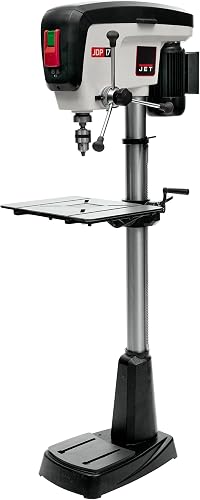
The WEN has a 12-inch swing and 3-1/8-inch spindle travel. The JET has a 17-inch class swing and 5-inch travel, while the Klutch has a 13-inch swing and 3-1/4-inch stroke.

Benchtop vs floor drill press: what is the main difference?
A benchtop press needs a suitable bench; a floor press needs clear floor space. Compare the whole working area, including room for the table, stock and your hands.
The WEN measures 16.8 by 13.5 by 36.6 inches and weighs 85 lb. Its cast iron base has predrilled holes for mounting to a bench or another work surface.
The JET is 66 inches high and weighs 187 lb. The Klutch is 62.25 inches high and weighs 110 lb, so either floor model needs a planned position and a way to move it into place.
Those dimensions describe the machines, not the extra room needed to position lumber or adjust the table. Tape out the footprint and include the largest piece you expect to drill.
Which benchtop vs floor drill press fits a small shop?
A benchtop press can preserve floor area when your bench has room for it. The tradeoff is giving up that bench surface, which may already hold a vise, tools or other equipment.
A floor press can work in a small shop if it has a dedicated corner and the table can move without blocking a walkway. If every patch of floor is spoken for, compare the floor footprint with the bench area the WEN would occupy.
Our benchtop woodworking tools guide can help you think through how machines share a small shop. For more layout ideas, see the small shop basics hub.
How much spindle travel do you need?
Choose spindle travel based on hole depth and how often you want to reposition the work. More travel can reduce table adjustments for deep holes, but it does not replace checking the machine’s full capacity.
The WEN provides 3-1/8 inches of spindle travel. The Klutch has a 3-1/4-inch vertical stroke, while the JET offers 5 inches.
For shallow holes in common project parts, the difference may not affect your routine. For deep holes, through-boring or dowel work, the JET’s longer travel gives the quill more movement in one setup.
The JET’s depth stop also helps repeat hole depth. The WEN and Klutch each include an adjustable depth stop or depth lock, so consider repeatability along with travel.
If you are unsure how machine size relates to your projects, our guide on what size drill press you need walks through capacity and workpiece fit.
Which drill press gives you more room for the workpiece?
Swing and table size tell you how much room you have around the bit. Check both against the widest pieces you plan to drill.
The WEN has a 12-inch swing and a 9-1/2 by 9-1/2-inch beveling work table. The Klutch has a 13-inch swing, and the JET is a 17-inch class machine with a 14 by 19-inch table.
The JET table has twin T-slot grooves and four slots for clamps or hold-downs. Its table tilts 90° left and right, while the WEN table bevels 45° in either direction and the Klutch table tilts 45°.
A larger table can support more of a workpiece, but long stock may extend beyond it. Add support for overhanging boards and keep the piece controlled while drilling.
Will a floor press reach farther across a board?
A larger swing gives more clearance between the column and the bit. That can help when placing holes farther from the edge of a wide workpiece.
The WEN’s 12-inch swing suits smaller parts and projects that fit its table. The JET’s 17-inch class swing allows more reach, while the Klutch falls between them at 13 inches.
Don't choose by the swing number alone. Consider how you will support a wide board and whether the table, column and nearby walls leave enough room to position it.
Are benchtop drill presses easier to set up?
A benchtop press is easier to place when you already have a sturdy work surface; a floor press needs no separate bench. Either type needs a stable setup and enough room to work safely.
The WEN is lighter than the two floor models, but a benchtop press still needs a suitable mounting surface. Use its predrilled base holes to secure it, and check that the bench does not rock or shift under pressure.
The Klutch and JET are heavier machines, so plan the move and assembly before they arrive. Account for stairs, narrow doors and tight turns, and arrange enough help to lift and position the machine safely.
Measure the ceiling and the space above the table as well as the footprint. A tall machine can be hard to place under cabinets even when its base fits neatly.
Before drilling, position the table at a comfortable height and lock it in place. Set the depth stop for repeated holes, confirm the bit is centered, and clamp the workpiece so it cannot spin or lift.
What speed controls and work lights matter?
Choose speed controls that suit your materials and bits, then make sure you can see the work clearly. Variable speed and multiple fixed speeds suit different preferences.
The WEN uses mechanical variable speed from 580 to 3100 RPM, with a digital readout showing the current RPM. The JET has 16 speeds from 210 to 3,500 RPM, and its belt tensioning is designed for one-handed speed changes.
The Klutch has 16 speeds and a maximum rotational speed of 3410 RPM. If a particular speed matters for your work, check the machine’s available settings before choosing.
The WEN includes a laser and overhead light. The JET includes an Xacta-X laser and LED work light, while the Klutch includes a laser guide.
A laser can help indicate the drill center, but it does not secure or align the workpiece. Clamp the stock and confirm the bit position before drilling.
How should you choose between the three models?
Choose by the work you do most often: compact parts, deeper holes or a floor-mounted setup. The best fit is the press whose capacity you will use without making setup difficult.
The WEN suits a home shop with a sturdy bench and projects that fit its 12-inch swing. Its variable speed and digital readout are useful if you regularly switch between materials or bit sizes.
The JET fits a shop that can dedicate floor space to a heavier machine. Its longer travel, large table and 17-inch class swing are the clearest reasons to choose it over the smaller presses.
The Klutch may fit if you want a floor base without moving up to the JET’s weight and larger table. Its stroke is close to the WEN’s travel, so the floor-mounted design is the main difference from that benchtop option.
For comparisons between drill press brands, read our guide to VEVOR vs WEN drill presses. It can help narrow the brand choice after you decide which stand style suits your shop.
What should you measure before choosing?
Measure the machine area and the working space around it before you buy. The base footprint alone does not show whether you can position stock, adjust the table and stand comfortably.
Start with the height available under shelves or ceiling fixtures. Then measure the route from the entrance to the final position, including doorways, stairs and turns.
Mark the footprint and the space needed for the largest workpiece. Leave room for table movement and support stands, and make sure the machine will not block access to other tools.
For a benchtop press, check that the bench is stable and has enough free surface. For a floor press, plan how to secure it and move heavy stock onto its table.
Also check your power setup and the machine’s requirements before installation. Keep the cord clear of moving parts and walking paths, and place the controls where you can reach them without leaning across the bit.
What mistakes should you avoid with either press?
Avoid choosing by stand style or headline capacity alone. A press that fits the shop can still be awkward if its table, reach or travel do not suit your stock.
One common mistake is buying a floor model for its larger frame without measuring the route into the shop. Measure doorways and turning space, then plan how the head and base will be moved and assembled.
Another is assuming the table supports a whole board. Long pieces need support beyond the table, and loose stock can catch or shift as the bit enters.
Don't rely on a laser as a substitute for marking and clamping. Set the bit over the mark, secure the work, and keep hands away from the bit while it turns.
Finally, match speed to the bit and material instead of leaving one setting for every job. Follow the machine and bit guidance, disconnect power before changing bits or making adjustments, and clear chips with the machine stopped.
Which press should you choose for your shop?
Pick the WEN if a bench setup and 12-inch swing cover your projects; choose the JET for 5-inch travel and a larger table; pick the Klutch for a floor base with a 13-inch swing. Match the machine to your work and the space you can give it.
If hole depth is your deciding factor, the JET has the most travel in this comparison. If floor space is tight and you have a suitable bench, the WEN avoids adding another floor footprint.
Choose the Klutch when you want a floor-mounted press with a moderate swing and 16 speeds, and its shorter stroke is enough for your work. Skip a floor model if you cannot reserve the space or move it safely; skip a benchtop press if the bench is unstable or your stock needs more reach.
Use the drill press guides for more help choosing and setting up a machine. Measure your largest stock first, then compare its reach and support needs with the press you plan to use.
Sources
- WEN DP1263V product information
- JET JDP-17 product information
- Klutch 13-inch floor drill press product information
Frequently asked questions
Is a benchtop or floor drill press more accurate?
Stand style alone does not determine accuracy. Choose a machine with the capacity and features that match your work, secure it to a stable surface, and set up the workpiece carefully.
The WEN has a digital speed readout and laser, while the JET and Klutch also include laser guides.
Does a floor drill press have more spindle travel?
Some floor presses have more spindle travel, but it varies by model. The JET has 5 inches, compared with 3-1/8 inches on the WEN benchtop and 3-1/4 inches on the Klutch floor press.
Check travel alongside swing and table clearance.
Can a benchtop drill press handle large boards?
A benchtop press can handle a board if its swing, table and surrounding clearance fit the job. Long or wide stock may need support beyond the table, and the benchtop machine must be mounted securely.
Measure the workpiece and planned setup before choosing.
Should I buy a floor drill press for a small shop?
Buy a floor press for a small shop only if you can reserve floor space and need its reach or table. A benchtop press can free floor area, but it still needs a stable bench and room to support the work.
Measure the full working area.
What should I check before installing a drill press?
Measure the machine footprint, ceiling height, workpiece clearance and delivery route. A floor model can be heavy, so plan how it will be moved and secured.
For a benchtop model, confirm the bench can support the machine and work safely.


