Surface Planer vs Thickness Planer: What Differs? (November 2026)
A surface planer flattens one face and squares an edge; a thickness planer makes the second face parallel at a set thickness. Most home shops start with the thickness planer because it works on boards the jointer cannot reach.
On this page (9 sections)
- What does a surface planer do that a thickness planer does not?
- How do the two machines compare side by side?
- Which machine comes first in a small shop?
- When does a surface planer earn its place?
- How much room does each machine need?
- Which cutter head should you choose?
- How do you set up and run each machine safely?
- Who should buy which?
- Verdict: which machine should most shops buy?
A surface planer flattens one face and squares an edge; a thickness planer makes the second face parallel at a set thickness. In any surface planer vs thickness planer comparison, the order matters more than the label: one machine creates the reference face, the other sizes the board from it.
The two are often sold as one idea, but they do different jobs. A surface planer (usually a jointer) removes warp and twist from one face.
A thickness planer takes that flat face and cuts the board to an even thickness.
If you buy only one machine, buy the thickness planer first. It earns its space in a home shop faster, as our guide to what a thickness planer does in a home shop explains.

What does a surface planer do that a thickness planer does not?
A surface planer flattens one face and squares an edge; a thickness planer only copies the face resting on its bed. That single difference decides how you prepare rough lumber.
The surface planer feeds stock over a rotating cutter head mounted in a flat table. The table gives you a reference plane, so high spots come off and the face ends up flat.
A fence lets you run an edge against the same head and square it to that face.
The thickness planer works the opposite way. The cutter head sits above the board and the bed sits below it.
The bed presses the board's underside flat, so whatever goes in comes out parallel to that underside.
That's why a thickness planer cannot flatten a twisted board. It copies the twist and makes the board thinner.
The table of a surface planer is the part that removes the twist in the first place.
The pair are called a jointer and a planer in most shops. Some catalogs use "surface planer" for the jointer and "thicknesser" for the planer, which is why the labels get muddled.
How do the two machines compare side by side?
The surface planer gives you a flat face and square edge; the thickness planer gives you an even thickness and a parallel face. Here is how the two functions line up on the jobs that matter in a small shop.
| Job | Surface planer | Thickness planer |
|---|---|---|
| Flatten one face | Yes, its main job | No, it copies the face on the bed |
| Square an edge | Yes, against the fence | No fence for edges |
| Cut to a set thickness | No | Yes, with a depth dial or scale |
| Handle wide boards | Limited by fence height and bed | Yes, up to 13 in on the DeWalt |
| Remove twist and cup | Yes | No, it preserves the warp |
| Repeatable results | Operator skill matters | The dial repeats the same cut |
The table also shows where a hand planer fits. A cordless or block plane works a face or edge by hand rather than through a machine bed.
It's the tool you reach for when a board is too big or too awkward for a machine.
The DEWALT 20V MAX Planer is a good example. It takes 2 mm off in a pass with a depth knob calibrated to about 0.01 mm.
That's handy for fitting a door or easing an edge, but it's not how you thickness a stack of boards.
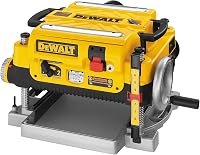
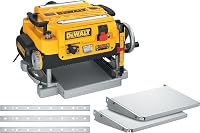
The two bench machines in this comparison are thickness planers. The DeWalt DW735X and the Craftsman CMEW320 both size stock from a flat face.
Neither one flattens a warped board, so keep that in mind as you read the specs.
Which machine comes first in a small shop?
Buy the thickness planer first. Most home shops buy boards that are already flat enough to use.
A thickness planer then takes them to an even size and handles wide panels a jointer cannot reach.
A benchtop planer such as the Craftsman CMEW320 fits on a bench and planes glued-up panels up to 12.25 in wide. That covers most furniture and cabinet parts without taking floor space you don't have.
The DeWalt DW735X goes further. Its 13 in width takes full cabinet panels, and its 15 amp motor handles larger cuts in wide stock.
The three-knife head gives longer knife life and faster knife changes.
The two feed speeds are the detail buyers often overlook. At 96 cuts per inch the feed is faster for rough sizing; at 179 cuts per inch the finish is cleaner.
You pick the speed to match the job, which is a real advantage over a single-speed machine.
For a small shop, a benchtop planer like the CMEW320 is enough for most work. Our roundup of benchtop planers for a home workshop compares the models that fit that role.
The DW735X is the step up when wide panels are routine.
When does a surface planer earn its place?
Add a surface planer when you buy rough or warped lumber. It flattens the first face and squares an edge, which is the step a thickness planer cannot do.
Rough-sawn boards from a mill are rarely flat. They cup, bow and twist as they dry.
A thickness planer run on that stock gives you a thin, still-warped board. The surface planer takes the warp off first, and the planer finishes the job.
That makes the jointer the machine for anyone milling their own lumber or working with reclaimed stock. The sequence is the same every time: flatten a face, square an edge, then thickness to size with the flat face down.
Skip the jointer if your supplier sells surfaced lumber and your projects are small. The thickness planer covers the sizing, and a hand plane handles the odd edge.
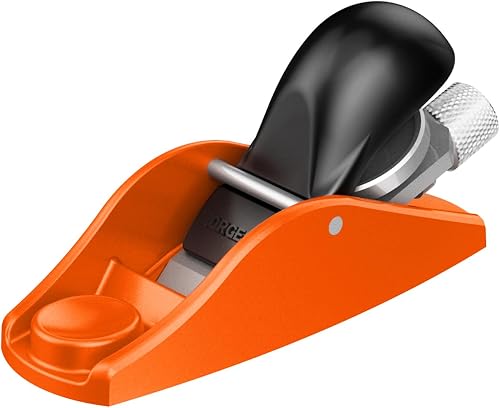
The hand plane is also the answer for short or narrow parts. The JORGENSEN No.101 has a 1.25 in cutting width and a body of ductile iron.
Its O1 tool steel blade can be sharpened and reused, so it stays useful long after the first edge dulls.
How much room does each machine need?
A benchtop thickness planer needs bench space; a floor-standing planer needs its own footprint and infeed and outfeed room. The jointer usually needs the most length because boards pass over its full table.
The DeWalt DW735X weighs 102 lb and sits on a 19-3/4 in cast aluminum base. It includes infeed and outfeed tables, which add length on both sides.
Plan for clear space in front and behind so long boards can pass without hitting a wall.
The Craftsman CMEW320 is a benchtop unit at 12.25 in wide. Its smaller footprint makes it the easier fit when the shop shares space with a car or a laundry corner.
It still needs room for boards to enter and exit the cut.
The hand planers take almost no space. The DEWALT 20V MAX Planer weighs 7.4 lb and runs on a 20V MAX battery, so it goes where the work is.
The JORGENSEN block plane fits in a drawer.
Measure the longest board you plan to thickness before you buy. A planer that fits the bench but leaves no room for the board to exit will fight you on every pass.
Which cutter head should you choose?
A helical cutter head gives a cleaner cut and simpler maintenance; a straight-knife head costs less and is easier to find. The choice changes the finish and the upkeep more than the basic planing function.
The DeWalt DW735X uses a three-knife cutter head. Three knives give 30% longer knife life than a two-knife head, and the design makes knife changes faster.
An extra set of knives comes in the kit.
The Craftsman CMEW320 uses two knives. Its quick-change, reversible solid steel head sits on ball bearings.
Reversible knives mean you can flip them when one edge dulls.
A helical head, by contrast, uses small indexable inserts. Our guide to the helical planer covers how those heads cut and why figured wood often finishes better under them.
If you plane highly figured stock, that difference matters.
Sharp knives are the bigger factor in finish quality, whichever head you own. Dull knives tear the grain and burn the surface.
Our guide on how to sharpen thickness planer blades walks through the upkeep.
On a hand planer, the blade quality shows up in the same way. The JORGENSEN's O1 tool steel blade is sharpened for efficient planing and can be honed again.
The DEWALT uses replacement blades when the edge dulls.
How do you set up and run each machine safely?
Both machines remove material fast, so set the depth shallow and keep hands clear of the cutter head. The surface planer needs a flat reference table; the thickness planer needs a level bed and locked carriage.
On the thickness planer, set the depth of cut and lock the carriage before the first pass. The DeWalt DW735X has an automatic carriage lock that reduces the movement that causes snipe.
Its material removal gauge and large thickness scale help you read each pass.
Take shallow passes. The DeWalt DW735X lists a 0.13 in cutting depth and the Craftsman lists the same figure.
Deep passes strain the motor and leave a rougher surface, so work down to size in steps.
Keep the bed clean and waxed so boards feed evenly. The DeWalt DW735X has a fan-assisted chip ejection system that clears chips from the cutter head.
The Craftsman CMEW320 has a vacuum port for a dust collector or bag.
On a hand planer, set the depth knob and check the cut on scrap first. The DEWALT 20V MAX Planer has precision-machined front and back aluminum shoes that keep the cut parallel.
A kickstand lets you set it down without gouging the work.
Never reach into a running cutter head on any machine. Unplug or remove the battery before changing blades or clearing chips.
Who should buy which?
Buy a thickness planer if you size boards and panels; buy a surface planer if you mill rough or warped lumber. Most readers need the planer first, then the jointer when their stock changes.
Pick the DeWalt DW735X if wide glued-up panels and repeatable thickness are routine. The 13 in width, two feed speeds and three-knife head suit a shop that runs a lot of stock.
Its 102 lb weight means it wants a permanent spot.
Pick the Craftsman CMEW320 if bench space is tight and 12.25 in width covers your work. The 15 amp motor and quick-change knives handle hard and soft woods, and the dust port keeps the bench cleaner.
Pick the DEWALT 20V MAX Planer if you fit trim on site or ease edges by hand. It's cordless, takes 2 mm per pass and adjusts depth finely.
It won't thickness a stack of boards, but it trims wide boards fast.
Pick the JORGENSEN No.101 if you work small parts. Its 1.25 in width and adjustable depth suit chamfers, trimming and craft work.
It's the cheapest way to add hand control to your edge work.
Skip the surface planer for now if you buy surfaced lumber. Add it when you start milling your own boards, because the thickness planer alone cannot flatten warp.
Verdict: which machine should most shops buy?
Buy the thickness planer first, and make it the DeWalt DW735X if wide panels are in your plans. The surface planer vs thickness planer choice comes down to your lumber supply, not to which machine is better.
The DeWalt DW735X is the best thickness planer for most home shops that size wide boards. Its 13 in width, two speeds and automatic carriage lock cover panels and repeated sizing.
The Craftsman CMEW320 is the value pick when 12.25 in is enough and floor space is short.
The surface planer earns its place when you buy rough stock. It flattens and squares so the thickness planer can finish the job.
Buy it after the planer, not instead of it, unless rough lumber is all you use.
If you already own a jointer, the planer is the missing half. If you own neither, start with the planer and add a hand plane for edges.
That pair covers more work per dollar than a jointer alone.
Frequently asked questions
What is the difference between a surface planer and a thickness planer?
A surface planer flattens one face of a board and squares an edge against a fence. A thickness planer makes the opposite face parallel at a set thickness.
The surface planer gives you a reference face; the thickness planer sizes the board from that face.
Can a thickness planer flatten a warped board?
No. A thickness planer copies the face that sits on its bed, so a twisted board comes out twisted but thinner.
Flatten one face on a surface planer or jointer first, then run the flat face down through the thickness planer.
Which should I buy first, a surface planer or a thickness planer?
Buy the thickness planer first if your boards are already flat enough to use. It handles wide panels and repeated sizing that a jointer cannot match.
Add a surface planer when you start working with rough or warped lumber.
Do I need both a jointer and a thickness planer?
For rough lumber, yes. The surface planer creates a flat face and a square edge; the thickness planer makes the second face parallel.
Working with already-flat stock, you can skip the surface planer and use only the thickness planer.
What does a helical planer change?
A helical cutter head uses small indexable carbide inserts set at an angle. It cuts quieter, leaves a cleaner finish in figured wood and lets you rotate a chipped insert instead of replacing a whole knife.
Our guide to the helical planer covers how that changes the machines.