WEN PL1326 vs DeWalt DW735: Spiral Head or Knives? (November 2026)
For wen pl1326 vs dewalt dw735, choose the WEN for its 26-blade spiral head or the DeWalt for its 3-knife head and 2 feed settings. Match the planer to how you process boards and manage cutting edges.
On this page (10 sections)
- WEN PL1326 vs DeWalt DW735: what is the main difference?
- Which cutterhead fits your projects and blade-care habits?
- Do feed settings matter for your typical cuts?
- Which planer suits a small shop or a repeatable workflow?
- How do their dust controls affect setup?
- How should you set up a planer for cleaner, more consistent boards?
- What common planer-buying and use mistakes should you avoid?
- Who should buy the WEN PL1326, and who should skip it?
- Who should buy the DeWalt DW735, and who should skip it?
- How do you decide between the WEN PL1326 and DeWalt DW735?
For wen pl1326 vs dewalt dw735, choose the WEN PL1326 for its spiral cutterhead or the DeWalt DW735 for its three-knife head and two feed settings. The right choice depends on how you want to manage cutting edges and whether your work benefits from a slower finishing feed.
All three planers here have a 13-inch cutting width and a 15-amp motor. The PL1326 handles boards up to 6 inches thick, while the DW735's maximum thickness isn't specified here.


WEN PL1326 vs DeWalt DW735: what is the main difference?
The WEN PL1326 uses 26 staggered, rotatable HSS blades, while the DeWalt DW735 uses 3 knives and offers 2 cuts-per-inch settings. Pick the WEN when its spiral head suits your blade-care preference; pick the DeWalt when you want to switch between dimensioning and a finer finish setting.
The PL1326 feeds at 26 feet per minute. The DW735's gearbox offers 96 or 179 cuts per inch (CPI), with the higher setting intended for a finer finish.
These numbers measure different things, so don't compare FPM directly with CPI.
The WEN PL1337 is a useful third choice if you want the spiral head and two feed rates. It has 26 and 16 FPM settings, giving it a slower option the PL1326 doesn't have.
Which cutterhead fits your projects and blade-care habits?
Choose the PL1326 if you prefer rotating small blades, or the DW735 if you prefer fewer reversible knives. Both have a 13-inch cutting width, so the cutterhead decision is more about your preferred blade system than board width.
The WEN head has 26 staggered blades. When an edge dulls, you can rotate the blade to use another edge.
Eventually, blades need replacement. That arrangement suits a woodworker who is comfortable managing several small cutting edges and values a spiral design.
The DeWalt's three knives are reversible and disposable. DeWalt describes a one-tool change process, and says the knives last 30% longer than traditional disposable knives.
Consider how you want to handle dull edges: a spiral head means tracking many small blades, while the three-knife system means fewer larger knives to change.
Neither style removes the need to keep edges in good condition. Before buying, check the availability and cost of compatible replacement edges in your area, and follow the instructions for your chosen machine.
For a wider comparison of machine features, read our guide to the best benchtop planers for a home workshop. If cutterhead design is your main concern, see more helical and spiral planer options.
Do feed settings matter for your typical cuts?
The DW735 offers 96 or 179 CPI, while the PL1326 runs at one 26 FPM feed rate. Choose the DeWalt when you want a setting for dimensioning and another for a finer finish; choose the PL1326 when its single feed rate meets your needs.
A feed setting affects how quickly a board moves through the machine or how many cuts land along each inch. CPI and FPM use different measures, so the numbers don't create a direct speed ranking between these planers.
The PL1326's onboard material removal gauge helps you judge cutting depth for each pass. Its single feed rate keeps the choice simple, but it doesn't provide a slower setting for a finishing pass.
The DW735 lets you select 96 CPI for dimensioning or 179 CPI for a finer finish. If you often move between rough sizing and a finish pass, that choice may fit your workflow better.
For a spiral head with two feed rates, consider the WEN PL1337. It offers 26 FPM for quicker dimensioning and 16 FPM for a slower pass, so compare it with other helical-style planers.
Which planer suits a small shop or a repeatable workflow?
The PL1326 is a fit for a shop that wants a spiral head and a 6-inch capacity; the DW735 is a fit for a shop that values two finish settings and built-in movement control. Measure your bench space and board path before choosing, since planer capacity is only useful when you can support stock at the infeed and outfeed.
Both machines are 13-inch planers, but only the PL1326's maximum board thickness is specified here: 6 inches. If you routinely work with stock near that limit, verify that the WEN's capacity suits your projects and leave room to guide the board steadily.
The PL1326 includes height-adjustable infeed and outfeed tables. Proper support before and after the cutter helps keep long stock level as it travels through the machine.
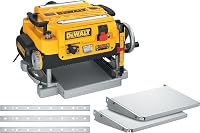
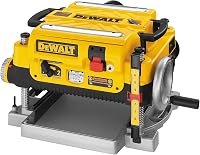
The DW735 has a 19-3/4-inch cast aluminum base. Its automatic carriage lock reduces movement that can cause snipe without a manual step, and a turret depth stop helps return to frequently used thicknesses.
A thickness planer reduces board thickness while smoothing a face, but it doesn't make a twisted board flat on its own. Learn what a thickness planer does in a home shop before planning a workflow around one.
How do their dust controls affect setup?
The DW735 ejects chips with a fan-assisted system, while the PL1326 has an adjustable dust port. In either case, plan where chips will go before you start feeding boards.
The DeWalt system pulls chips off the cutterhead and exhausts them from the machine. The WEN port directs chips and sawdust away from the workpiece, and its table supports can help keep stock aligned.
Connect dust collection as directed in the machine manual, and keep the collection path clear. A blocked or poorly routed hose can leave chips around the work area and interfere with a smooth workflow.
Dust collection capacity should match the planer and your other machines. Our guide to sizing a dust collector for a small shop explains how to plan a system around your tools.
How should you set up a planer for cleaner, more consistent boards?
Support the board, make controlled passes, and use the depth gauge to avoid removing too much material at once. Good setup helps reduce snipe and keeps boards moving steadily through either planer.
Set the machine on a stable work surface, then arrange infeed and outfeed support for the longest boards you expect to plane. The PL1326 has adjustable tables; with either model, keep the board level as it enters and exits.
Check the board for loose knots, nails, screws, or other foreign material before planing. Keep hands clear of the cutter area and follow the safety, setup, and feed instructions in the manual for your model.
Use the material removal gauge to plan each pass, and take lighter cuts when the wood or the desired finish calls for them. Avoid forcing a board through the machine or changing settings while stock is engaged.
For repeatable thickness, measure the board and set the machine before feeding it. The DW735's turret stop and the PL1326's depth stop can help you return to a chosen setting, but confirm the result on the workpiece rather than relying on the stop alone.
What common planer-buying and use mistakes should you avoid?
Don't choose by cutterhead label alone, and don't assume the feed numbers are directly comparable. Check capacity, blade care, support, and dust collection against your actual projects.
One common mistake is buying a planer for its maximum width without checking whether the boards you use also fit its thickness capacity. The PL1326's specified maximum is 6 inches; the DW735's maximum board thickness isn't stated here.
Another is treating 26 FPM as faster or slower than 96 or 179 CPI. FPM measures feed rate, while CPI measures cuts per inch, so use the settings each machine actually provides to judge its role.
Don't expect a planer to flatten a warped board by itself. If a board rocks or twists, a planer sled can help flatten it without a jointer.
Finally, don't neglect chip removal or board support. A planer needs a clear route for chips and enough space to guide stock before and after the cutter.
Who should buy the WEN PL1326, and who should skip it?
Buy the PL1326 if you want a 13-inch spiral planer with a 6-inch capacity and one 26 FPM feed rate. Skip it if you need a slower feed setting or prefer a three-knife system.
Its 26 rotatable blades, material removal gauge, depth stop, and adjustable dust port make it a sensible fit for a home shop that wants a spiral head and straightforward feed operation. The cast iron base and height-adjustable tables are also useful setup features.
The single feed rate is the main limitation for buyers who want a dedicated slower pass. If that matters, consider the PL1337, which keeps the spiral head and adds a 16 FPM setting.
Who should buy the DeWalt DW735, and who should skip it?
Buy the DW735 if you want a three-knife head, 2 CPI settings, and automatic carriage lock. Skip it if a spiral cutterhead is your priority or you need a stated maximum board thickness to plan around.
Its 96 and 179 CPI settings suit a workflow that moves from dimensioning to a finer finish. Fan-assisted chip ejection, a material removal gauge, an extra-large thickness scale, and a turret depth stop support a repeatable setup.
The DW735 makes less sense if you specifically want many small, rotatable blades or a feed-rate choice expressed in FPM. In that case, compare the WEN models and confirm which blade and feed system matches the way you work.
How do you decide between the WEN PL1326 and DeWalt DW735?
Choose the WEN PL1326 for the spiral head and single 26 FPM rate; choose the DeWalt DW735 for its three knives and 96 or 179 CPI settings. Choose the WEN PL1337 if you want a spiral head with a slower feed option.
The PL1326 is the more direct fit when you know you want rotatable spiral blades, need its stated 6-inch capacity, and don't need more than one feed rate. The DW735 suits a shop that prefers reversible knives and will use the choice between dimensioning and finishing settings.
Before you buy, match the machine to your board thickness, bench layout, chip collection, and replacement-edge preference. For more options in the same category, compare benchtop planers for a home workshop.
Frequently asked questions
Is the WEN PL1326 better than the DeWalt DW735?
The WEN PL1326 fits buyers who prefer a spiral head with 26 staggered, rotatable HSS blades. The DeWalt DW735 fits buyers who want a three-knife head and two feed choices, 96 or 179 CPI.
Choose based on cutterhead style and whether you want a slower finish setting.
Does the DeWalt DW735 have a spiral cutterhead?
No. The DW735 has a three-knife cutterhead with a 10,000 rpm cutterhead speed.
Its gearbox offers 96 or 179 cuts per inch, giving you two feed settings without a spiral head.
What is the difference between the WEN PL1326 and PL1337?
Both WEN planers have a spiral cutterhead with 26 staggered, rotatable HSS blades and handle boards up to 13 inches wide and 6 inches thick. The PL1326 has one 26 FPM feed rate, while the PL1337 offers 26 and 16 FPM.
Which planer has a two-speed feed?
The DW735 offers 96 or 179 cuts per inch, and the WEN PL1337 offers feed rates of 26 or 16 feet per minute. The WEN PL1326 has one 26 FPM feed rate.
CPI and FPM measure different things, so compare each machine's available settings within its own measure.