What to Look for in a Benchtop Planer
Look at the cutterhead first, then match motor power and feed speed to the woods you plane. Width and thickness capacity set what boards you can feed, and carriage support plus table length decide how much snipe you fight.
On this page (6 sections)
Look at the cutterhead first, then match motor power and feed speed to the wood you plane. Width and thickness capacity set which boards you can feed at all.
Carriage support and table length decide how much snipe you fight on the way out.
Those five points cover most of what to look for in a benchtop planer. The rest of this guide works through each one with the numbers that separate a comfortable machine from one you outgrow in a season.
If you already know you want a spiral head, the best helical planer comparison covers the top options. If you are still deciding whether you need the machine at all, read what a thickness planer does first.
Which cutterhead type should you choose?
Choose a spiral cutterhead with rotatable inserts if you plane hardwood often; choose a straight-knife head if you want the lowest entry cost. The cutterhead sets the surface finish, the noise level and how you handle a nicked edge.
A straight-knife head uses two or three long blades held in a rotating drum. The DeWalt DW735X runs a three-knife head at a 10,000 rpm cutterhead speed, and DeWalt says the design gives 30% longer knife life and makes knife changes faster and easier.
A nick in one spot means you replace or sharpen the whole blade.
A spiral head carries many small inserts set in staggered rows. The WEN PL1326 uses 26 rotatable HSS blades across its cutterhead.
The Cutech 40800H uses 26 tungsten carbide inserts in 6 staggered rows. When one insert dulls, you turn or swap that insert alone.
Finish differs in practice. Spiral heads cut in many small shearing passes, so they leave fewer tearout marks on figured grain.
Straight knives can be fine on pine, poplar and clear boards.
Insert count is not the whole story. Cutech's two-sided inserts sit in a non-cutting edge that Cutech says stops the insert skewing as it planes.
More inserts mean more chances to rotate a fresh edge.
The head also changes how the machine behaves in a home shop. Cutech says its spiral cutterhead runs at reduced noise levels and gives smoother finishes, which matters when the planer runs in a basement or a shared garage.
The staggered cut breaks the chip into smaller pieces too, so the chip stream leaves the machine in a more even flow than a straight knife throws.
Rule: pick a spiral head for hardwood and figured stock; pick a straight-knife head only when the lower purchase price outweighs the blade upkeep.
What should you know about spiral cutterheads?
The WEN PL1326 and Cutech 40800H show the two approaches to spiral cutting in a benchtop planer. WEN staggers 26 HSS blades for a smooth finish on hard and soft woods.
Cutech uses 26 carbide inserts in 6 rows, and Cutech says the design reduces noise.
HSS blades hold a sharp edge cheaply but wear faster in hard stock. Carbide inserts last longer and cost more when a replacement set is due.
For a home shop planing a few hundred board feet a year, either type works; the difference shows up in maintenance time. Cutech makes its own inserts in house to a 0.02 mm tolerance, which Cutech says is thinner than a human hair.
WEN lists a replacement spiral blade set, the BP510H, so you know fresh blades are available when the originals dull.
When do straight knives still make sense?
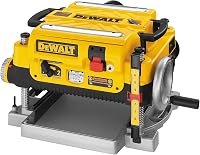
The DeWalt DW735X shows what a straight-knife head can do with enough motor behind it. Its three knives sit in a 13-inch cutterhead turning at 10,000 rpm, driven by a 15-amp motor.
DeWalt includes an extra set of knives with the kit.
The catch is blade care. Straight knives need periodic sharpening or replacement, and one bad board with grit or staples can chip an edge across the full cut.
If you plane recycled lumber often, the spiral head's individual inserts save time. Straight knives also need care when you change them: the three-knife head on the DeWalt is set up so the change goes faster and easier, but you still handle long blades that must sit even across the drum.
How much motor power and feed speed do you need?
A 15-amp motor is the practical ceiling for a benchtop planer on a standard household circuit, and it handles wide hardwood passes without bogging down. Below that, you feel the machine strain in full-width cuts.
Power matters most when you take a deep cut in a wide, dense board. A 15-amp motor turning the cutterhead at 10,000 rpm holds speed better through a 13-inch maple pass.
All three planers here use 15 amps, so power is not the deciding factor between them.
Feed speed is the second half of the equation. A slower feed gives more cuts per inch and a cleaner surface; a faster feed moves boards through quicker but leaves a rougher finish.
The DeWalt DW735X runs a two-speed gearbox at 96 or 179 cuts per inch. The WEN PL1326 runs one speed at a 26 feet per minute feed rate.
The Cutech 40800H offers a two-speed lever and slows to 16 fpm to cut tearout on figured wood.
Match feed speed to your workflow. If you dimension rough stock all day, the faster setting saves time.
If you finish figured boards for furniture, the slower setting and a light final pass do more for the surface.
Motor speed and feed speed are separate numbers, and catalogs sometimes blur them. The WEN, for example, lists 10,000 rpm at the cutterhead and a 26 fpm feed in the same sentence.
The rpm tells you how fast the head spins; the fpm tells you how fast the board travels. A fast head with a fast feed takes many shallow cuts and covers ground; a fast head with a slow feed takes more cuts per inch over the same board.
Rule: buy 15 amps for wide hardwood; choose a two-speed feed if you work a mix of rough milling and fine finishing.
What does a two-speed feed rate buy you?
The DeWalt DW735X and the Cutech 40800H both give you a speed lever. On the DeWalt, the two speeds run 96 or 179 cuts per inch.
On the Cutech, slowing to 16 fpm reduces tearout on figured boards.
A single-speed planer like the WEN PL1326 planes at 26 fpm and 10,000 rpm. That is fine for general stock prep.
A two-speed machine gives you a slower finishing option without buying a second planer. The trade is time: a slow final pass on every board adds minutes to a batch, so many shops rough at the fast setting and take one slow pass on the boards that show grain.
What width and thickness capacity fits a home shop?
A 13-inch width and 6-inch thickness capacity covers almost every home-shop board, and 13 inches is the standard benchtop size. Anything narrower limits the panels you can surface in one pass.
Width decides your maximum board. A 13-inch planer handles boards from the home-center racks and lets you flatten a glued-up panel in two passes.
A 10-inch planer forces a third pass on the same panel and leaves a seam to sand.
Thickness capacity sets how deep a board can go. The WEN PL1326 planes boards up to 13 inches wide and 6 inches thick.
The DeWalt DW735X cuts to a 13-inch width with a 0.13-inch maximum depth of cut per pass. The Cutech 40800H lists a 0.25-inch cutting depth and a 13-inch width.
Depth of cut per pass matters for speed. A planer that takes 1/8 inch per pass needs more trips over the same board than one rated for 1/4 inch.
Deep cuts also load the motor harder, so check the motor rating before using the full depth. A 15-amp motor covers a 1/4-inch pass in softwood, but hardwood at that depth asks more of the machine, so many woodworkers take lighter passes in dense stock and save the full depth for rough softwood.
Rule: buy 13 inches of width and at least 6 inches of thickness unless your boards are always smaller.
How do you judge snipe control and table support?
Look for a carriage lock and long infeed and outfeed tables, because snipe comes from board ends dipping as they enter and leave the cut. Support at both ends is the cheapest fix.
Snipe is the shallow dip planed into the last inch or two of a board when it loses support. A planer with short tables lets the board tip down as the trailing end leaves the feed rollers.
Long tables and a locked carriage hold the board level.
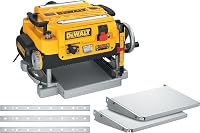
The DeWalt DW735X uses an automatic carriage lock that engages without you tightening anything by hand. DeWalt also includes folding infeed and outfeed tables in the kit.
That combination attacks snipe from both ends.
The Cutech 40800H takes a different route. Cutech uses four lead screws and a patented coupling design that Cutech says automatically minimizes snipe without a separate snipe lock.
The WEN PL1326 includes height-adjustable infeed and outfeed tables to limit snipe.
Check what comes in the box. Folding tables that ship with the planer save you a purchase later.
A planer sold without tables needs them added before you can expect clean board ends. If you plan to mount the machine on a stand, look for predrilled base holes: the WEN has them for mounting on a planer stand, and they save you drilling into the base later.
Rule: buy a planer with tables in the box and a carriage lock, or plan to build support tables yourself.
Which planer handles snipe best for a small shop?
The DeWalt DW735X gives you the most complete snipe setup out of the box. Its automatic carriage lock removes a manual step, and the folding tables store flat when the planer is not in use.
For a shop where the planer sits on a cart and gets moved, that matters.
The Cutech 40800H suits a buyer who wants the machine to handle snipe without a separate lock step. Its four lead screws and coupling design are Cutech's answer to the problem.
The board return rollers on top also save walking around the machine to send a board back for another pass.
The WEN PL1326 is the simplest of the three. Its adjustable tables do the work, and the cast iron base keeps the machine from walking or wobbling during a pass.
A steady base helps you hold a board flat as it exits.
Weight plays a part in that steadiness. The DeWalt kit weighs 102 pounds, the WEN weighs 36.74 kg (about 81 pounds), and the Cutech runs on a cast iron base as well.
A heavier machine sits stiller, but it is harder to move between a shelf and a bench.
Does dust collection matter on a benchtop planer?
Yes, because a planer throws a lot of chips and a port that fits your shop vacuum keeps the cutterhead clear. Chips under the feed rollers can mark a board or feed unevenly.
A planer removes a lot of material fast. One pass on a 13-inch board at 1/8 inch depth produces a pile of chips.
Without a port, those chips land on the floor, on the board and in the cutterhead.
Look for two things: a chip ejection design and a port that matches your hose. The DeWalt DW735X uses fan-assisted chip ejection that vacuums chips off the cutterhead and exhausts them out of the machine.
DeWalt includes a dust hose adapter and a dust-ejection chute in the kit.
The WEN PL1326 includes an adjustable dust port. The Cutech 40800H has a flip dust hood: flip it up to let chips blow out the back, or flip it down to attach a dust collector.
That flexibility suits a shop that sometimes runs a hose and sometimes does not.
The type of chip matters too. A straight-knife head peels longer shavings that can bridge at the port and clog a small hose.
A spiral head cuts smaller chips that travel through a vacuum hose more easily. If you plan to run a shop vacuum rather than a full collector, the spiral machines tend to keep the port clearer.
Rule: buy a planer with a dust port that fits a 2.5-inch or 4-inch hose, and pair it with a shop vacuum or dust collector.
Should you run a dust collector or a shop vacuum?
A shop vacuum handles a benchtop planer in a small shop. The chip volume is high but the runs are short, so a vacuum with a 2.5-inch hose keeps up.
A dedicated dust collector moves more air and stays cooler on long sessions.
Check the port size before you buy either. The DeWalt kit includes an adapter, the WEN port is adjustable, and the Cutech hood flips to accept a collector.
A mismatched hose needs an adapter, and a loose fit leaks chips back into the cut. Also check the hose diameter against the port before you set the machine up, because an adapter that ships in the box saves a trip to the store.
Which planer should you buy?
Pick the DeWalt DW735X if you want the best all-round benchtop planer for a home shop; pick the WEN PL1326 for spiral cutting on a tighter budget; pick the Cutech 40800H for figured wood and snipe control.
The DeWalt DW735X earns the top spot for most readers. Its 15-amp motor, three-knife head and two-speed gearbox cover rough milling and fine finishing.
The folding tables and automatic carriage lock mean you fight less snipe out of the box. Its straight knives need more upkeep than inserts, but the kit includes an extra set.
The WEN PL1326 suits a buyer who wants spiral cutting without spending more. Its 26 staggered HSS blades and cast iron base give you a stable machine with a smooth finish.
It runs one feed speed, so it is best for general stock prep rather than figured hardwood finishing.
The Cutech 40800H fits a shop that planes figured boards and batches of stock to the same thickness. Its two-speed feed slows to 16 fpm to cut tearout, and the 8-position depth stop makes repeat thicknessing easier.
The flip dust hood and board return rollers speed up the workflow.
Check the planer against your boards before you commit. Measure the widest board you expect to plane and the thickest, then confirm the machine's capacity covers both.
For more options at each size, see our benchtop planer roundup. If you are still weighing a straight-knife model against a spiral head, our DeWalt DW734 planer review shows what the smaller sibling offers.
Rule: match the cutterhead to your wood, the motor to your widest hardwood pass, and the tables to how often you move the machine. Then buy the planer whose dust port fits the hose you already own.
Frequently asked questions
What should I look for first in a benchtop planer?
Start with the cutterhead, because it drives finish quality and blade upkeep. A spiral head with rotatable inserts gives you fresh cutting edges without buying new knives, while a straight-knife head usually costs less to buy and still delivers a clean surface on mild lumber.
How much motor power does a benchtop planer need?
A 15-amp motor is the common ceiling for a benchtop planer running on a standard 120-volt household circuit. Below that you feel the machine slow in wide hardwood passes, so a lighter motor suits softwoods and narrow stock rather than full-width boards in hard maple or oak.
What planing width and thickness do I need?
A 13-inch width covers boards from most home-center racks and lets you joint wider panels in two passes. Thickness capacity matters too: 6 inches of board thickness lets you resurface thick stock and glued-up blanks, while a lower limit stops you at tabletop and furniture parts.
Can a benchtop planer remove twist or warp?
No, a planer makes one face parallel to the opposite face at a set thickness. A jointer flattens and squares a face and an edge first, so the planer only copies the face it sits on.
Feed a board that already rocks and you get a thinner, still-twisted board.